

10 Stories of Redemption in the Bible for Families
A child knocks over a glass, hides the pieces, and then watches your face for signs of rejection. Another child says something hurtful to a sibling and worries that “sorry” won't be enough. In those small, tense moments, families face a question that biblical redemption answers with both warmth and honesty: Can love remain strong while someone takes responsibility for what they've done?
The Bible doesn't present redemption as one tidy formula. Some people return home. Some confess terrible wrongs. Others receive dignity after shame, discover a new purpose, or find belonging when society has pushed them aside. Many stories of redemption in the Bible also remain complicated, reminding us that forgiveness doesn't erase consequences and that healing can take time.
The ten narratives below are designed for family conversations. Each one includes its biblical reference, its central form of restoration, a caution for younger listeners, and a practical way to connect the story with everyday life. You won't need to turn every lesson into a lecture. A quiet bedtime conversation, a cuddle after conflict, or a discussion inspired by plotting a classic hero story can help children recognize grace as something they can understand and practice.
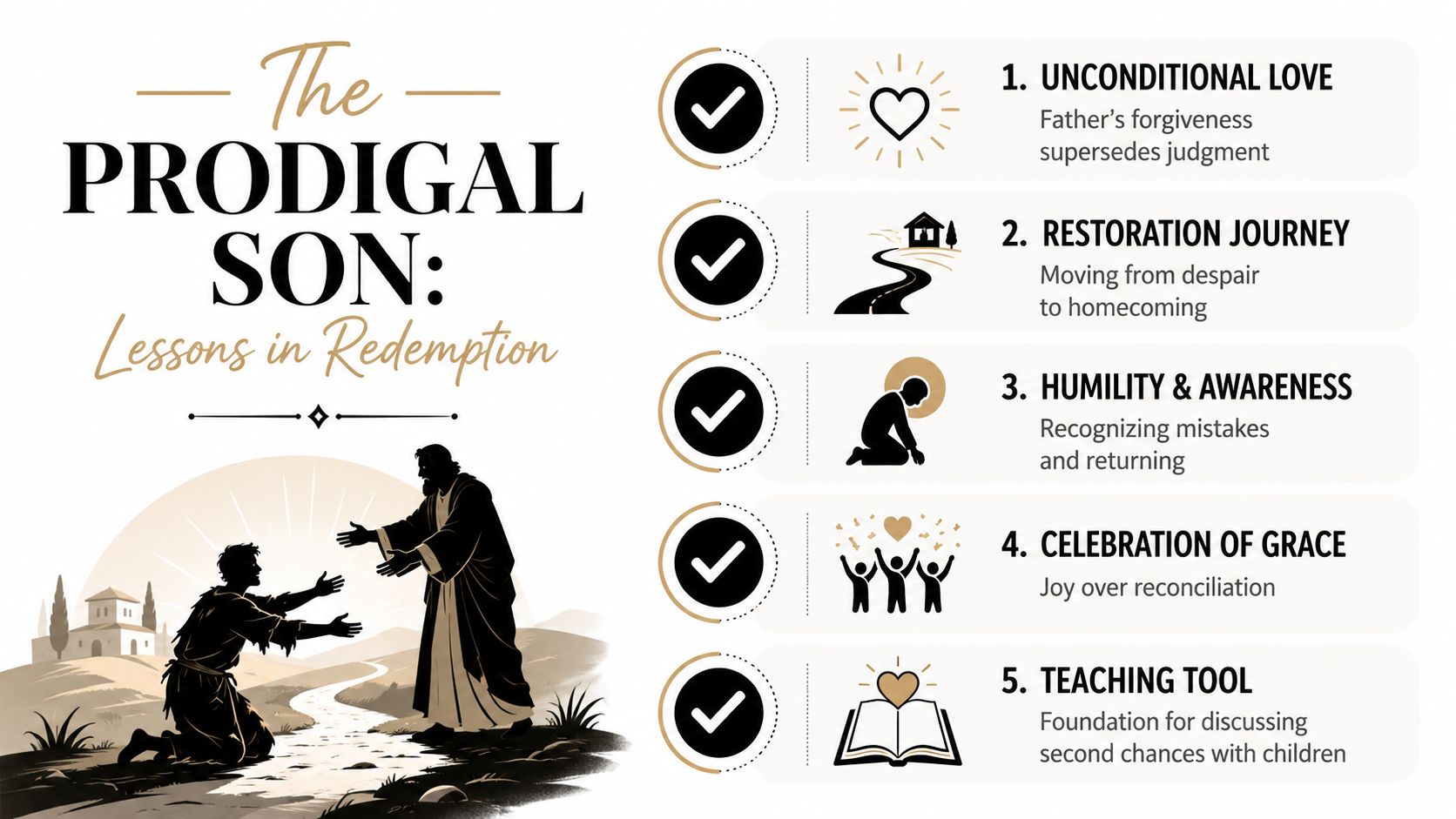
1. The Prodigal Son
Jesus's parable in Luke 15:11-32 begins with a son demanding his inheritance, leaving home, and wasting everything. He eventually reaches a place of deep need and decides to return, expecting judgment or at least a reduced place in the household. Instead, his father runs to meet him and celebrates his return.
The father doesn't pretend the son made wise choices. The son still has to face the truth about his actions. Yet the father's welcome shows that accountability and love can exist together. Redemption here takes the form of returning home, not because the son has repaired everything, but because relationship remains open.
For young children, avoid making the story mainly about money, reckless living, or punishment. Focus on the simple image of coming home to safety after admitting a mistake. Older children can discuss the tension between the father's joy and the older brother's resentment. The parable gives parents an opportunity to say that forgiveness doesn't require ignoring harm, and welcoming someone back doesn't mean pretending trust is instantly rebuilt.
A family practice
Read the passage slowly, then ask:
- The turning point: What made the son decide to go home?
- The father's response: How did the father show love before the son could prove anything?
- Our lives: When have you needed courage to tell the truth?
- One action: Is there someone in the family who needs an apology, a welcome, or patient reassurance?
A bedtime routine can make this conversation feel safe rather than corrective. Children in soft pajamas may be more willing to talk about moments when they felt ashamed or afraid. You can also pair the story with these Bible quotes about forgiveness of sins, choosing language your child can understand.
2. David and Bathsheba
David's story in 2 Samuel 11-12 is difficult because the wrongdoing is grave. He commits adultery, uses deception, and arranges circumstances that lead to Uriah's death. The prophet Nathan confronts him, and David finally acknowledges his sin instead of hiding behind his authority.
This is redemption through repentance, but the story doesn't offer a cheap version of forgiveness. David's confession doesn't remove every consequence, repair every relationship, or make the suffering disappear. His restored relationship with God and continued purpose exist alongside painful results. That complexity matters for children, because they need to learn that saying “I'm sorry” is the beginning of making things right, not a magic phrase that cancels harm.
With younger children, don't describe adult sexual wrongdoing in detail. Use the story to teach that leaders can make serious choices, that truth-telling matters, and that a sincere apology must be followed by changed behavior. Older children can explore why authority increases responsibility and why trusted adults sometimes need accountability from other people.
A useful family rule: An apology names the wrong, accepts its impact, and changes the next action.
Ask your children what David did after Nathan confronted him. Did he blame someone else? Did he defend himself? Then connect repentance to ordinary family life. A child who breaks a sibling's toy may need to apologize, help repair it, and accept that the sibling may need time before trusting again. Parents can model this process too, including through a guided practice of praying Scripture in the Bible.
3. Joseph's Journey
Joseph's story stretches across Genesis 37-50, and its redemption doesn't arrive in one dramatic moment. His brothers betray him, he is sold into slavery, falsely accused, and imprisoned. Even so, Joseph continues choosing integrity in places where nobody seems able to reward him.
Eventually, Joseph rises to leadership in Egypt and helps preserve food during famine. That position brings his brothers back into his life. He could use his power for revenge, but he chooses a harder path. He tests their character, protects the family, and allows a damaged relationship to move toward reconciliation.
Joseph represents redemption from betrayal to redemptive leadership. The story doesn't mean every painful event was good or that suffering automatically produces success. It shows that a person can remain faithful in small decisions, grow in wisdom, and use later influence to protect rather than harm others.
Tell the story in stages
Younger children may need the narrative divided into short scenes. Begin with Joseph's family conflict, then focus on his courage in hardship and his eventual decision not to retaliate. Older children can discuss whether forgiveness requires immediate closeness and how Joseph's careful testing differs from revenge.
Use questions such as:
- Feelings: What emotions might Joseph have carried through each change?
- Character: Which small choices showed integrity?
- Family repair: Why might Joseph have needed time before fully trusting his brothers?
- Action: How can you respond when someone who hurt you asks for help?
A simple drawing activity can help children map Joseph's journey from pit, to prison, to palace, to family repair. Families who want to begin reading Scripture together can also use this guide on where to start in the Bible.

Joseph's story works especially well during a bedtime routine because children can name difficult emotions without needing to solve them immediately. After discussing the story, invite each family member to name one way to respond to unfairness without becoming cruel.
Here's a short visual retelling to use alongside your reading:
4. The Woman at the Well
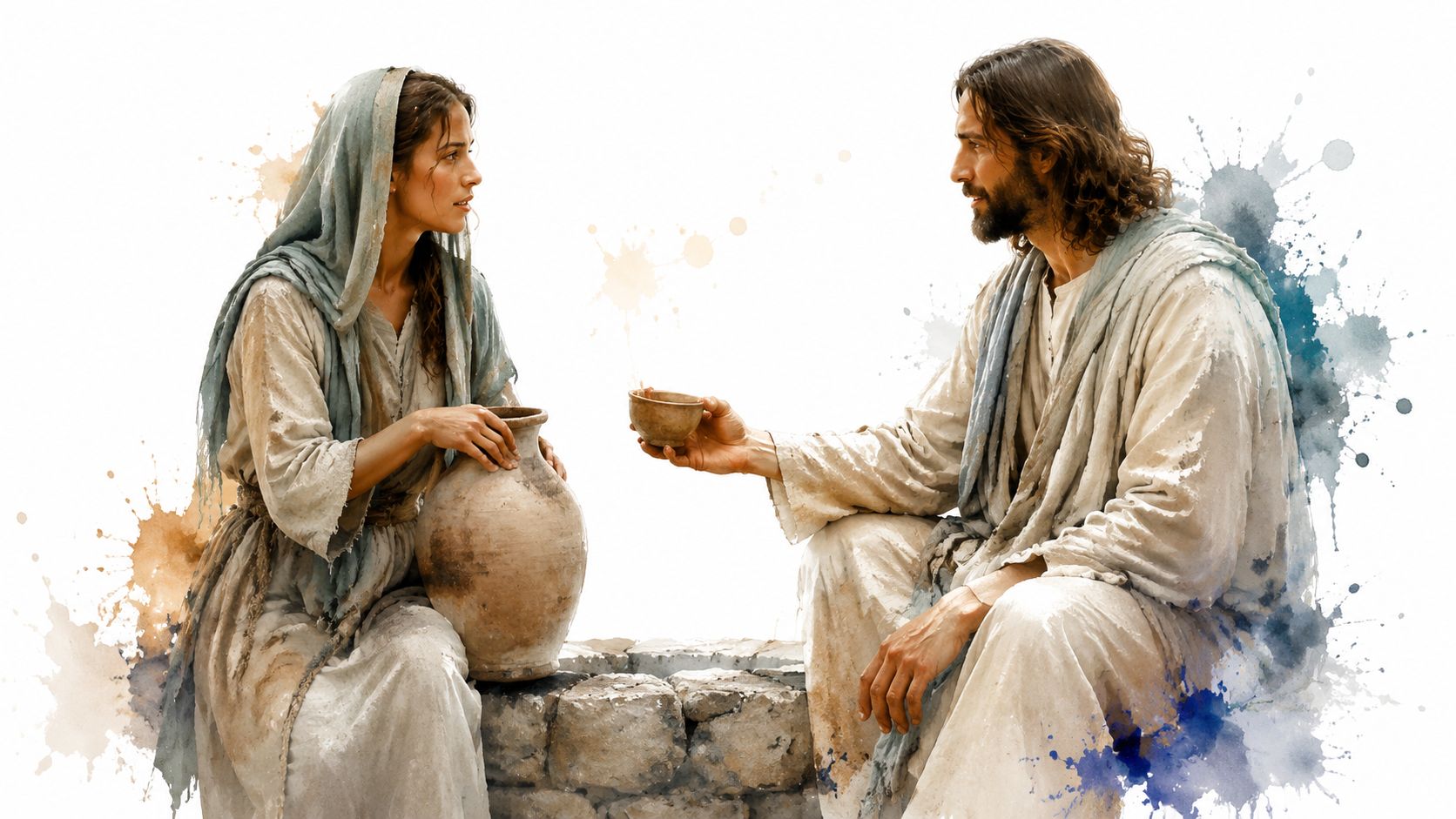
In John 4, Jesus meets a Samaritan woman at Jacob's well. The encounter crosses social, cultural, and religious boundaries. Jesus speaks with her directly, addresses her complicated history, and offers living water. He doesn't reduce her to her past or treat her shame as a reason to dismiss her.
This narrative centers on dignity restored. The woman is known, but she isn't humiliated. She receives truth and respect together. Her encounter with Jesus changes how she sees herself and how she relates to her community. She leaves the well and tells others about the person she has met.
For small children, keep the focus on being seen, known, and valued. You can explain that some people were treated unfairly because of where they came from or what others believed about them. Older children can discuss how Jesus's conduct challenged prejudice and how spiritual conversations should never become excuses for cruelty or public shaming.
From exclusion to welcome
Ask your child to remember a time when someone was left out of a game, conversation, or group. Then ask what a respectful welcome might have looked like. Avoid suggesting that the Samaritan woman's worth depended on becoming useful after meeting Jesus. Her dignity was present before the conversation, even though the encounter helped her recognize it.
A family activity can be simple. Invite each child to notice someone who often sits alone, gets interrupted, or struggles to join a group. Choose one concrete act of inclusion for the week, such as saving a seat, inviting someone to play, or listening without correcting.
5. Saul and Paul
Before he was known as Paul, Saul actively opposed Christians. Acts 9 describes his journey to Damascus, where he encounters Jesus and loses his sight for a time. His identity and direction change dramatically. Later, he becomes a major messenger of the Christian faith, using his energy and abilities to serve the people he once tried to destroy.
Paul's story shows radical transformation and redemptive purpose. It doesn't teach that a harmful past should be forgotten or that people affected by wrongdoing must immediately trust the person who caused harm. The early Christian community responds to Saul with caution, and that caution matters. Redemption can produce a new direction, but healthy restoration also needs evidence, wise boundaries, and time.
For young children, emphasize the idea of a changed heart and a new way of using one's gifts. Don't dwell on violent details. Older children can consider how someone might redirect influence from harmful goals toward protecting and serving others.
Try this exercise:
- Name the gift: What ability did Saul already possess?
- Notice the change: How did he use that ability after meeting Jesus?
- Set a boundary: Why might other believers have needed time to trust him?
- Choose a purpose: How could you use your own strengths to help someone this week?
Families studying the New Testament can connect this story with a child-friendly Bible study in Galatians. The key lesson is not that the past has no importance. It's that the past doesn't have to be the final word when a person turns toward what is good.
6. Peter's Denial and Restoration
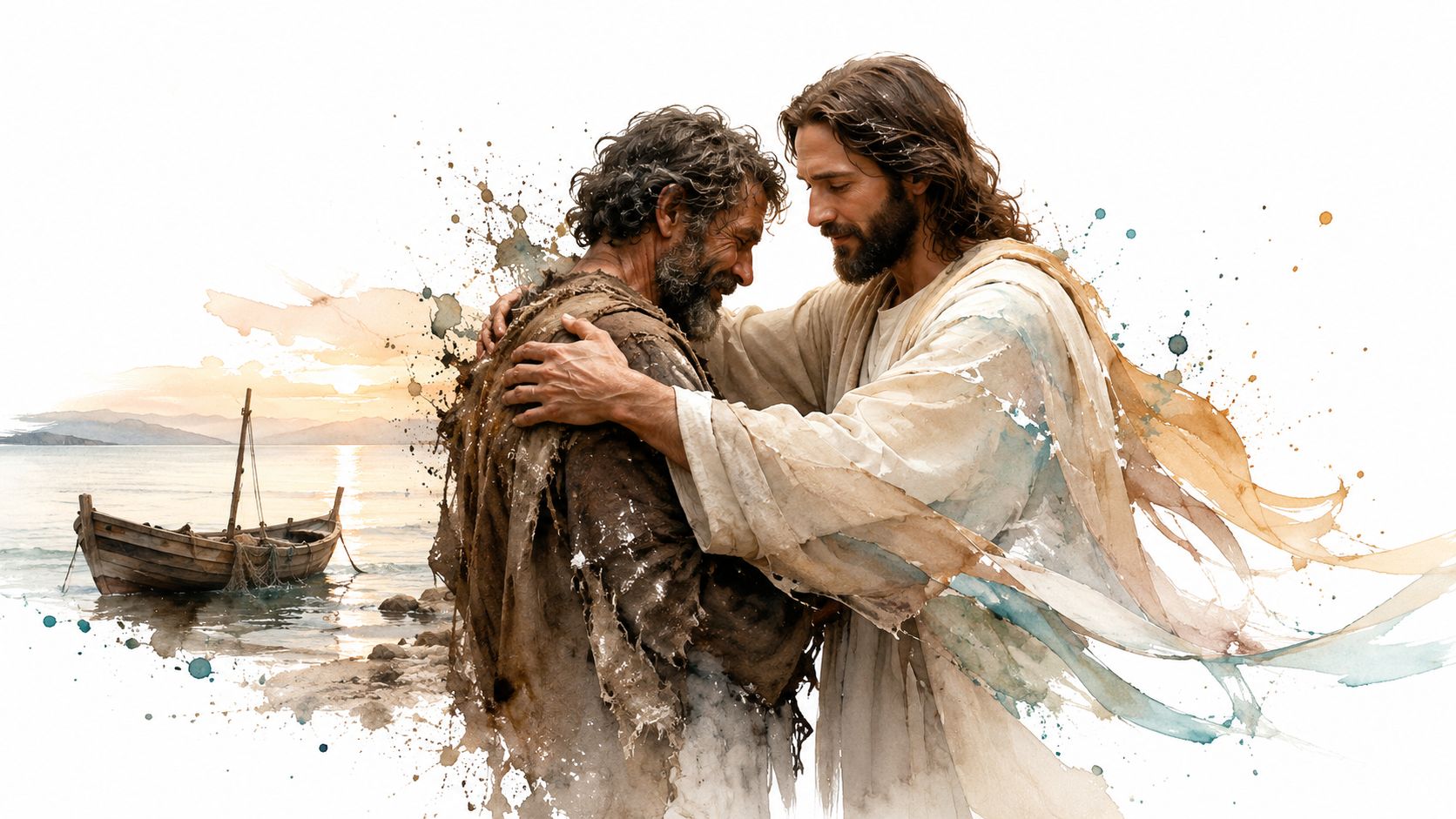
Peter denies knowing Jesus three times during the events surrounding Jesus's arrest, as recorded in the Gospel accounts. The failure cuts because Peter had publicly presented himself as loyal. After Jesus's resurrection, John 21 records a restoring conversation beside the Sea of Galilee.
Jesus doesn't treat Peter's shame as the whole truth about him. He asks about love, receives Peter's response, and gives him work to do. Peter's restoration is redemption through love, with relationship and purpose placed back in front of him.
This story speaks to children who've disappointed someone they love. A child may lie about homework, exclude a sibling, or freeze when a friend needs courage. The fear often sounds like, “They'll never trust me again.” Peter's story gives parents language for saying that failure can be faced directly without becoming a permanent identity.
Cuddle-time questions
Younger children can focus on “coming back” and being welcomed. Ask whether Peter expected Jesus to speak to him again and how Jesus helped him move forward. Older children can discuss the difference between shame, which says “I am hopeless,” and conviction, which says “I did something wrong and need to respond.”
During a quiet moment, ask:
- Relationship: What did Jesus restore first, Peter's reputation or their relationship?
- Responsibility: What work did Jesus give Peter afterward?
- Repair: What could Peter do to show dependable love?
- Practice: Who needs a gentle conversation after a recent conflict?
A hug, a prayer, or an invitation to try again can make the lesson tangible. Love doesn't excuse denial, but it can create the conditions for truth, repair, and renewed service.
7. Jonah
Jonah's story in Jonah 1-4 is often remembered for the great fish, but its deeper conflict concerns obedience and compassion. God sends Jonah to Nineveh, and Jonah runs in the opposite direction. The storm, the fish, and the return to the mission expose his resistance, but the story remains unresolved in an important way: Jonah obeys outwardly while still struggling inwardly with God's mercy toward his enemies.
That makes Jonah a story of redemption through obedience and compassion, but not a polished success story. Jonah needs rescue from his own fear and anger as much as he needs rescue from the sea. The city's repentance shows that redemption can extend beyond one person to a whole community.
For younger children, describe the fish as part of God's rescue and focus on choosing the right direction. Older children can handle the harder question: Why might we resist mercy when it reaches people we dislike? Make sure the conversation doesn't turn into pressure to reconcile with unsafe people. Compassion can include wise boundaries.
A movement activity
Place a line of pillows across the room. Let children walk away from the line when you say “running,” then turn back when you say “listening.” Afterward, explain that obedience isn't only about physical direction. It can also involve changing our attitude toward people we'd rather avoid.
Ask:
- Resistance: What did Jonah want God to do?
- Mercy: Who received compassion in the story?
- Growth: Which part was harder for Jonah, going to Nineveh or accepting God's forgiveness?
- Action: What would a merciful response look like in a family disagreement?
Jonah helps families distinguish between obedience and emotional perfection. A person may do the right thing while still needing God to reshape the heart behind the action.
8. The Thief on the Cross
One of the Bible's most concentrated redemption narratives appears in Luke 23:39-43. A criminal crucified beside Jesus recognizes the injustice of his own situation, acknowledges Jesus, and asks to be remembered in Jesus's kingdom. Jesus responds with a promise of welcome.
This is last-minute grace. The man has no opportunity to build a new public reputation, complete a long record of service, or repair every earthly relationship. His story shows that redemption isn't limited by a person's past or by the amount of time remaining. It also reminds us that sincere faith can arise in a moment of profound vulnerability.
Children should hear this story gently. For younger listeners, focus on forgiveness, welcome, and Jesus's readiness to receive someone who turns toward him. Older children can discuss why the other criminal responds differently and how the scene holds both justice and mercy together.
When a child asks about death
Parents may encounter this story during illness, grief, or questions about heaven. Keep your answer calm and age-appropriate. You can say that Christians trust Jesus with people who turn to him, while also acknowledging that sadness, fear, and unanswered questions are real.
A family conversation might include:
- Recognition: What did the criminal understand about Jesus?
- Honesty: What did he admit about himself?
- Hope: What did Jesus promise?
- Care: How can we offer peace to someone who is afraid?
The story should never be used to frighten children into belief. Its force comes from the tenderness of Jesus's welcome, even at the edge of death.
9. Rahab
Rahab appears in Joshua 2 and 6 as a woman living in Jericho who protects the Israelite spies and helps secure safety for her household. Her social position and past would have made her easy for others to dismiss, but her courageous action places her inside the story of Israel's future.
Rahab's redemption involves inclusion despite shameful circumstances. She doesn't remain only a person rescued from danger. She becomes part of a people and a legacy. The New Testament also places Rahab within Jesus's genealogy in Matthew 1, showing that God's redemptive work includes people outsiders might consider unlikely or unworthy.
For children, focus on courage, faith, and protecting family members. You don't need to explain her profession to a very young child. Older children can discuss how communities label people and how Rahab's actions challenge assumptions about who can demonstrate wisdom and faith.
Courage with discernment
Rahab's story offers a chance to talk about brave choices without teaching children to obey every adult or keep dangerous secrets. Explain that protecting people from violence is different from hiding wrongdoing that should be reported. Children need permission to seek help from a trusted adult when someone is unsafe.
Try these prompts:
- Risk: What made Rahab's choice difficult?
- Faith: What did her actions reveal about what she believed?
- Belonging: How did her future change?
- Legacy: How can one courageous decision help a family?
A child might draw a “welcome map” showing people who help them feel safe and included. Families can then choose one way to welcome someone who has been overlooked.
10. The Prodigal Daughter
The Bible doesn't present one parable titled “the prodigal daughter,” but it does contain several narratives in which women receive healing, dignity, welcome, and restored purpose. The bleeding woman in Mark 5, Mary Magdalene, and the woman confronted by accusers in John 8 each reveal a different aspect of feminine redemption.
These stories resist a narrow definition of salvation as merely being rescued from a bad decision. They include healing, public dignity, belonging, and wholeness. Jesus sees women whom others overlook, speaks to them with respect, and refuses to let shame become their permanent identity. Their stories also remind parents that daughters and mothers need more than messages about behaving well. They need to know that their worth isn't earned through perfection.
For young children, talk about Jesus treating people with care when others are staring, judging, or pushing them away. Older children can discuss how shame affects people differently and why a safe faith community should protect vulnerable people rather than use their stories for entertainment or gossip.
Make space for honest healing
Ask your child what helps someone feel safe enough to tell the truth. Then distinguish forgiveness from pretending that pain never happened. Healing may involve prayer, trusted adults, medical care, counseling, boundaries, or patient friendship.
A simple response activity could include writing affirmations about inherent worth, such as “You are made in God's image” or “You can ask for help.” Mothers can also share, carefully and without oversharing, that adults sometimes need healing and forgiveness too. Redemption belongs to the whole family.
10 Biblical Redemption Stories Compared
| Story | 🔄 Complexity | ⚡ Resource Requirements | 📊 Expected Outcomes (⭐) | 💡 Ideal Use Cases | ⭐ Key Advantages |
|---|---|---|---|---|---|
| The Prodigal Son | 🔄🔄 Medium, clear narrative with moral nuance | ⚡ Low, simple retelling, low prep | Restoration, forgiveness, hope, ⭐⭐⭐⭐ | Bedtime stories; early lessons on grace | Universal theme; emotionally accessible; supports parental reassurance |
| David and Bathsheba | 🔄🔄🔄 High, complex moral and ethical issues | ⚡⚡ Medium-High, needs contextual framing | Repentance, accountability, restoration, ⭐⭐⭐⭐ | Older children/adults; pastoral counseling on repentance | Models confession + consequences; balances mercy with accountability |
| Joseph's Journey | 🔄🔄🔄 Medium-High, long arc with development stages | ⚡⚡ Medium, best in segmented lessons | Resilience, purpose, reconciliation, ⭐⭐⭐⭐ | Lessons on perseverance, leadership, family healing | Shows integrity under trial; demonstrates restorative leadership |
| The Woman at the Well | 🔄🔄 Medium, cultural/social context important | ⚡⚡ Medium, benefits from cultural explanation | Dignity restoration, inclusion, ⭐⭐⭐⭐ | Teaching inclusion, dignity; diverse audiences | Affirms marginalized individuals; promotes compassion and belonging |
| Saul/Paul | 🔄🔄🔄 High, dramatic conversion with theological depth | ⚡⚡⚡ High, careful theological framing needed | Radical transformation, redirected purpose, ⭐⭐⭐⭐⭐ | Testimonies, adult sermons, conversion studies | Exemplifies total life turnaround; inspires mission and identity change |
| Peter's Denial and Restoration | 🔄🔄 Medium, emotional and relational focus | ⚡ Low-Medium, simple retelling with pastoral tone | Relational restoration through love, ⭐⭐⭐⭐ | Parent-child reconciliation; pastoral care | Emphasizes restoration via love; relatable and reassuring |
| Jonah | 🔄🔄 Medium, narrative with symbolic elements | ⚡⚡ Medium, visual aids helpful (storm/sea) | Obedience, compassion, communal mercy, ⭐⭐⭐ | Teaching obedience and mercy; resistance themes | Illustrates God's pursuit and mercy; shows impact of obedience |
| The Thief on the Cross | 🔄 Low, brief but theologically weighty | ⚡ Low-Medium, sensitive framing for children | Immediate grace and assurance, ⭐⭐⭐⭐ | Consolation in crisis; discussions on grace and hope | Powerful demonstration of grace; accessible theological point |
| Rahab | 🔄🔄 Medium, social stigma and risk themes | ⚡⚡ Medium, needs sensitive contextualization | Inclusion, courage, social restoration, ⭐⭐⭐⭐ | Stories of redemption for marginalized; women's ministries | Highlights faith in action; models inclusion and dignity |
| The Prodigal Daughter (composite) | 🔄🔄🔄 High, synthesis of multiple narratives | ⚡⚡⚡ Medium-High, careful, sensitive synthesis | Healing, public restoration, empowerment, ⭐⭐⭐⭐ | Women's groups; motherhood-focused discussions | Addresses women's vulnerabilities; affirms dignity and healing |
Turn Redemption Into a Family Practice
These ten stories show that redemption has many forms. The Prodigal Son returns home. David faces repentance. Joseph moves from betrayal toward leadership. The woman at the well receives dignity. Saul discovers a new purpose. Peter is restored through love. Jonah learns obedience and compassion. The thief receives grace at the last moment. Rahab finds inclusion, and the women represented by the “prodigal daughter” theme experience healing and public worth.
Together, these stories fit a wider biblical pattern. Many readers use creation, fall, promise, redemption, and restoration as a framework for understanding Scripture as one unfolding story centered on Christ. The Exodus, commonly placed around 1446 BC in standard Bible timelines, illustrates redemption as a national rescue from slavery, followed by covenant life, worship, and identity formation. The later return from Babylon, commonly dated from about 538 BC to 445 BC, shows restoration operating through land, community, worship, and rebuilding, not only through private forgiveness. These broad movements help children see that redemption can involve a person, a family, a people, or a generation.
Bible engagement is also reaching families through varied channels. The American Bible Society reports that Bible Users in the United States rose from 38% to 41% in 2025 in its State of the Bible release, while Barna reports a rebound in weekly Bible reading to 42% after a previous low. Another report notes that 59% of digital Scripture users prefer Bible apps, a third prefer podcasts, and nearly a quarter use TikTok for learning. These figures don't tell parents exactly how to disciple their children, but they do show why flexible, accessible family practices matter. A printed Bible, an audio reading, a short video, and a calm conversation can all serve the same purpose when the family keeps returning to Scripture.
Use this repeatable pattern:
- Read a short passage: Choose a scene rather than trying to cover an entire book.
- Name the turning point: Ask where the character begins to respond differently.
- Ask what changed: Look for a change in identity, relationship, behavior, belonging, or purpose.
- Name the responsibility: Who was harmed, and what kind of repair was needed?
- Choose one action: Apologize, welcome someone, forgive wisely, tell the truth, set a boundary, or seek help.
- Pray: Thank God for grace and ask for courage to practice what the family learned.
Keep the action concrete. “Be more loving” is difficult for a young child to remember. “Invite your brother into the game,” “tell Grandma the truth,” or “ask a trusted adult for help” gives grace a visible shape.
Parents should also avoid forcing every story into a clean ending. Joseph's family repair takes time. David's forgiveness doesn't erase consequences. Paul's transformation doesn't require injured people to ignore caution. Jonah obeys while still wrestling with compassion. These tensions make the stories useful for real families, because children already know that doing the right thing can be difficult and that feelings don't always change as quickly as behavior.
Bedtime and cuddle time create natural space for these conversations. A child in a comfortable bamboo romper or two-piece set may settle more easily into a short Scripture reading, a question, and a prayer. Families using a Christian homeschool curriculum can also connect these narratives to writing, drawing, history, music, or service projects. The aim isn't to turn every evening into a lesson. It's to help children recognize that love, responsibility, forgiveness, and new beginnings belong together.
Choose one story tonight. Read the key scene, ask your child what changed, and name one small act of restoration your family can practice before the day ends.
Little Venture Co. offers faith-inspired bamboo sleepwear and daywear for babies and toddlers, including zip rompers, two-piece sets, and accessories made with soft, Oeko-Tex® Standard 100 certified materials. Visit Little Venture Co. to find comfortable clothing for bedtime Bible conversations, meaningful gifts, and everyday family moments shaped by grace.