

Bible Study in Galatians: 4-Week Family Guide 2026
It's Tuesday night. One child is asking for water again, another can't find the stuffed animal they need in order to sleep, and the kitchen still looks like dinner just happened because, well, dinner just happened. You want to study the Bible. You really do. But “deep study” can feel like something for people with quiet houses, matching pens, and an uninterrupted hour.
That's why Galatians is such a helpful place to begin. It's short, direct, and full of truth that reaches straight into family life. A good Bible study in Galatians doesn't require a perfect routine. It needs a Bible, a little focus, and a willingness to let Paul challenge the way you think about grace, pressure, freedom, and love.
If you're parenting babies or toddlers, that may already sound like a stretch. But this letter works well in small pieces, and it gives you language your children need too. They may not be ready to talk about justification in formal terms, but they already understand approval, rules, belonging, and love. Galatians speaks to all of that.
Getting Ready for Your Galatians Journey
Galatians matters because it was written into a real church crisis. The letter is one of Paul's earliest surviving letters, likely written around AD 48, and it addresses the controversy over whether Gentile believers had to follow the Mosaic law to belong to God's people, as noted in The Gospel Coalition's Galatians overview. That's why the letter feels urgent from the first lines. Paul isn't discussing a side issue. He's protecting the gospel itself.
For busy parents, that's good news. You don't have to guess why Galatians matters. The main issue is clear. How is a person made right with God, and what makes someone part of God's family? Once you know that question, the whole letter becomes easier to follow.
Start with the whole letter
One of the most helpful ways to study Galatians is to read all six chapters in one sitting before getting lost in details. A practical study method described at Sean McDowell's strategic Bible study guide says a full read can take about 12 to 15 minutes, and then 10 to 15 minutes in a commentary or notes can make a solid 25 to 30 minute session. That works well for early mornings, nap time, or one evening a week when you and your spouse can trade off kid duty.
Practical rule: Read big first, small second. Don't zoom in on one verse before you know how Paul builds his argument across the letter.
If you only have a short window, use a simple three-pass habit:
- Observation first. Notice repeated words, sharp contrasts, and places where Paul sounds especially intense.
- Interpretation second. Ask what Paul is arguing, not just what sentence sounds familiar.
- Application third. Bring it into your parenting, marriage, stress, and habits.
That order helps because Galatians is tightly argued. If you jump too quickly to a favorite verse, you can miss Paul's point.
A simple plan for four weeks
Here's a family-friendly rhythm that keeps things realistic.
| Session | Reading | Key Theme |
|---|---|---|
| Week 1 | Galatians 1 to 2 | Freedom from performance |
| Week 2 | Galatians 3 to 4 | Freedom from rules |
| Week 3 | Galatians 5 | Freedom for love |
| Week 4 | Galatians 6 | Freedom to serve |
You can pair this with a notebook, a simple children's Bible for little ears, and one short quiet-time tool you already use. If you want another gentle option for daily spiritual rhythm, this family devotional reading fits nicely alongside a Bible reading habit.
Keep expectations low and steady
Don't aim for impressive. Aim for repeatable.
- Choose one time slot that already exists. After bedtime often works better than “whenever I get a minute.”
- Use one question per day if you're tired. “What does this show me about God?” is enough.
- Invite children in briefly. A toddler doesn't need the full discussion. They can still join for prayer, a picture, or one sentence of truth.
A simple phrase to carry through the month is this: Jesus is enough, and that changes how we live.
Session One Freedom From Performance (Galatians 1-2)
Paul begins with urgency because the churches in Galatia were drifting toward a message that added something to Jesus. In these opening chapters, he defends the gospel he preached and makes clear that he didn't receive it as a human invention. That matters because once people add religious performance to the gospel, peace disappears.

Galatians has had a huge place in Christian history because it gives such a strong defense of justification by faith. Liberty University's study guide calls it the “Magna Charta of the early Church” and notes its importance for the Protestant Reformation and for leaders such as Martin Luther in this Galatians study resource. That history isn't just interesting. It helps you feel the weight of what Paul is saying in chapters 1 and 2.
What to observe in chapters 1 and 2
Read these chapters and watch for tension. Paul sounds astonished, not casual. He's not dealing with minor style differences between churches. He's confronting a different message.
Look for these repeated ideas:
- One gospel. Paul treats the true gospel as singular, not flexible.
- Divine authority. He roots his message in Jesus, not popularity.
- Table fellowship and belonging. Peter's behavior becomes a real-life example of gospel confusion.
- Faith versus works of the law. The heart of the issue keeps surfacing.
A helpful question for parents is this: where do I act as if God loves me more on my good days?
Where parents often get confused
Many of us don't struggle with circumcision debates. We struggle with a quieter version of the same problem. We think, “I know I'm saved by grace, but surely God is more pleased with me when I've had a better week.” That's performance thinking.
The false gospel in modern family life often sounds polite. “Jesus saves, but good moms have it together.”
Paul won't let that stand. In Galatians 2, he drives toward the truth that people are made right with God through faith in Christ, not by piling up merit. That doesn't make obedience unimportant. It puts obedience in the right place. Obedience flows from acceptance. It doesn't purchase it.
Family application for little ones
Try a simple object lesson. Set out one open door and one locked box. Tell your child, “A toy can go in the box if you have the key. But with Jesus, we don't earn our way by trying hard enough. He opens the way for us.”
Keep it short and concrete.
- Ask: “Do we have to be perfect for Jesus to love us?”
- Answer together: “No. Jesus is enough.”
- Pray: “Jesus, thank You that we belong to You because of Your grace.”
If you want a related encouragement for daily life, gospel-centered motherhood reflections connect well with this session's theme of resisting performance.
Session Two Freedom From Rules (Galatians 3-4)
These chapters can feel dense at first. Paul talks about Abraham, promise, law, sonship, slavery, and inheritance, often in quick succession. If you've ever read Galatians 3 and thought, “I know this matters, but I'm lost,” you're not alone.
The easiest way in is to follow one contrast all the way through. Slave versus child. Paul's argument isn't just about rules. It's about identity.
Think in terms of family, not just commands
A slave obeys from external pressure. A child belongs because of relationship. Paul uses that difference to show why returning to law-based standing with God is such a step backward.
Try reading chapters 3 and 4 with these categories in mind:
| Theme | What to notice |
|---|---|
| Promise | God's plan rests on His faithfulness |
| Law | It had a real role, but not as the basis of final belonging |
| Adoption | Believers are brought in as sons and heirs |
| Return to slavery | Going back to rule-based identity denies what Christ has done |
If that still feels abstract, bring it into the home. A toddler may clean up toys because they're afraid of losing a treat. A child who feels secure in love can obey from trust and relationship. Parents know both kinds of obedience look similar on the surface, but they grow from different roots.
Modern rules we quietly trust
Most of us don't write down our “law,” but we still live by one.
- Spiritual rules. “If I miss a quiet time, I've failed God.”
- Parenting rules. “If my child melts down in public, I must be doing this wrong.”
- Church-culture rules. “A faithful family always looks calm, involved, and polished.”
None of those are small temptations. They shape how we pray, confess, and rest. Galatians 3 and 4 help us name them for what they are. They are false foundations for worth.
Don't read these chapters as an argument against effort. Read them as an argument against using effort to create identity.
A family activity about promise
Use sticky notes or index cards. Write simple promises from God in child-friendly language, such as “God keeps His promises” and “Jesus brings us into God's family.” Tape them around the room and let your child help collect them.
Then say, “We trust God's promises because He is faithful. We don't become His family by being perfect.”
This session works well with a very ordinary family conversation too. Ask your older child, or ask yourself with your spouse, “What rule do I lean on when I want to feel like a good Christian?” That question often opens the door to honest prayer.
For more ideas on bringing big truths into simple home conversations, teaching children about God offers practical language parents can adapt.
Session Three Freedom For Love (Galatians 5)
By the time you reach Galatians 5, the obvious question is already sitting there. If we're not under the law, what keeps this from becoming spiritual chaos? Paul's answer is strong and balanced. Christian freedom is not permission to drift into selfishness. It is freedom for a better way of life.
This visual can help you hold the chapter together.
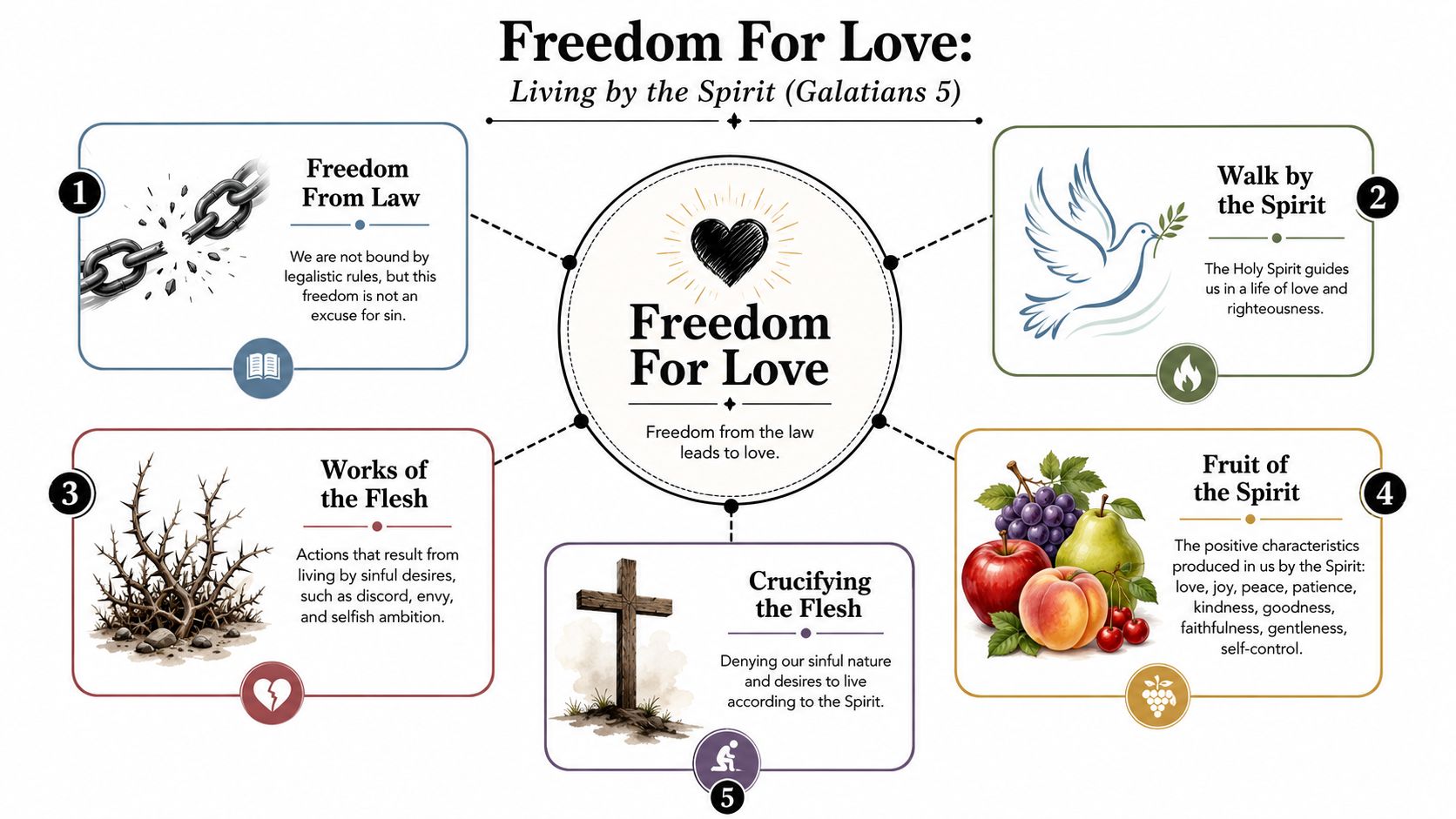
BibleProject's guide to Galatians explains that Christian freedom in chapters 5 and 6 is often misunderstood. Paul presents freedom not as autonomy but as Spirit-enabled love, burden-bearing community life, and becoming a new creation, as summarized in BibleProject's book of Galatians guide. That keeps us away from two cliffs. One cliff is legalism. The other is license.
Why freedom needs direction
People sometimes hear “free from the law” and think, “Then I can do whatever I want.” Paul says no. That kind of freedom only creates a new kind of slavery. Self-rule sounds exciting until it starts wrecking relationships.
The better question is, what are we freed for? Paul answers with love, Spirit-led living, and the slow growth of Christlike character. In family life, that matters right away. Freedom in Christ doesn't make you less patient, less gentle, or less responsible. It makes those things possible in a new way.
A short summary for your notebook could be this:
- Not rule-based righteousness
- Not self-directed indulgence
- Yes to Spirit-led love
Later in the chapter, Paul contrasts the works of the flesh with the fruit of the Spirit. That list is familiar, but don't turn it into a new chart for self-scoring. Fruit grows. It isn't taped onto a branch.
Bring Galatians 5 into real parenting
A parent can use the fruit of the Spirit list as a mirror, not a weapon. Instead of saying, “I need to become more patient so I can prove I'm doing well,” ask, “Am I staying close to the Spirit, or am I running on irritation, pride, and control?”
This video gives a helpful overview before you discuss it with your family.
Try a practical family moment around snack time. Put out different fruits and read the fruit of the Spirit slowly. For very young children, choose one word for the day, like kindness or patience, and repeat it in simple situations.
- At breakfast: “Today we're asking God to help us be gentle.”
- During conflict: “What would love do right now?”
- At bedtime: “Where did we see God help us today?”
If you want a simple companion resource for that rhythm, this fruit of the Spirit article fits naturally with a Galatians 5 family discussion.
Session Four Freedom To Serve (Galatians 6)
It is the end of a long day. One child is crying, another is arguing over something small, and you can feel your own patience thinning. Galatians 6 meets you there. Paul brings the gospel into ordinary moments like these, where people need help, correction, and steady love.
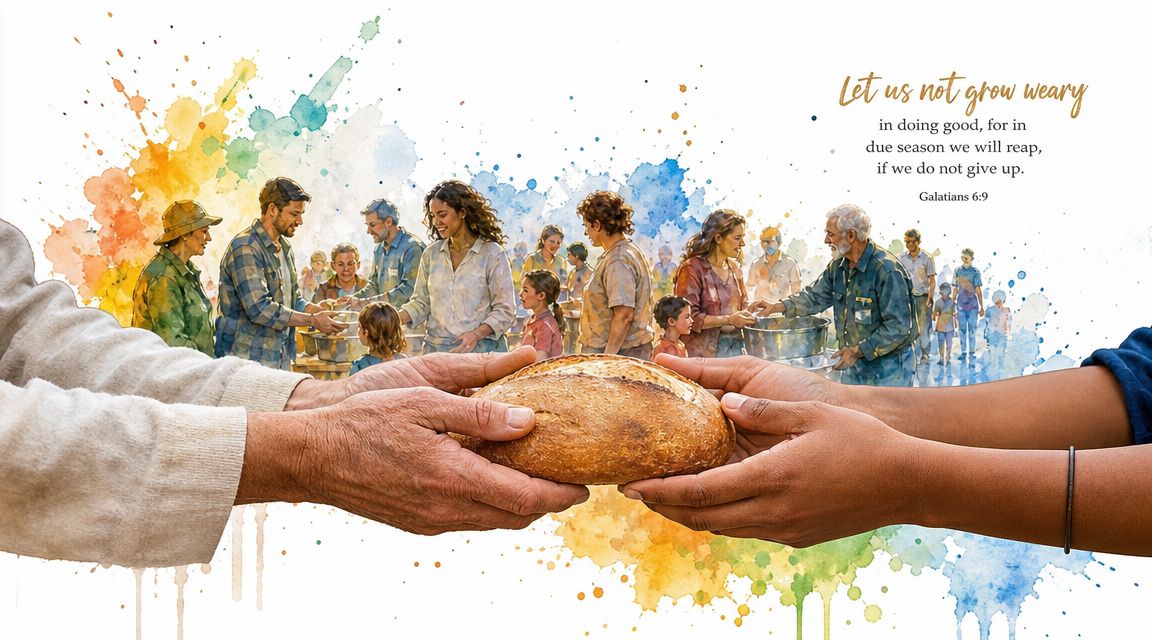
This chapter makes more sense when you remember the whole-book approach mentioned earlier. Chapter 6 is not a loose collection of final thoughts. It shows what gospel freedom looks like after it enters real relationships. Paul talks about restoring someone gently, carrying burdens, paying attention to your own faithfulness, and staying steady in doing good.
What burden-bearing looks like at home
“Bear one another's burdens” can sound big, almost like Paul only means crisis moments. But families usually live this out in small, repeatable ways.
A husband notices his wife is worn out and takes over bath time. A parent sees a child heading toward a meltdown and offers help before shame takes over. A church friend has had a heavy week, so you drop off soup, send a short text, or offer to watch the kids for an hour.
That is burden-bearing. It is love with work boots on.
Parents of young children need this reminder because home can become a place where everyone carries too much, in silence. Galatians 6 teaches a better pattern. We notice strain early. We step in kindly. We help before resentment hardens.
Paul also includes correction. That part can feel uncomfortable, especially for parents who want a peaceful home. Yet he gives the tone clearly. Restore gently. Correction in a Christian family should work like setting a dislocated arm. It may hurt for a moment, but the goal is healing, not payback.
A gospel-shaped family corrects with a soft tone, clear truth, and a goal of restoration.
For a simple family application, try one question at dinner: “Who needed help today, and how did we respond?” Younger children can answer with examples like sharing, helping a sibling, or bringing a blanket to someone who felt sick. Older children can begin to see that service is one way faith becomes visible.
Sowing and reaping in family rhythms
Paul's picture of sowing and reaping helps tired parents think long term. Much of family discipleship feels repetitive because growth usually is repetitive. You pray over the same struggles. You repeat the same truths. You apologize again after a sharp response. You read Scripture while someone is upside down on the couch.
That does not mean nothing is happening.
A garden grows slowly, below the surface first. Family discipleship often works the same way. Children may not show immediate change, but daily habits of prayer, confession, kindness, and service are still planting something real.
Try a simple object lesson this week:
- Plant seeds in a cup with your child.
- Water them each day and let your child check for small changes.
- Connect growth to habits by saying, “Kind words, helping hands, and prayer are seeds too.”
This works well for young children because they can see the waiting. It also helps parents who are tempted to measure growth only by quick results.
Paul adds another helpful balance in this chapter. He tells believers to carry one another's burdens, and he also tells each person to examine their own work. That keeps service from turning into comparison. In family life, that may mean asking, “Am I being faithful with what God has given me today?” instead of, “Why does that other family seem to have this figured out?”
Choose one burden-sharing habit for the week and keep it simple:
- At home. Each person does one hidden act of help for another family member.
- At church. Reach out to one person who may be carrying something heavy.
- In your own heart. Notice where comparison or self-pity is making service harder.
Galatians 6 gives families a steady path. Serve patiently. Correct gently. Keep planting good seeds. God often grows beautiful things in homes that look ordinary from the outside.
Living the Galatians Gospel in Your Family
By the end of Galatians, a picture of family life begins to emerge. It isn't a family with perfect routines, polished behavior, or constant calm. It's a family learning to live from grace instead of fear. That changes the tone of everything.
A Galatians-shaped home sounds different. Parents confess sin without acting shocked by it. Children hear that obedience matters, but they also hear that love isn't earned. Correction still happens, but it happens inside security, not as a test for belonging.
Four marks of a Galatians family
You don't need a slogan wall. You need repeatable practices.
| Mark | What it can look like at home |
|---|---|
| Grace over performance | Parents apologize and don't pretend to have it all together |
| Identity over image | Family choices are shaped by belonging to Christ, not by appearances |
| Spirit-led growth | Fruit matters more than polished outward behavior |
| Service over self-focus | Burdens are shared, and needs are noticed |
That kind of culture is built in tiny moments. A mother stops after a sharp tone and says, “I was wrong. Will you forgive me?” A father prays with a child after discipline instead of ending with tension. A family learns that “good Christian life” isn't about looking impressive to others.
Keep going after the four weeks
Galatians is short enough to revisit often. You might read it once a month for a season, or return to one chapter that speaks directly to a current struggle. If your family has older children later on, this same study can deepen with them too.
A few practical next steps can help:
- Re-read the whole letter aloud occasionally so the big picture stays fresh.
- Memorize one verse together that captures the gospel clearly.
- Use one dinner question each week such as “Where do we forget grace?” or “How can we carry someone's burden this week?”
- Pair Bible study with children's resources that keep biblical language normal in the home. One example is the Counting Through the Bible Board Book from Little Venture Co., which gives younger children a simple way to engage Bible themes alongside family reading.
The point of a Bible study in Galatians isn't to finish with more notes. It's to live with more freedom. Freedom from needing to prove yourself. Freedom from building identity on rules. Freedom for love. Freedom to serve.
And if you're tired, that may be the best news in the letter. The gospel doesn't ask you to become a heroic parent before God welcomes you. In Christ, you begin from welcome. Then you walk forward from there.
Little Venture Co. offers faith-inspired products for families with babies and toddlers, including children's apparel and Bible-centered items that can support everyday discipleship at home. If you want simple tools that fit naturally into family life, you can browse Little Venture Co. and see what aligns with your home rhythms.