

Where to Start in the Bible: A Simple Guide for Beginners
Some nights, the house is finally quiet, and you reach for your Bible with the best intentions. Then you open it and feel stuck almost immediately. Should you start at the beginning? Should you read a Psalm because it's short? Should you pick a random page and hope it makes sense?
If you're a parent of a baby or toddler, that confusion can feel even heavier. You're already making a hundred decisions a day, running on interrupted sleep, and trying to hold onto your faith in the middle of diapers, dishes, and snack requests. It's no surprise that figuring out where to start in the Bible can feel bigger than it should.
You Are Not Alone in Wondering Where to Start
I've known plenty of parents who wanted to read the Bible and still felt intimidated by it. One mom told me she kept her Bible on the kitchen counter for weeks. She wanted to begin, but every time she saw those thin pages and all those books, she thought, “I need a plan first.” Another dad said he opened to Genesis, got to the long names and unfamiliar places, and gave up.
That kind of hesitation is common. It doesn't mean you're bad at reading the Bible. It means you're a human being trying to approach a big, important book while living a very full life.
You don't have to prove anything before you begin. You only have to begin.
The biggest pressure many new readers carry is the fear of doing it wrong. They think they need the perfect notebook, the perfect schedule, and the perfect understanding from day one. But the Bible isn't a test you pass. It's how you come to know God more personally.
Start with grace, not pressure
If you only have ten quiet minutes before your baby wakes up, that counts. If you read one paragraph and get interrupted three times, that still counts. If you miss two days and come back on the third, you haven't failed. You've just come back.
Sometimes one early decision makes reading easier. If your current translation feels hard to follow, it helps to look for the best Bible version to read for your season and reading level, especially if you're brand new or returning after a long break.
What new readers often get wrong
A few common thoughts trip people up:
- “I should start at page one.” That works for some people, but many beginners get lost fast.
- “I need to understand everything immediately.” You won't. No one does.
- “A short reading doesn't matter.” It does. Small, steady contact with Scripture matters a lot.
When you set down guilt and pick up a simple starting point, the Bible becomes much less intimidating. It starts to feel like an invitation instead of an assignment.
Three Great Starting Points for Your Journey
A good starting place should fit the kind of help you need today. Some mornings you want to know Jesus better. Some days you need the big story to make sense. Other days you are holding a baby with one arm, reheating coffee for the third time, and you need a few honest words to pray.
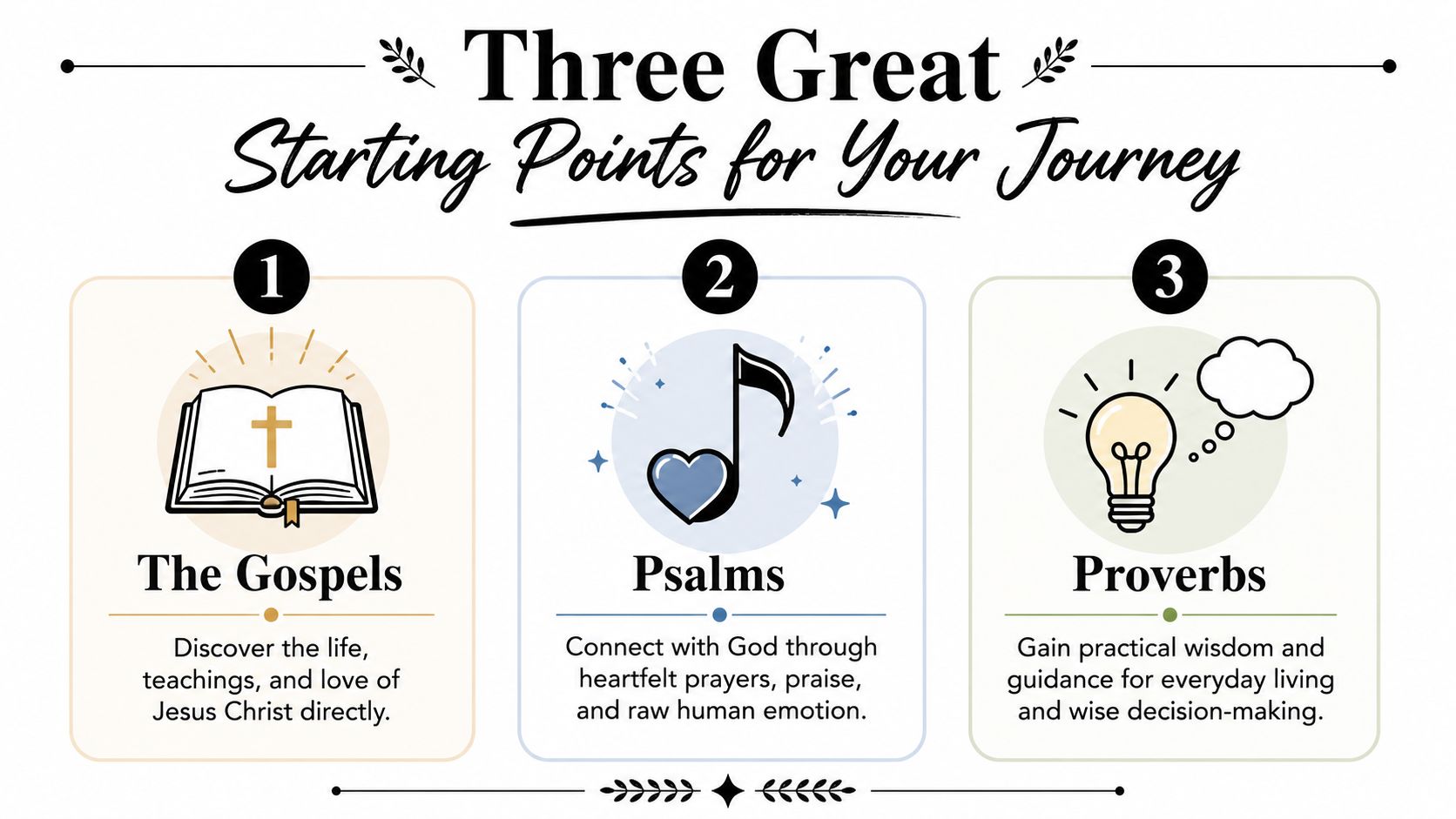
A simple comparison
| Starting place | Best for | What you'll find |
|---|---|---|
| John | Someone new to faith or returning after time away | Jesus' life, His words, and His identity |
| Genesis | Someone who wants the foundation story | Creation, humanity, sin, promise, family beginnings |
| Psalms | Someone needing comfort and honest prayer | Praise, grief, trust, fear, hope |
You do not need to pick the perfect book forever. You only need a wise first step. A starting point in the Bible works like choosing the best trailhead for a hike with small children. The goal is not to prove you can handle the hardest path. The goal is to begin in a way that helps you keep going.
Start with John if you want to meet Jesus first
John is often the clearest place to begin because it brings you straight to Jesus. You hear His words, watch how He responds to hurting people, and see what He says about Himself.
If you are new to the Bible, this matters. Starting in John can keep you from getting lost in names, timelines, and details before you have met the center of the Christian faith.
John is a strong fit if you're thinking:
- “I want to understand who Jesus is.”
- “I need something personal and clear.”
- “I only have a few minutes at a time, so I want each reading to feel focused.”
Even if your reading happens in tiny pieces between diaper changes, John still works well. You can read one short scene and come away with something real to hold onto.
If you want a simple companion resource, this collection of Bible verses everyone should know can help you notice key passages worth returning to.
Start with Genesis if you want the big story
Genesis gives you the opening chapters of everything. You see God as Creator, learn what went wrong in the world, and begin to understand why the rest of the Bible keeps talking about sin, promise, blessing, and rescue.
For some readers, that wider view is calming. It helps the Bible feel less like scattered stories and more like one unfolding account. Genesis lays the foundation the way footings support a house. You may not live in the footings, but the whole structure rests on them.
Genesis is a good place to begin if you enjoy story, family history, and seeing how early promises shape everything that follows.
Start with Psalms if your heart is tired
Psalms is a gentle place to start when life feels full and your mind feels crowded. It does not move in a straight line the way Genesis does, and that can help in a season with broken sleep and frequent interruptions.
You will find prayers for joy, fear, gratitude, anger, sorrow, and trust. The psalmists speak to God with honesty, which is good news for a parent who feels worn down and does not have polished words.
Psalms can meet you in five quiet minutes on the couch, with a toddler climbing beside you and a baby monitor on the table. You can read one psalm, underline one sentence, and let that become your prayer for the day.
If your heart needs comfort more than structure right now, start there.
Simple Bible Reading Plans You Can Actually Use
You finally sit down with your Bible while the baby naps. Three minutes later, the monitor crackles, someone needs a snack, and your reading plan is gone before it started. If that happens often, your plan is not failing you because you lack discipline. It may just be too large for this season.
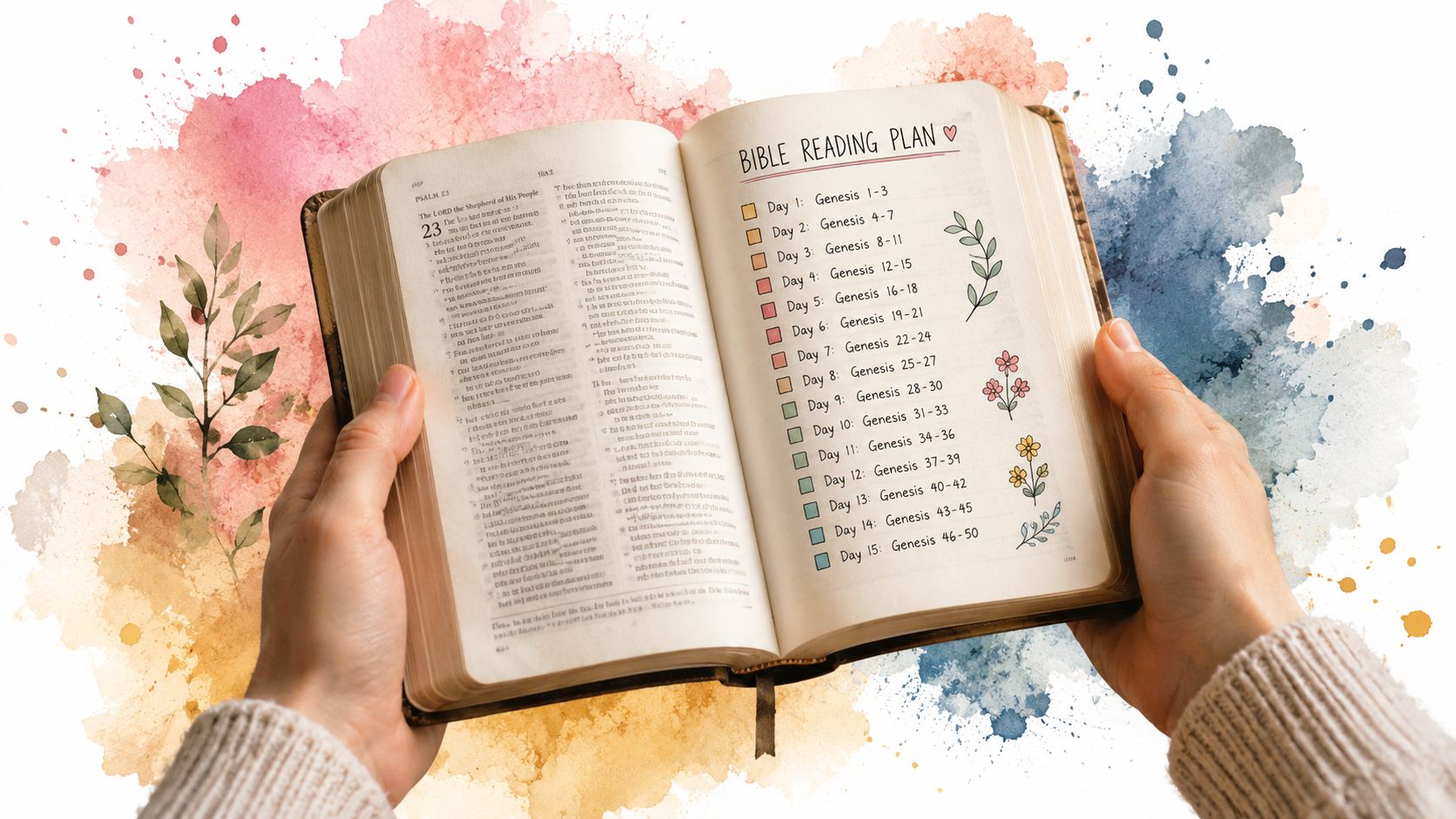
A usable Bible reading plan works like a good baby blanket. It does not need to be fancy. It needs to be within reach and used often.
A seven day Meet Jesus plan
If you want one clear place to begin, spend a week in John. This plan keeps your focus on Jesus, which helps when your attention is already being pulled in ten directions at home.
- Day 1, John 1. Notice how John introduces Jesus.
- Day 2, John 2 and 3. Watch His power and His personal care.
- Day 3, John 4. Pay attention to how Jesus speaks to the Samaritan woman.
- Day 4, John 6. Read slowly and let the hard parts stay hard for now.
- Day 5, John 10. Sit with the picture of the Good Shepherd.
- Day 6, John 11. Notice both grief and hope.
- Day 7, John 20. End with the resurrection.
After each reading, finish one sentence: “Today I saw that Jesus is...”
That simple line gives you something solid to carry into diaper changes, preschool pickup, and the middle-of-the-night wake-up.
A gentle thirty day foundations plan
Some parents do better with a month-long path. A little variety can keep you engaged without making the Bible feel scattered.
Try this rhythm:
- Days 1 to 10. Read through selected chapters in John.
- Days 11 to 20. Read key chapters in Genesis such as 1, 3, 12, 15, 22, 37, 39, 45, and 50.
- Days 21 to 30. Read one Psalm a day, slowly and prayerfully.
This plan gives you three kinds of help at once. John shows you Jesus. Genesis gives you the beginning of the larger story. Psalms gives you words to pray when you are tired, grateful, frustrated, or afraid.
If you want ideas for making that rhythm part of family life, these family devotionals offer simple, home-friendly ways to keep Scripture close.
A family five minute routine
Five minutes counts. In a house with little children, five faithful minutes can do more good than a thirty-minute plan you never open.
Try a pattern like this:
- At breakfast. Read a few verses from a Psalm aloud.
- During floor play. Read one paragraph from John while your child builds or colors nearby.
- Before bedtime. Pray one short prayer from what you read.
- On stroller walks. Listen to an audio Bible sometimes instead of a podcast.
Keep your Bible where your day already happens. Put it on the kitchen table, beside the nursing chair, or in the basket that holds diapers and burp cloths. Reading is easier when you do not have to go looking for your Bible first.
If you are trying to build that rhythm from scratch, the same basic ideas that help any small habit stick can help here too. This short guide on how to start a habit explains how to attach a new practice to a cue you already have.
A short visual walkthrough can also help if you learn best by watching someone explain a plan out loud.
How to read so it actually sticks
A plan matters, but so does your approach once you open the page. One helpful method is to paraphrase a verse in your own words. As noted in this guide to inductive Bible study, putting a passage into everyday language can improve comprehension and reduce the chance that you miss the author's meaning.
Try it. Read one verse. Close your Bible. Say the verse again in normal, plain words.
You are not trying to impress anyone. You are learning to understand what God is saying, even in a season where you may be reading with a baby on your lap and only half a cup of coffee in your system.
Practical Tips for Reading the Bible Consistently
Consistency matters, but guilt is a terrible motivator. It may get you through one day. It won't carry you through a long season of parenting.
Many people assume they need a broad reading plan with lots of variety to stay interested. Usually the opposite is true. Benchmark data from inductive Bible study programs shows that studying one book at a time and reading it through multiple times yields a 92% success rate in internalizing theological themes, compared to 35% for topical studies that jump around without context, as explained in Cru's overview of Bible study techniques.
Why simple beats ambitious
When you stick with one book, you stop starting over every day. You remember the people, the setting, and the main ideas. That's especially helpful when your attention is divided by little children.
Here are a few habits that work well in real homes:
- Pair it with something fixed. Read while the coffee brews, during nap time, or right after you buckle the baby into the car for preschool drop-off.
- Keep your goal small. One chapter, one paragraph, or even one verse is enough for a hard day.
- Use one simple notebook method. If you like structure, a Bible study journal can help you record one observation, one application, and one prayer.
- Choose audio when reading isn't possible. Listen while folding laundry or washing bottles.
- Restart fast after interruptions. Missed days don't require a speech. Just open the Bible again.
Grace keeps the habit alive
If habit building feels hard, it may help to think in tiny repeatable actions. This practical guide on how to start a habit lines up well with what many parents discover by experience. Small routines are easier to repeat than dramatic ones.
Missing a day is not the same as quitting. Parents need reminders like that.
A grace-based approach is not lazy. It's honest. Babies get sick. Toddlers wake early. Some weeks feel upside down. A sustainable Bible habit leaves room for ordinary life and keeps pointing you back to God instead of deeper into shame.
Reading the Bible with Babies and Toddlers on Your Lap
This part matters because your season matters. Reading the Bible with young children nearby rarely looks peaceful in the way people imagine. It often looks like a baby tugging your sleeve while you read two verses, or a toddler asking for the same board book again while your Bible sits open beside you.
Let it be simple and visible
Your child does not need a full lesson every time. Sometimes the most valuable thing is letting them see that Mom or Dad opens God's Word.
That may look like:
- Reading one verse aloud while your baby plays on a blanket
- Using an illustrated children's Bible for a short bedtime story
- Saying a one sentence prayer before naps or meals
- Leaving your Bible open nearby so faith feels normal in the room
There's a quiet kind of discipleship in that. You're building an atmosphere, not performing a program.
Use the moments you already have
Bedtime can become a gentle place for Scripture, especially when the house is dim, pajamas are on, and everyone is settling down. Morning snuggles can work too. You don't need a formal family devotional every day to make your home feel rooted in God's Word.
If you want extra encouragement from women in a similar season, these PrayerPetals resources for mothers may be a comforting next step. And if you'd like short, manageable encouragement for your own quiet time, a simple daily devotional can support the rhythm you're trying to build.
Your baby may not remember the words yet, but they can grow up remembering the peace of hearing them.
Your Adventure Is Just Beginning
It might look like 9:47 p.m. The baby finally fell asleep on your chest, the kitchen is still a mess, and you are wondering whether reading three verses even counts. It does.
You do not need to master the whole Bible this month. You need a faithful place to begin, one small step at a time. For some parents, that is the Gospel of John. For others, it is Genesis, a Psalm before bed, or a few lines read during nap time. The best starting place is the one you can return to in your actual life.
Grace matters here. Life with little children is full of interruptions, short windows, and tired brains. A missed day does not mean you failed. It means you are a parent in a demanding season, and God is still kind to meet you there.
One helpful practice is to put a verse into your own words. It works like slowing down enough to taste your food instead of swallowing it in a rush. Even a simple question such as "What is this showing me about God?" can help the passage settle into your heart, especially on days when you only have five quiet minutes.
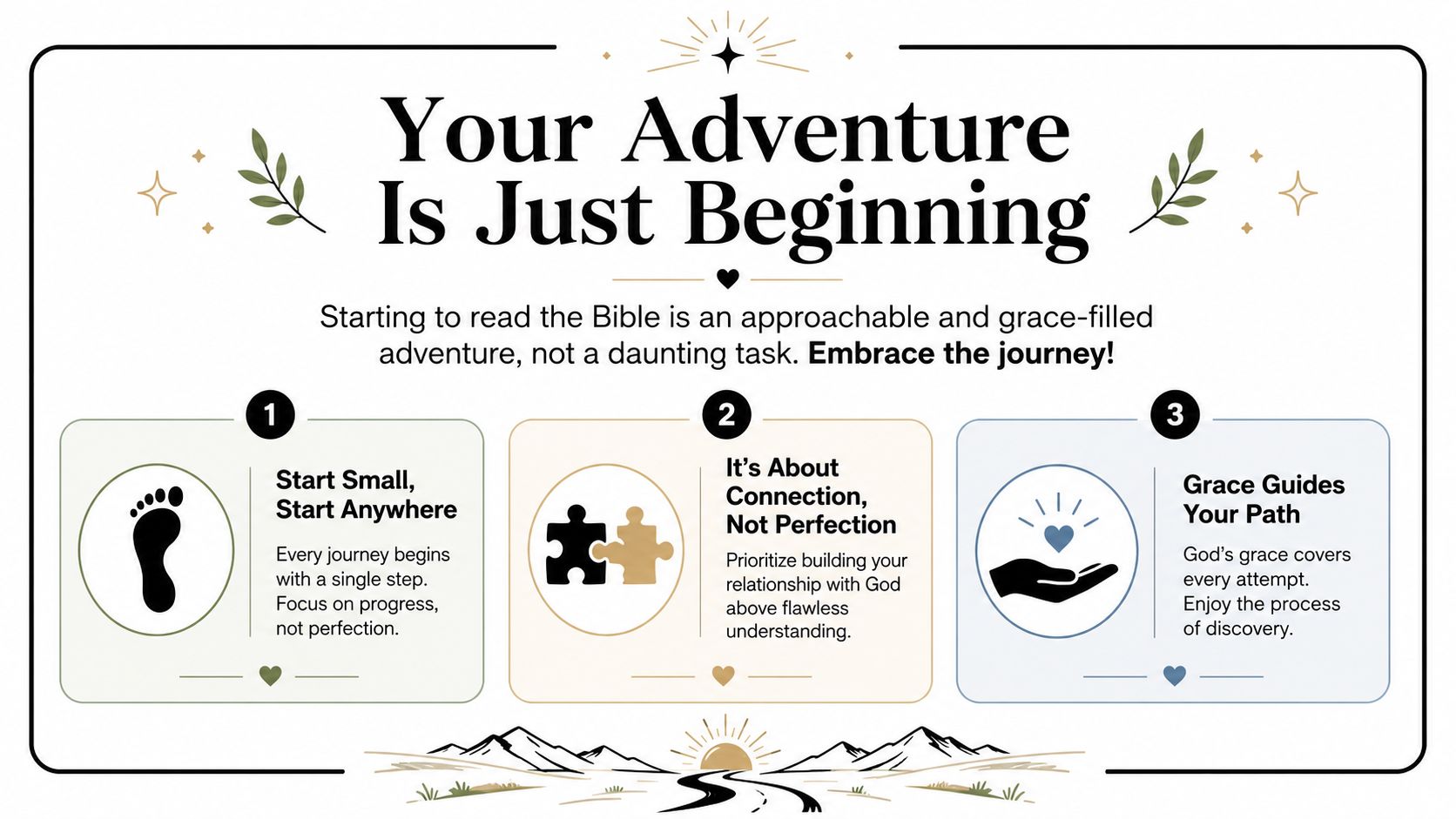
Start tonight if you can. Start tomorrow morning if that works better. Read one passage. Ask one honest question. Pray one small prayer. Those simple habits may feel tiny, but they are how a real Bible reading life begins, even with a baby on your lap.
If you're building a faith-filled home for little ones, Little Venture Co. offers beautiful children's essentials created with comfort, meaning, and family life in mind. It's a lovely place to find pieces that reflect the warmth and care you want your children to grow up around.