

How to Pray Scriptures in the Bible: A Simple Guide
Some nights you finally get the kids down, step over a pile of blocks, reheat your tea for the third time, and try to pray. Then your mind goes blank.
You want to talk to God, but the words feel thin. Maybe you keep saying the same few things. Maybe you're carrying a real burden, but you're too tired to explain it. Maybe your prayers have started to sound more like a mental to-do list than a conversation with the Lord.
If that's where you are, you're not failing.
A lot of parents live in that space between deep desire and daily exhaustion. You love God. You want your home to be full of peace and truth. You just don't always have the focus to come up with polished prayers in the middle of diapers, dishes, wakeups, and nonstop questions.
That's why praying Scripture can feel like such a gift. Instead of trying to invent the right words, you let God's Word guide your words. You borrow language from the Bible and turn it into honest prayer. It's simple, grounded, and surprisingly calming.
When Your Prayer Life Feels Stuck
I've had plenty of prayer moments that looked nothing like the quiet devotional picture in my head. I've prayed while buckling a toddler into a car seat. I've prayed while folding tiny pajamas. I've prayed half-awake at 2 a.m. with one eye on the baby monitor.
In those seasons, I didn't need a more impressive prayer life. I needed a more doable one.
Praying Scripture helps because it takes the pressure off. You don't have to search for fresh words or wonder if you're saying enough. You open the Bible, read a verse slowly, and answer God with what's already there. That can be enough for a very full day.
If you've been carrying stress, fear, or mental clutter, this kind of prayer can steady you. Sometimes the best place to begin is with a simple prayer for overwhelmed hearts, like these gentle ideas on prayer when feeling overwhelmed.
Why this feels different
Regular prayer can sometimes feel abstract when your day is loud. Scripture prayer gives your mind something solid to hold.
It also reminds you that prayer isn't a performance. You're not trying to sound wise. You're responding to God's words with your real life.
When you can't find your own words, you can start with God's.
That's often the turning point. Not perfection. Just relief.
What stuck prayers often sound like
You might recognize yourself in one of these:
- Repetitive prayers: You say the same phrases every day and feel disconnected from them.
- Scattered prayers: You start praying, then remember the laundry, the permission slip, or the child who still needs water.
- Wordless prayers: You know what you feel, but you can't shape it into sentences.
Praying Scripture meets all three. It gives fresh language, keeps your attention anchored, and carries you when your own thoughts feel tangled.
Finding the Right Words in the Bible
If you're learning how to pray Scriptures in the Bible, start small. You do not need a complicated reading plan or a seminary-level understanding of every passage. You need one short portion of Scripture you can read slowly and pray sincerely.
A long-standing Christian practice treats praying Scripture as a practical way to turn Bible reading into spoken prayer. A widely recommended starting point is the book of Psalms, since it's already a collection of prayers and songs, and one simple method is to read a Psalm once for understanding, then read it again more slowly and pray after each section, as described by Daily Grace's guide on how to pray Scripture.
Start where the language is already prayerful
The Psalms are especially helpful when you don't know where to begin. They give words for fear, joy, gratitude, grief, trust, and need. They sound like real people talking to God, because they are.
The Gospels can also be a beautiful place to start. If you read a short passage about Jesus calming fear, showing compassion, or teaching His followers to trust, you can turn that into prayer without overthinking it.
Try beginning with:
- A short Psalm when you feel emotional, tired, or unsure what to say
- A Gospel passage when you want to focus on Jesus' character
- A familiar verse you already know by heart
Keep your choice connected to your real life
You don't need the “perfect” verse. Pick one that fits the moment you're in.
If you're anxious, look for a passage about peace. If you need wisdom as a parent, choose a verse about guidance. If you're thankful, pray from a Psalm of praise. Many parents find it helpful to keep a small list of familiar verses nearby, or use a simple collection like these Bible verses everyone should know.
A good starting verse is one you can understand well enough to pray back to God.
What if you don't understand the verse
That's one of the biggest hang-ups, especially when you're trying to pray in a short window.
If a verse feels confusing, don't force it. Read a few lines before and after it. Look for the plain meaning. Ask, “What does this show me about God?” or “What response does this invite?” If it still feels hard, choose a simpler passage and come back later.
You're building a habit, not passing a test.
A Simple Method for Praying Scripture
One of the easiest ways to learn how to pray Scriptures in the Bible is to use a short rhythm you can remember in the middle of normal life: Read, Reflect, Respond.
That simple flow fits well with a more careful approach many Christian teachers recommend: choose a passage tied to your need, read the surrounding context so you preserve the original meaning, identify its command, promise, or principle, and then turn that meaning into prayer without changing the text's intent, as explained in this step-by-step guide to praying Scripture.
Here's a visual way to remember it.
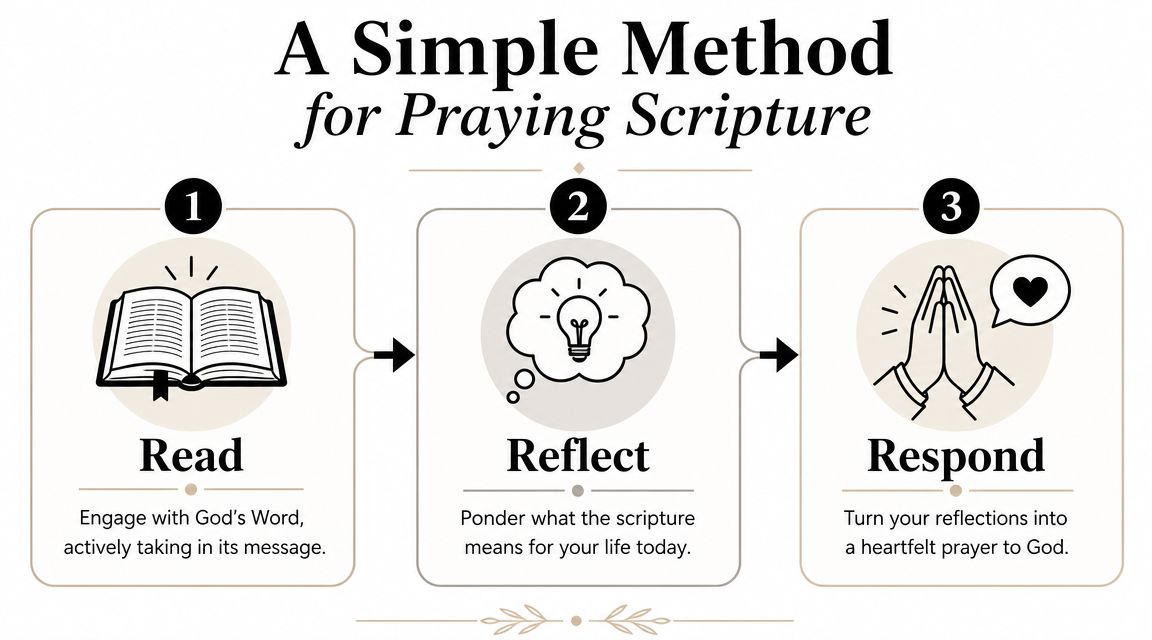
Read
Read one verse or a short passage slowly. Not ten chapters. Not even a full devotional if you're short on time. Just enough to really notice the words.
If you can, read it twice. The first reading helps you see what it says. The second lets it settle.
For example, take Philippians 4:6. Read it slowly and notice the main movement of the verse. It calls you away from anxiety and toward prayer with thanksgiving.
Reflect
Ask one or two simple questions:
- What is this passage saying about God?
- Is this a command, promise, or truth I need today?
- What part stands out to me right now?
This part matters because it keeps you from grabbing a phrase and making it mean whatever you want. Even a brief pause helps you stay rooted in what the verse says.
Practical rule: Don't rush past meaning on your way to application.
Here's where the video below can help if you want to see the process taught out loud.
Respond
Now turn the verse into a personal prayer. Use your own words, but stay close to the passage.
For Philippians 4:6, that might sound like this:
God, I'm anxious about my child, my home, and things I can't control. Please help me bring these worries to You instead of carrying them alone. Give me a thankful heart even before I see the answers.
That's it. You prayed Scripture.
You can do the same with almost any clear verse. Read it. Think about its real meaning. Then answer God from that truth.
A short version for rushed days
When your toddler is crying and dinner is burning, use the tiny version:
- Read one line
- Name one truth
- Pray one sentence
That counts. It really does.
Sample Prayers for Your Everyday Needs
Sometimes it helps to see Scripture prayer already shaped into everyday language. Not because you need a script forever, but because examples make the process feel less mysterious.
One useful framework is ACTS, which stands for Adoration, Confession, Thanksgiving, and Supplication. The value of a structure like this is that it helps you match what a passage says to how you pray. Truths about God can become adoration, commands can become requests for help, and promises can become expressions of trust, as noted in this practical guide to praying according to the Bible.
Scripture Prayer Starters for Parents
| When You Need... | A Go-To Scripture | A Simple Prayer Starter |
|---|---|---|
| Protection for your child | Psalm 121 | Lord, watch over my child today. Keep them in Your care when I can't see every need or stop every hurt. Be their protector in every place they go. |
| Gratitude in a busy day | Psalm 118:24 | Father, thank You for this day. Even if it feels messy and fast, help me receive it as a gift and notice Your goodness in it. |
| Guidance in parenting | James 1:5 | God, I need wisdom for this child and this moment. Please guide my words, my tone, and my decisions so I respond with grace and truth. |
| Peace in anxiety | Philippians 4:6 | Lord, I bring You the worries I've been carrying. Help me trade panic for prayer and remember that You are near. |
| Patience when I'm worn out | Psalm 86:11 | Teach me Your way, Lord. Steady my heart so I don't react from frustration, but walk in patience and honesty. |
How this looks in real life
A prayer for protection might happen at the front door while you're zipping a coat.
Father, You see what I can't. Please guard my child today, lead them, and hold them close.
A gratitude prayer might happen while you wipe the high chair for the fourth time.
You don't need a peaceful soundtrack or a long journal entry. You can thank God for the child in front of you, the food on the table, and the grace to start again after a hard morning.
Use categories when your mind is tired
If your brain feels foggy, categories can help. Try one of these:
- Adoration: Praise God for who He is in the passage.
- Confession: Admit where your heart or actions don't align with it.
- Thanksgiving: Thank Him for a gift, promise, or mercy in the text.
- Supplication: Ask for help to live what you just read.
That keeps your prayers grounded without making them stiff.
Praying Scripture with Your Babies and Toddlers
If you have very little ones, Scripture prayer can become part of the atmosphere of your home long before your child can explain any of it back to you.
That matters because many adults already live with some rhythm of Bible engagement and prayer. Barna found that 34% of U.S. adults read the Bible at least once a week, and Pew Research Center reported in 2025 that 44% of Americans pray daily, which shows that many people already have a foundation for practices like Scripture-based prayer, according to Pew Research Center's report on prayer and religious practices.

Keep it short and repeatable
Babies and toddlers don't need long explanations. They need repetition, warmth, and simple words.
You can whisper a short blessing at bedtime. You can pray one line from a Psalm during breakfast. You can repeat the same verse all week while rocking your baby or strapping your toddler into the stroller.
Here are a few easy ways to begin:
- At bedtime: Use a brief verse of peace or blessing and pray it softly over your child.
- At meals: Pick one simple sentence of thanks and repeat it daily.
- During hard moments: Use a short line like “God, help us” or “Jesus, give us peace.”
- On the go: Pray a single verse in the car instead of waiting for a perfect quiet time.
Let your child hear your real faith
Children learn the sound of faith before they understand the meaning of every word. They notice your tone. They notice what you return to when someone is sick, upset, scared, or grateful.
That's one reason I love simple family rhythms. They don't require a polished family devotional. They just invite God's Word into ordinary moments. If you want a gentle way to support that habit for yourself, a short daily devotional for parents can help you keep Scripture close at hand.
Small repeated prayers often shape a home more than occasional big moments.
Don't aim for formal
Many parents get stuck because they think family prayer has to sound serious and structured to “count.”
It doesn't.
A toddler-level Scripture prayer can be as simple as, “Jesus, thank You for our food,” or, “Lord, watch over us as we sleep.” If the words are true and offered in faith, they are enough.
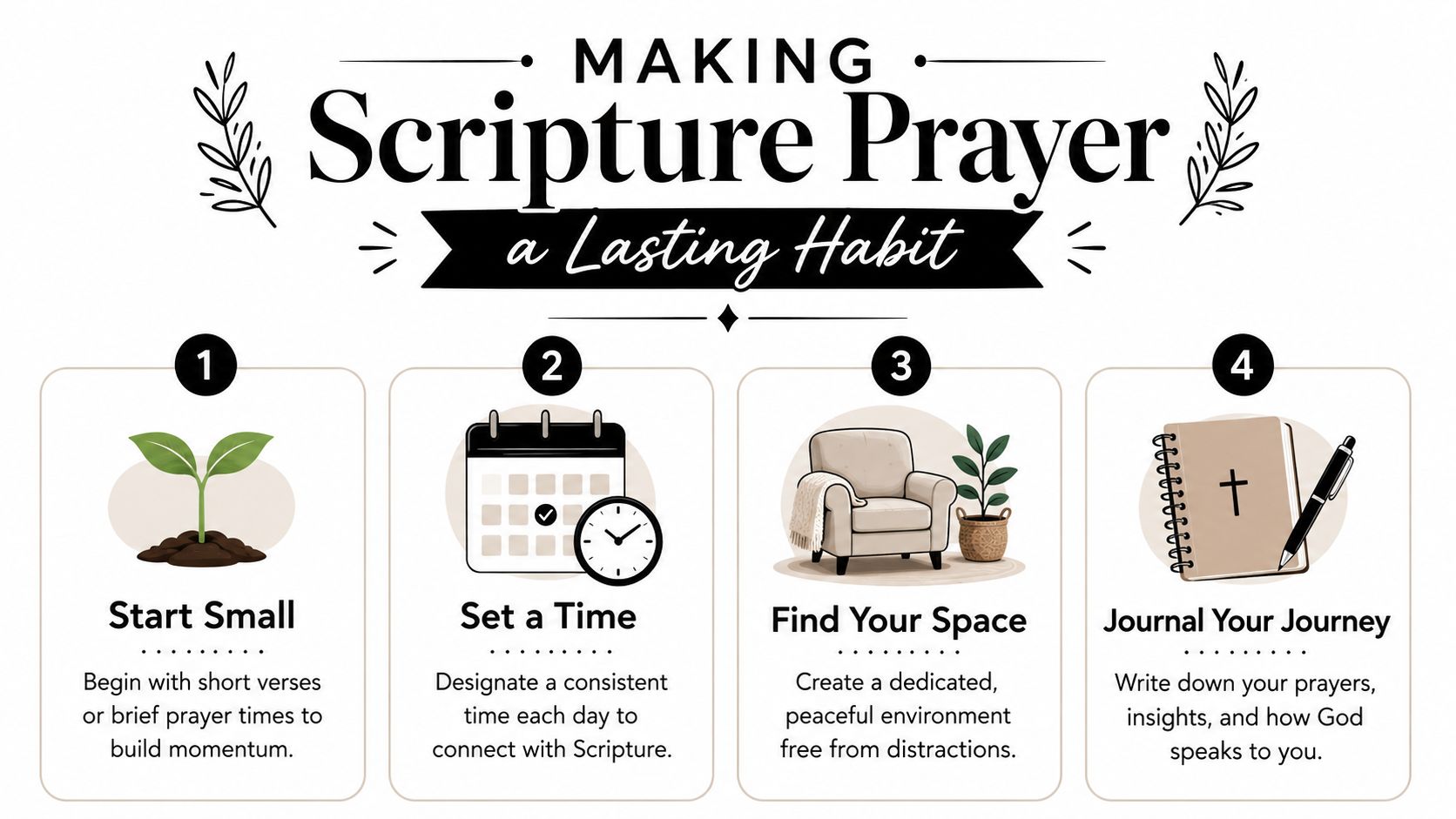
Making Scripture Prayer a Lasting Habit
The best habits for parents are the ones that fit actual life. Not the ideal version of life. The actual one.
That's especially important here, because a common gap in online prayer advice is that it often misses the daily reality of caregivers, bedtime routines, and rushed moments. More helpful guidance offers short, scenario-based patterns and beginner-friendly passages instead of assuming every reader can personalize any verse on the spot, as reflected in this discussion of practical gaps in prayer guidance.
Build around what you already do
Attach Scripture prayer to routines that already happen.
- Morning coffee: Read and pray one verse before checking messages.
- School or daycare drop-off: Speak a short prayer of blessing in the car.
- Nap time or bedtime: Keep one familiar Psalm nearby.
- Kitchen clean-up: Thank God out loud for one grace from the day.
A short practice you repeat will outlast an ambitious plan you avoid.
Give yourself a simple next step
Pick one verse this week. Write it on a sticky note. Save it to your phone. Pray it every day until it feels familiar.
You might also keep a small notebook where you write the verse and one sentence of response. If you like a little structure, a simple devotional resource for everyday faith can make it easier to stay consistent without adding pressure.
Faithful habits usually grow from small acts repeated with love.
If you miss a day, start again the next day. If the kids interrupt, pray with them there. If all you have is thirty seconds, offer thirty seconds.
Learning how to pray Scriptures in the Bible isn't about mastering a technique. It's about letting God's Word meet you in the middle of your actual life.
If you're building a faith-filled home for your little ones, Little Venture Co. offers beautifully designed, faith-inspired clothing for babies and toddlers that reflects comfort, care, and meaning for everyday family life.