

Welcome Song for Preschool: A Guide to Joyful Mornings
Some mornings start with a child hiding behind a parent's leg, another one spinning in circles, and somebody else asking for a snack before you've even said hello. That's normal in preschool. Little children arrive with big feelings, busy bodies, and different levels of readiness.
A welcome song for preschool helps gather all of that energy into one shared moment. It gives children a simple message right away. You belong here. We're together now. The day has started.
For Christian families, churches, and home preschool spaces, that opening moment can do even more. It can reflect the values you already want to teach at home. Gratitude, gentleness, community, wonder, and joy all fit beautifully into a short song that children remember.
Why a Welcome Song Is Your Morning Secret Weapon
A good morning routine doesn't have to be complicated. In most classrooms, the strongest routines are the simplest ones. A welcome song works because it's predictable, repeatable, and warm.
Children learn quickly when the first few minutes always sound the same. They hear the tune, notice the motions, and understand what comes next. That predictability matters, especially when a child has just separated from a parent or walked into a noisy room feeling unsure.
According to this early childhood resource citing NAEYC guidance, 85% of educators believe welcome songs significantly improve a child's emotional transition from home to the classroom. That lines up with what many preschool teachers see every day. A child who won't answer a spoken greeting will often join a song by the second verse.
What the song does right away
A welcome song isn't just filler before the “real” lesson. It does three important jobs at once.
- It settles the room: Singing together gives children one thing to focus on.
- It creates belonging: When everyone joins the same words and motions, the group starts feeling like a group.
- It marks the transition: Home time is over. School time has begun.
A short song can do what repeated reminders often can't. It gathers attention without turning the morning into a lecture.
That's why many teachers use a welcome song for preschool as the first domino in the whole schedule. If your mornings feel choppy, it often helps to look at the flow of the full routine too. These expert tips for a balanced routine can help you shape the rest of the day around that strong beginning.
Why it matters in a faith-based setting
In a Christian classroom or home, the morning tone matters just as much as the lesson content. A child's first experience of the day can be cheerful and calm, but also rooted in love for others.
That doesn't mean every song has to sound formal. It means that the ritual itself can reflect your values. Kind greetings, thankful language, and noticing each child by name all support the same spirit many families are already building at home through habits like simple family devotionals.
How to Choose or Create Your Perfect Welcome Song
You don't need to write original music. Most preschool welcome songs work best when they borrow a tune children already know. Familiar melodies lower the pressure for adults and make it easier for children to join in fast.
If you can sing “Twinkle, Twinkle, Little Star” or “Row, Row, Row Your Boat,” you can make a welcome song for preschool.
Start with these three ingredients
The strongest songs usually share the same features:
- Short lines that children can hear and repeat.
- A steady beat that fits clapping or patting.
- Personal touches like a child's name, class name, or a simple greeting action.
Personalization matters more than many adults realize. According to Jbrary's welcome and hello song recommendations, 92% of toddlers and preschoolers demonstrate higher retention of social cues when their names are explicitly sung during a welcome song. The same source says a simple rhythmic structure, like 8 claps per line, is used in 70% of effective welcome songs and can increase rhythmic coordination skills by 35%.
That gives us a practical rule. Keep the rhythm simple, and make room for names.
Simple Welcome Song Formulas
| Familiar Tune | Sample Lyric Adaptation | Focus |
|---|---|---|
| Twinkle, Twinkle, Little Star | “Good morning, friends, it's time to play / We're so glad you're here today” | Easy melody, calm start |
| Row, Row, Row Your Boat | “Wave, wave, wave hello / To every friend you see” | Movement and greeting |
| If You're Happy and You Know It | “If your name is Hannah, wave hello” | Name recognition |
| Farmer in the Dell | “Our hands can wave hello / Our hands can wave hello” | Repetition and actions |
How to make the lyrics feel natural
Many adults get stuck here. They try to make the song clever. Preschool songs don't need clever. They need clear.
Use words children already understand:
- hello
- glad
- name
- friends
- clap
- wave
- sing
- here
Practical rule: If a child can't echo the last word of the line, the lyric is probably too complicated.
You can also borrow the social-emotional shape of a good preschool lesson. If you want examples of how simple routines support belonging and feelings language, Soul Shoppe's SEL lesson plans offer helpful ideas you can adapt to circle time.
A few small choices make a big difference
If you're writing your own version, decide these pieces first:
- Who gets named: every child, one child each day, or the whole group
- What action matches each line: wave, clap, stomp, point to self
- How long the song lasts: short enough to keep attention, long enough to include everyone
If you want to build a whole morning basket around songs and read-alouds, it can help to pair your music with familiar read-together materials like simple board books for little ones.
Simple Techniques for Teaching a New Song
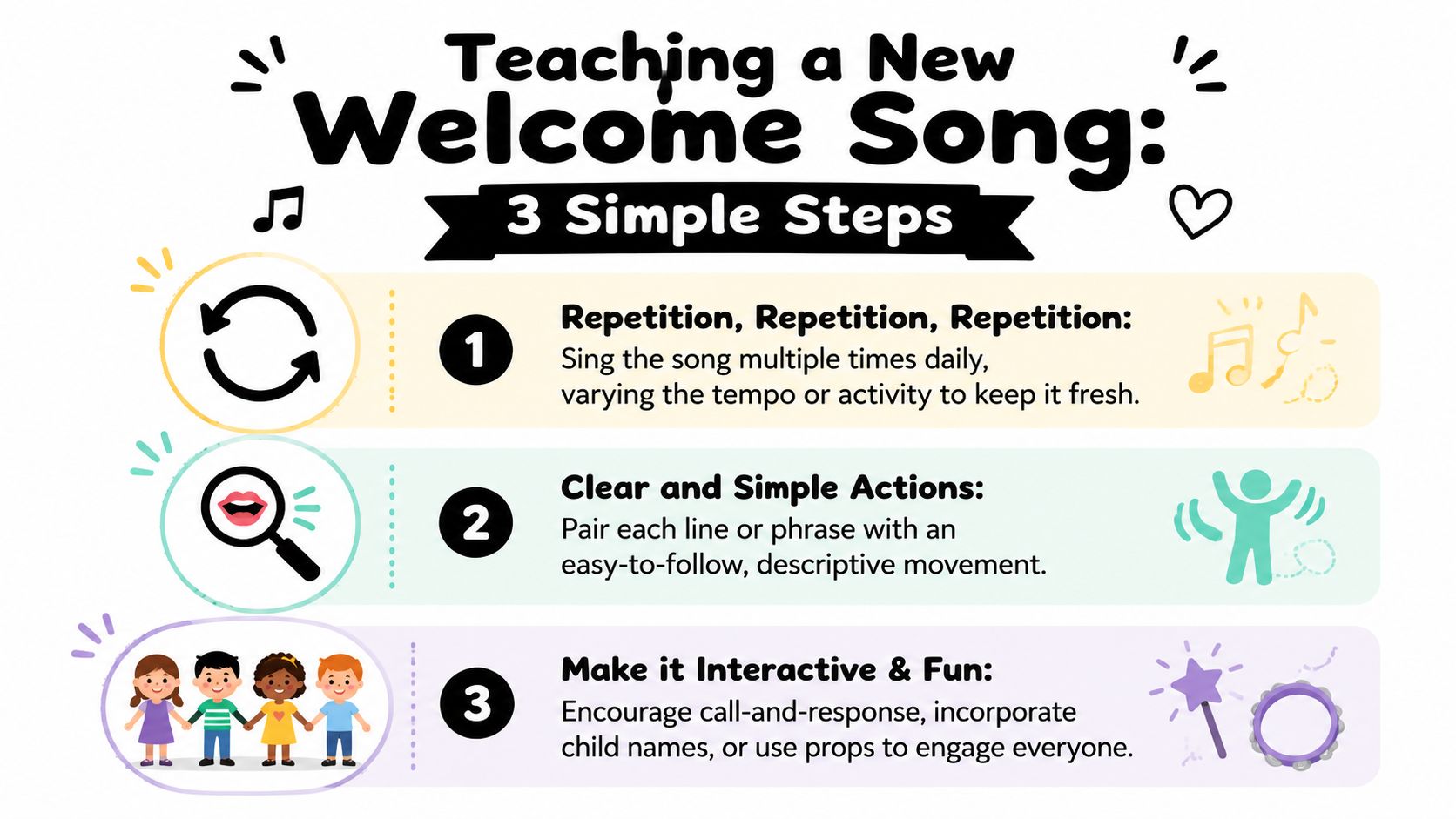
Children don't need a polished performance. They need a leader who's clear, cheerful, and willing to repeat the same song again tomorrow.
That's the part many new volunteers miss. If the children don't join on day one, the song isn't failing. They're still learning the pattern, the words, and the cues from your face and hands.
Three habits that help children join in
- Repeat the song often: Use the same opening song for several days in a row so children can predict it.
- Pair words with movement: A wave, clap, or tap gives children another way to participate even if they're not singing yet.
- Sing with energy, not pressure: Children read your tone quickly. Warmth invites. Commands can shut them down.
Sometimes it also helps to watch how music teachers build participation through echo singing, movement, and steady pacing. If you want more inspiration from music educators, you can find music lessons and teaching ideas through East Valley School of Music.
A steady routine children can count on
A structured routine works especially well when a group is wiggly or unsettled. One classroom-tested model reports 87% success in improving preschooler regulation and engagement when the routine is used consistently.
Move first, sing second, breathe third, and end with thanks. That sequence helps children arrive with both their bodies and their attention.
Here's what that can look like in real life:
Try this four-part flow:
- Start with movement. Toe taps, hand claps, sways, or gentle crossing motions wake up the body.
- Sing a familiar song and let the children carry parts of it.
- Pause for three slow breaths together.
- Finish with one thankful phrase such as “Thank You, God, for this day” or “Thank you for our friends.”
What to do when children don't sing
That's common, especially with younger children.
Some will only watch for a week. Some will whisper. Some will do the motions but never sing a word. Participation still counts. If a child is looking, smiling, swaying, or waiting for their name, they're engaged.
Your job is to keep the door open. Smile. Repeat. Keep the motions simple. Let the song become familiar before you expect a full chorus.
Adapting Songs for Every Age and Stage
A welcome song for preschool should match the child in front of you, not an ideal child from a lesson plan. Babies, young toddlers, and older preschoolers respond to music in different ways, and that's where many adults get frustrated.
A 2024 study on early childhood musical development noted that 74% of parents with babies under 18 months specifically ask how to perform welcome songs that require coordination, yet few resources provide adaptations for non-mobile infants. That question makes sense. Many popular songs assume clapping, jumping, waving, and fast imitation.
For babies and young toddlers
With infants and non-mobile babies, think bonding before action. The song doesn't need big motions to be meaningful.
Try gentle choices like these:
- Lap rhythm: Pat a slow beat on your lap while baby rests against you.
- Hand-over-hand movement: Help baby's hands open and close softly.
- Back tapping: Tap the rhythm lightly on baby's back during the song.
- Face and voice focus: Smile, sing their name, and keep eye contact.
If a baby seems tired or overstimulated, soften your voice and shorten the song. A whispery version often works better than an upbeat one.
For older toddlers and preschoolers
Once children can follow one-step directions, you can add clearer actions and a stronger beat. This age usually enjoys repeating motions with the group.
Good options include:
- Touch your head, shoulders, or nose
- Stomp your feet on the beat
- Wave to a friend
- Jump once when your name is sung
The key is matching movement to ability. A toddler may love stomping but struggle to coordinate finger motions. A three- or four-year-old may enjoy more complex call-and-response play. When in doubt, choose the simpler version first and build from there.
Faith-Inspired Welcome Songs for Little Hearts
Christian parents often notice the same problem. Most welcome song ideas online are friendly and useful, but they stop at generic greetings. That's fine for some settings, but it can feel incomplete if you want your morning routine to reflect faith in a natural, child-sized way.
That need is real. A 2025 survey discussed in this resource found that 68% of home-based Christian preschool parents struggle to find welcome songs that explicitly mention God's creation or biblical community, with most search results returning secular content.
Keep the faith language simple
The best faith-based songs for little children don't need heavy wording. They work when they sound like something a child could say.
That usually means focusing on:
- God made the day
- we're thankful to be here
- each child is loved
- creation gives us reasons for wonder
- our classroom is a place for kindness
A song can mention God without becoming long or formal. One line is often enough.
Easy lyric swaps that work
Take a tune you already know and make one small change.
For example:
- “Good morning, friends, we're here today” becomes “Thank You, God, for this new day”
- “Hello, Emma, we're glad you're here” becomes “God loves Emma, we're glad she's here”
- “Wave hello to all our friends” becomes “Wave hello to all God's friends”
These tiny adjustments keep the song singable. They also help children hear faith language in an everyday rhythm, not only during Bible story time.
If you're building a larger home discipleship rhythm, these simple music habits fit naturally alongside gentle ways of teaching children about God.
Themes children understand right away
Creation and gratitude are especially easy to sing because children can see them.
Try short verses like:
- “Thank You, God, for birds that sing”
- “Thank You, God, for sun and rain”
- “Thank You, God, for all our friends”
- “Thank You, God, for hands to clap”
That gives the song a faith-filled tone without asking children to memorize abstract ideas.
Here's a simple example set to “Twinkle, Twinkle, Little Star”:
Thank You, God, for this new day
For our friends and for our play
For the sunshine, for the trees
For the birds and buzzing bees
Thank You, God, for this new day
Help us love in work and play
If you'd like to hear another musical example before adapting your own, this video can spark ideas for melody, pacing, and group participation.
Beyond the Song Using Music for Transitions
The welcome song does more than open circle time. It sets up the next step. Once children are looking in one direction, moving together, and sharing one rhythm, you've created the perfect moment to guide them forward.
You can use a simple verbal bridge after the final line:
- “Now we're ready for our story.”
- “Let's take our song voices and carry them to the rug.”
- “After we say hello, we listen for our book.”
A goodbye song helps in the same way at the close of the day or class. It gives closure, lowers resistance, and helps children understand that the routine has a beginning and an ending they can trust. That kind of gentle structure matters in both classrooms and homes.
If you enjoy weaving meaningful words into your family rhythms, even outside circle time, many parents also love quiet resources like Hymns for a Mother's Heart for their own moments of pause.
If you're building a home, nursery, or preschool space shaped by comfort, faith, and everyday wonder, Little Venture Co. offers thoughtfully made children's clothing designed to feel gentle on little ones and meaningful to the families who love them.