

Teaching Children About God: A Gentle Guide
Teaching your little ones about God isn't about diving into deep theological discussions. It starts with simple, loving actions woven right into the fabric of your daily life. For infants and toddlers, it’s all about connecting God to feelings of love, comfort, and wonder through gentle words, sweet songs, and simple prayers. You're creating a warm, safe atmosphere where faith can naturally take root and grow.
Starting Your Child's Faith Journey

First, let's take a deep breath. You don't need a seminary degree or a special curriculum to introduce your child to God. It’s really just about being present and intentional in the small, everyday moments you already share. Think of it as wrapping them in a cozy blanket of love, security, and faith.
You’re already doing it when you cuddle them close, hum a lullaby, or point out a beautiful butterfly fluttering by the window. This guide is here to help you connect those simple, tender moments to a budding awareness of God's love and presence. It's a gentle framework that feels natural, never forced.
Building A Foundation Of Faith
The goal here isn't for them to understand complex concepts—it's to build positive associations. You're laying an emotional and spiritual foundation based on three core feelings:
- Love: Showing them that God is connected to the feeling of being cherished and secure.
- Wonder: Pointing out the beauty in creation, like a vibrant flower or a sky full of stars.
- Gratitude: Modeling simple thankfulness for everyday blessings, like a warm meal or our family.
This approach is actually pretty common. Research shows that among highly religious parents, a staggering 81% pray or read scripture with their children. Even more broadly, 70% of Christian parents use at least one method to teach their kids about faith, showing just how important it is to weave it into family life. You can find more of this data over at pewresearch.org.
By focusing on the heart, you create a nurturing space for their spiritual life to blossom. You're showing them that faith is a comforting and joyful part of who your family is.
This journey is also about building a village around your child. For more practical tips, you can explore this excellent guide to teach your kids about faith. And as you build that spiritual support system, you might find our own guide on how to choose godparents super helpful for picking people who will share and reinforce these precious values.
Age-Appropriate Spiritual Milestones
For infants and toddlers, spiritual growth isn't about memorizing facts; it's about experiencing God’s love through their senses and relationships. Below is a simple table to give you an idea of what to focus on at each stage.
| Age Group | Developmental Focus | Simple Activity Example |
|---|---|---|
| Infants (0-12 months) | Feeling safe, loved, and secure. | Singing a soft hymn like "Jesus Loves Me" as a lullaby during cuddle time. |
| Toddlers (1-3 years) | Experiencing wonder and gratitude. | Saying, "Thank you, God, for the yummy apples!" before snack time. |
These are just starting points, of course. The key is to keep it simple, joyful, and connected to the loving world you’re already building for them.
Weaving Faith into Everyday Routines
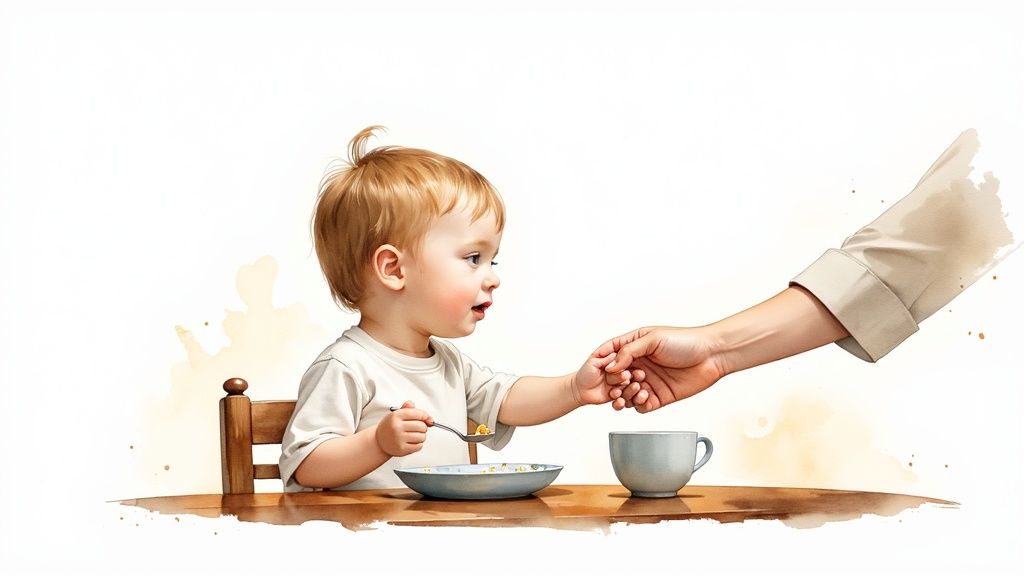
If you have an infant or toddler, you know that routines are everything. Mealtime, bath time, and bedtime aren't just events on a schedule; they are the anchors that make your little one’s world feel safe and predictable. It’s this very predictability that gives us a perfect, low-pressure way to introduce them to God.
The goal isn't to carve out a formal 'God time' that feels like another task on your to-do list. It’s about seamlessly weaving faith into the rhythm you already have. You just find those small, teachable moments that pop up all day and add a little layer of faith.
Connecting Faith to Their World
Little kids learn with their hands, their eyes, and their hearts. Big, abstract ideas about faith? Those will come later. Right now, their reality is the warmth of a cuddle, the juicy taste of a strawberry, or the exciting flutter of a butterfly. We can use these tangible, everyday wonders to point them toward God.
Picture this: you're on a walk, and your toddler stops to poke at a bright yellow dandelion. Instead of just moving on, you can say something simple like, "Wow, what a pretty flower! God made that yellow just for us to see." In that tiny moment, you've connected the beauty they can touch and see with the idea of a creative, loving God.
This approach makes faith feel as normal and comforting as their favorite stuffed animal. It isn't some separate subject they have to learn, but a natural part of living and loving.
The most powerful faith lessons for little ones don't happen in a classroom. They happen in the middle of ordinary life—the whispered prayer at bedtime, the happy "thank you" for a snack, and the wonder-filled comment on a sunny day.
These small, consistent affirmations slowly build a foundation. They start to see God as a present, loving, and good part of their world, which is so much more effective than trying to have a big, formal lesson once in a while.
Practical Ways to Weave in Faith
Making this a habit is probably easier than you think. It really just takes a little bit of intention. Here are a few simple, real-world examples you can start using today.
Mealtime Moments
Before everyone digs in, take a moment to hold hands and say a quick, cheerful prayer. It doesn’t have to be fancy.
- "Thank you, God, for our yummy food! Amen."
- "We love this food! Thanks, God!"
This simple act teaches gratitude from the very beginning and connects God with the good things we enjoy every day.
Bedtime Blessings
Bedtime is naturally a quiet, cuddly time, making it the perfect moment to reinforce how loved and safe they are. As you're tucking them in, you can whisper a simple blessing over them.
- "God is watching over you all night long."
- "Sweet dreams. God loves you, and I love you."
This helps your child associate God with peace, security, and the comfort of being with you. Over time, this can become a cherished ritual. A great way to create a peaceful atmosphere is to hang beautiful art in their room—our guide on using framed scripture verses has some wonderful ideas that are perfect for a child's space.
Playtime and Discovery
Don't forget playtime! It’s a goldmine for teachable moments. While you're building with blocks, you can talk about how God helps us build strong things. When you’re playing with animal figures, you can mention how God created every single one, from the roaring lion to the tiny ladybug.
It’s all about narrating their world through a lens of faith, turning these early years into a joyful, ongoing conversation about God.
Using Simple Words and Loving Prayers

Let's be honest, it's easy to get tongue-tied when talking to a two-year-old about God. Big theological concepts feel clunky and out of place, and you might worry you’re just confusing them.
The secret? Forget the seminary words. Instead, lean into simple, concrete language centered on love, security, and kindness.
For toddlers, God isn't some abstract idea floating in the clouds. He's connected to their world right now—the warm blanket, the yummy snack, the sunshine on their face. The words we use should reflect that. Think in heartfelt phrases they can feel, not just concepts they have to figure out.
Your tone matters just as much as your words. A warm, gentle voice turns these little chats into something special and safe. This isn't about giving a lecture; it's about sharing a beautiful part of your life with the person you love most.
Building Their First Spiritual Vocabulary
A child’s first spiritual words should be simple, positive, and easy to repeat. The goal is to sprinkle them into your day so naturally that they become part of your family’s rhythm. You're building a foundation of God's character in a way that actually sinks into a little one's heart.
Here are a few of my go-to phrases:
- "God loves you so much." This is the absolute cornerstone. Say it during cuddles, at bedtime, or when they’ve just accomplished something big (like using the potty!).
- "Jesus is our kind friend." Framing Jesus as a friend makes him feel close and approachable, not like a distant historical figure.
- "God made our amazing family." This connects God directly to the most important people in their world, reinforcing that feeling of safety and belonging.
- "Wow, God made the beautiful sunshine!" Pointing out God in the everyday wonders they can see and touch makes faith tangible.
By repeating these simple truths, you're doing more than just teaching vocabulary. You're shaping their emotional connection to God. You're giving them an internal script that says, "God is loving, God is good, and God is always near."
Introducing Your Toddler to Prayer
Prayer with a toddler is not about formal speeches or long, quiet moments of reflection. Not even close. It's about modeling a warm, simple conversation. Think of it as introducing them to a friend they can talk to anytime. The goal is to make it feel as natural as saying "good morning."
One-line "thank you" or "help me" prayers are the perfect starting point. They're short enough for a toddler to repeat, which empowers them to join in and make the prayer their own.
My First Prayers Collection
- Mealtime: "Thank you, God, for my yummy snack."
- Playtime: "Thank you, God, for my fun toys."
- Bedtime: "God, please watch over me while I sleep."
- Friendship: "Help me be a good friend at the park today."
These tiny prayers connect God to the real, tangible parts of their day. It shows them that prayer isn't just for Sundays—it's for every moment. As a new parent, modeling this can feel like a big responsibility, but remember, your simple, heartfelt words are more than enough. If you need some encouragement for yourself, our prayer for new parents can be a wonderful resource for your own journey.
Telling Stories and Singing Songs About God

If you really want to connect with a little one, you have to speak their language. And for babies and toddlers, that language is stories and songs. They aren't just for fun; they’re how we can plant the very first seeds of faith in a way that feels like pure joy.
Big ideas like kindness, bravery, and God's love suddenly click when they're wrapped in a simple story or a catchy tune. You're not just telling them about God; you’re helping them feel the wonder and happiness that comes with knowing Him.
Making Bible Stories Come Alive
The key here is to keep it simple, visual, and full of action. Forget about deep theological lessons for now. The goal is to build happy, positive feelings around these foundational stories.
For the littlest listeners, I always stick to stories that show God's creativity and how much He cares.
- Noah’s Ark: Skip the scary flood details. This is all about the animals! We line up all our stuffed animals two-by-two, make all the sounds, and talk about how God wanted to keep every single creature safe. It’s a blast.
- The Creation Story: This one is fantastic for getting their senses involved. On a sunny day, you can say, "Look! God made the bright, warm sun!" When you see the moon at night, you point it out. It connects God to the real world they can see, touch, and feel.
- David and Goliath: Once they're a bit older, this is a great story about being brave. I’ll grab a small doll and a big one to act it out, showing how God helped the little guy do something huge. The focus is just on courage.
To really make these tales stick, you've got to be a little theatrical. Use silly voices. Act things out with your hands or a couple of puppets. Having some sturdy, colorful faith-based board books on hand is also a game-changer for making storytime a hands-on experience. You can find some great ones here: https://littleventureco.com/collections/board-books.
The Magic of Simple Songs
Music is basically magic for toddlers. A simple song can teach a core truth about God far better than a long explanation ever could. The mix of melody, rhythm, and movement helps lock the message right into their memory and heart.
Passing down faith through music is a tradition that's been around forever. It’s no surprise that using songs and Sunday school has been a cornerstone of childhood for generations. In fact, research shows about 69% of American adults had some kind of religious education growing up. It’s a classic method because it just plain works. You can find more on that research from Pew Research Center.
Don’t just sing the songs—get up and move! Simple hand motions turn listening into a full-body experience that toddlers absolutely love.
Think about those timeless classics with easy lyrics and actions. "Jesus Loves Me" is perfect for quiet bedtime cuddles, while "This Little Light of Mine" is my go-to for getting the wiggles out. When they hide their "light" under a basket and then burst it out to "let it shine," they are physically feeling the joy of sharing God’s love.
This kind of playful interaction makes teaching feel less like a lesson and more like a celebration.
Answering Their First Big Questions
It was only a matter of time. Whether it’s from the back of the car, during a splashy bath time, or just as you’re tucking them in, the big questions will start to pop up.
"Where is God?"
"Who is Jesus?"
"Can God see me right now?"
In those moments, it’s so easy to feel a jolt of panic. You might feel like you need a perfectly polished, theologian-approved answer on the spot. But take a deep breath. You don't need a seminary degree, just a simple, heartfelt response your child can feel.
Keep It Concrete and Comforting
Toddlers are wonderfully literal. They think in terms of what they can see, touch, and taste. Trying to explain abstract concepts like omnipresence or the Holy Trinity will just fly right over their little heads. The real key is to connect God to the things they already know and understand from their own sensory world.
Your goal here isn't just to answer a question; it's to build a foundation that says God is a safe, loving, and constant presence in their life. Frame everything you say around that core idea of reassurance and love.
The goal isn't theological accuracy; it's emotional security. A child who feels God's love is far more prepared for a lifetime of faith than one who can recite facts they don't yet understand.
Think of yourself as a loving translator. You’re simply taking big, beautiful truths and making them small and huggable for your little one.
Simple Answers for Big Questions
It really helps to have a few simple, go-to answers in your back pocket. It makes you feel more prepared and confident when you're caught off-guard. Below is a quick guide to some of the most common questions you might hear.
Answering Toddler Questions About God
This table offers a starting point for responding to your toddler's spiritual curiosity with simple, reassuring, and age-appropriate answers.
| Common Question | Core Concept to Convey | Simple Answer Example |
|---|---|---|
| "Where is God?" | Presence and closeness | "God is always with us, like the air we breathe. We can't see Him, but He's here." |
| "Who is Jesus?" | Love and friendship | "Jesus is God's Son and our very best friend. He helps us learn how to love everyone." |
| "What does God do?" | Creativity and care | "God made all the beautiful things, like puppies and flowers, and He takes care of them and us." |
Remember, these are just conversation starters. The most important thing is to listen to your child and respond to the heart of their question with warmth and love.
Sometimes, these questions come up when your child is feeling a big emotion like fear or sadness. This is a perfect opportunity to introduce God as a source of comfort. You could say something like, "When you feel scared, you can talk to God. He is always listening and wants to help you feel brave."
This helps them see that faith isn't just something we talk about; it's a real, practical part of life. For older kids just beginning to wrestle with these big ideas, a book like Judy Blume's classic, Are You There God? It’s Me, Margaret can be a great way to open up the conversation.
Ultimately, your role is to create a safe space for their curiosity to blossom. You're turning what could be tricky questions into beautiful moments of connection and trust.
Parents Often Ask...
Starting this faith journey with your little one is exciting, but let's be honest, it can also bring up a whole lot of questions. That’s completely normal! Here are a few of the most common worries I hear from parents, along with some gentle, real-world advice to help you feel more confident.
What if My Partner and I Believe Differently?
This is a big one, and it's a reality for so many families. Navigating different beliefs can feel like walking a tightrope, but the secret is finding common ground and leading with respect.
Instead of getting bogged down in theological debates, focus on the shared values you both want for your child. Think kindness, compassion, gratitude, honesty. You can frame your faith practices around these core ethics.
For example, you could say, "In our family, we believe it's so important to be kind, and one way we show that is by saying a little prayer of thanks." This approach respects your beliefs while keeping your partner right there with you in building your child's moral foundation.
The most important thing? Keep talking. Agree on what you'll teach together and what you might introduce separately. Decide how you'll answer your child’s questions about your different views when they get a bit older. Unity doesn't have to mean uniformity.
Is My Toddler Even Old Enough to Get This?
It's so easy to look at your busy toddler and wonder if any of this is actually sinking in. The short answer is yes, but it’s not what you think. For a toddler, "understanding" God isn't about deep thoughts; it’s all about emotional and sensory connection.
They won’t be grasping complex doctrines, but they can absolutely feel that:
- Singing "Jesus Loves Me" is tied to warm cuddles and feeling loved.
- Saying "thank you" for their yummy snacks is a happy, grateful moment.
- Hearing "God is watching over you" feels safe and cozy at bedtime.
What you're really doing is building a foundation of positive feelings and associations. This emotional groundwork is what makes those bigger, more complex faith conversations possible down the road. You're not teaching them theology; you're teaching them that God feels like love.
How Do I Make Church Feel Fun, Not Scary?
To a little one, a big new building filled with strangers and loud music can be a lot to handle. The key to making church a positive experience is to frame it as an adventure and prepare them for what's coming.
Talk it up beforehand! Try saying things like, "On Sunday, we get to go to a special place called church! We'll sing happy songs and see lots of friends." Focus on the parts they'll love—the nursery with cool toys, the yummy snacks, or the chance to play with other kids.
When you arrive, stick with them until they feel settled. Your calm, happy energy is contagious. If they see you’re relaxed and enjoying yourself, they’re far more likely to feel comfortable and safe, too.
At Little Venture Co., we believe in wrapping your little ones in comfort and inspiration from day one. Our buttery-soft bamboo sleepwear and daywear are designed to be as gentle on their skin as your words are on their heart.