

Oeko Tex Certified Bamboo Clothing: Soft Baby Wear for 2026
You're comparing two soft bamboo rompers online, both promising comfort for your baby, and both using words like “gentle,” “safe,” and “eco-friendly.” One has an OEKO-TEX® mark, the other doesn't. The question is simple but important: what does that label tell you about the clothing your child will wear against their skin for hours at a time?
The short answer is reassuring, but it isn't the whole story. OEKO-TEX® Standard 100 tests the finished textile for harmful substances. It doesn't prove that bamboo was grown organically, that the manufacturing process had a small environmental footprint, or that every possible risk has been eliminated. Understanding that boundary helps you shop with confidence instead of relying on vague bamboo marketing.
Why the OEKO-TEX Label Matters When You Shop for Bamboo Baby Clothes
A parent usually encounters OEKO-TEX® in one of two places. You might notice the mark on a hangtag while standing in a baby department, or spot it in a product description while comparing several bamboo pajamas during a late-night feeding. The garments may look nearly identical, yet one brand provides a certificate reference and the other offers only broad promises about softness and safety.
That difference matters because “bamboo” describes the source of the cellulose, not necessarily the safety of the finished garment. Bamboo clothing is commonly made by processing bamboo pulp into regenerated fibers, so the plant's natural reputation doesn't answer what remains in the fabric after manufacturing, dyeing, and finishing. OEKO-TEX® focuses on that finished item, which is the part that touches your child.
OEKO-TEX® Standard 100 was introduced in April 1992 at the Interstoff trade fair as an internationally recognized label for textiles tested for harmful substances. The OEKO-TEX® Association was established in March of the same year by the Hohenstein Research Institute and the Austrian Textile Research Institute, later joined by TESTEX. The program's long history gives parents and manufacturers a recognizable framework for textile safety. OEKO-TEX® describes the program's history and development.
The useful question is not “Is bamboo safe?” It's “Has this finished garment been independently tested, and what does that testing cover?”
Why baby clothing deserves closer attention
Baby sleepwear and daywear can stay against the skin for prolonged periods. Babies also spend much of their time in close contact with clothing, blankets, and bedding, so parents reasonably want more than a soft hand feel. A finished-product safety label gives you a way to distinguish a specific tested item from an unsupported claim about a raw material.
That doesn't mean the label should make every other question disappear. It gives you a meaningful safety signal, especially when the product carries the appropriate infant product class and the brand can provide a verifiable certificate. For a broader introduction to the certification, Little Venture Co.’s guide to OEKO-TEX Standard 100 offers useful background.
What OEKO-TEX Standard 100 Tests in Bamboo Clothing
OEKO-TEX® Standard 100 operates as a finished-product test, not an endorsement of bamboo as a raw material. The standard examines textiles and their components against requirements for harmful substances. Depending on the garment, that scope can include fabric, dyes, thread, prints, buttons, snaps, and other parts that remain in the finished item.
For bamboo viscose, this distinction matters. Bamboo pulp is processed before it becomes a soft textile, so testing the completed romper or pajama set gives parents more relevant information than relying on the plant's origin alone.
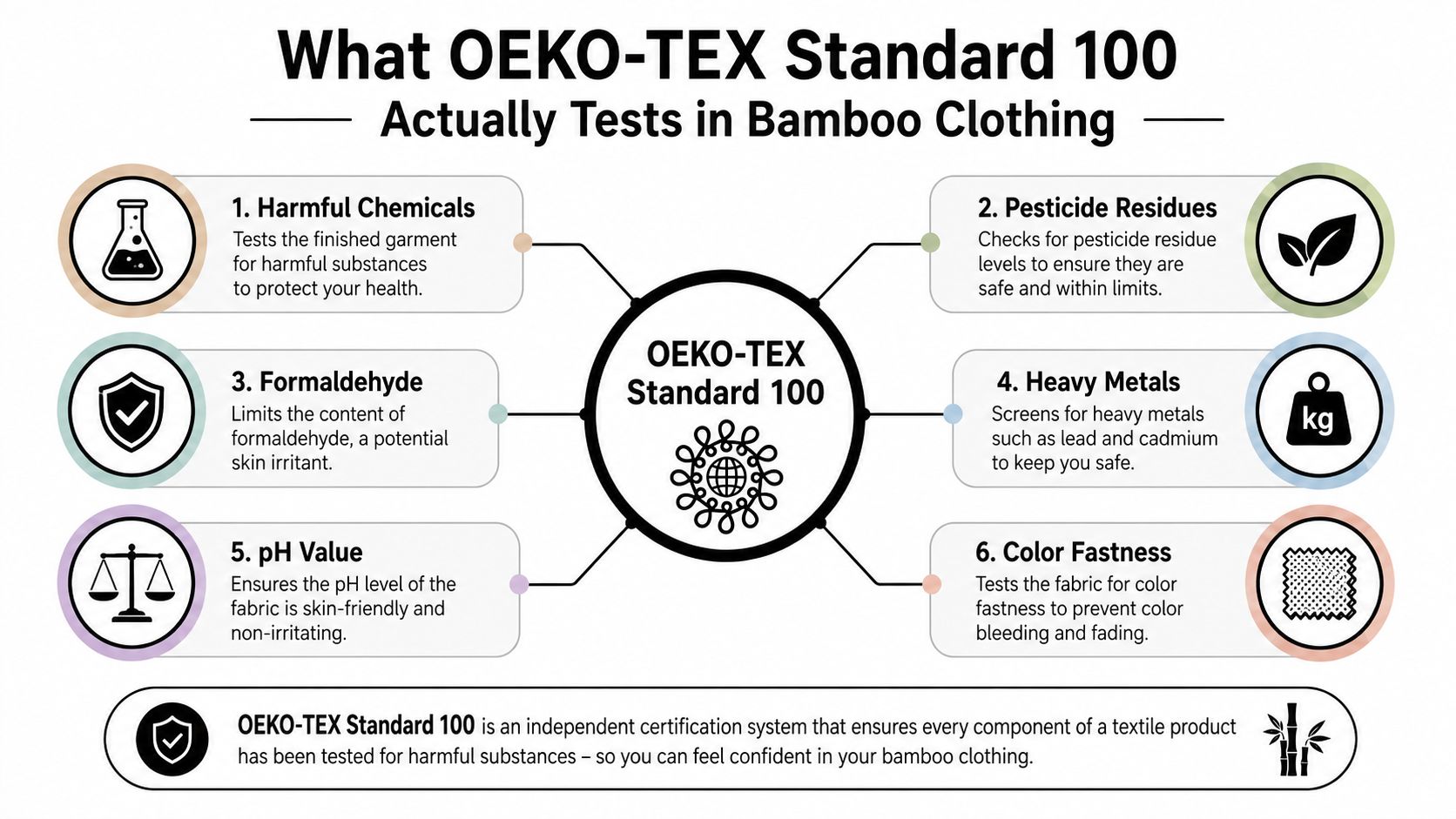
The main checks parents should understand
The published OEKO-TEX® limit tables set requirements for substances such as formaldehyde, heavy metals, and other chemical groups. The standard also assesses characteristics including pH and color fastness. These checks matter because smooth fabric cannot reveal every residue or component that requires objective testing. The OEKO-TEX® limit-value document explains the standard's substance requirements.
OEKO-TEX® assigns product classes according to intended use and expected skin contact. Product Class I is the strictest category, designed for products intended for babies and children within a defined young age range. Parents shopping for infant sleepwear, bodysuits, rompers, or other garments worn directly against the skin should look for this class.
The certificate applies to the certified product and its stated components. It does not automatically cover every garment from the same brand, every colorway, or products made at another facility. Check that the certificate matches the item under consideration. One certified garment does not prove that an entire collection has the same status.
What the label promises
The certification process can be understood in three steps:
- The garment is submitted for testing.
- The textile and relevant components are assessed against applicable requirements.
- The certificate applies to the tested product scope and product class.
That provides a defined safety layer, stronger than an unsupported “non-toxic” statement because it relates to a tested finished article. It still does not certify that bamboo clothing is organic, sustainably produced, ethically made, or free from every possible risk. It also does not replace checking the certificate's scope, the infant product class, or the brand's manufacturing information.
For parents, the label answers a specific question: whether the identified textile product and its covered components met the applicable OEKO-TEX requirements. Keeping that boundary clear prevents a safety certification from becoming a broader marketing promise.
Why Bamboo Viscose Is Comfortable for Sensitive Skin
Bamboo viscose isn't a strand of bamboo woven directly into a shirt. It's a regenerated cellulose fiber, meaning cellulose from bamboo is dissolved and then formed into textile fibers. A plain-language explanation of viscose composition facts can help clarify why the finished material behaves differently from the original plant.
Parents often choose it because the fabric feels smooth, drapes easily, and manages moisture comfortably. You can think of the fabric as a breathable sponge. It takes up moisture from the skin and spreads it through the textile, where it can dry more readily than a dense, poorly ventilated material. That doesn't make every bamboo garment identical, since knit structure, weight, finishing, fit, and laundering all affect how it feels.
The comfort advantage is practical rather than mystical. A soft, flexible fabric can reduce the roughness and stiffness that some children dislike, while moisture behavior can make pajamas more comfortable during warm nights or active play. For a straightforward explanation of the fiber itself, Little Venture Co.’s overview of bamboo viscose fabric is a helpful companion.
Don't confuse softness with antimicrobial protection
Bamboo clothing is frequently marketed as naturally antibacterial. That claim needs careful handling because the properties of the bamboo plant don't automatically remain after the plant has been chemically regenerated into textile fiber.
Peer-reviewed comparisons found that regenerated bamboo fabrics could show strong moisture management and wettability, but they didn't outperform viscose rayon in antibacterial testing. The comparisons also didn't prove that bamboo's natural antimicrobial properties survive the regeneration process. The comparative study of regenerated bamboo, cotton, and viscose rayon supports a more measured interpretation.
Treat bamboo viscose as a softness and absorbency choice, not as a guaranteed germ-control fabric.
OEKO-TEX® adds a different kind of value. It doesn't make bamboo antimicrobial. Instead, it provides a safety assurance layer focused on harmful substances in the finished garment. For sensitive skin, that distinction is healthier than allowing one appealing marketing word to carry several unrelated promises.
How OEKO-TEX Compares to Organic, GOTS, and Other Eco Labels
Parents often see several labels together and assume they all certify the same thing. They don't. OEKO-TEX® answers a product-safety question, while organic, supply-chain, environmental, and labor labels address different parts of production.
| Label | What It Tests | What It Does Not Test |
|---|---|---|
| OEKO-TEX® Standard 100 | Harmful substances in the finished textile and its components | Whether the fiber was organically grown, whether the process had a low environmental impact, or whether labor conditions were fair |
| GOTS | Organic fiber requirements, processing criteria, and broader supply-chain standards | The same finished-product scope as OEKO-TEX® unless the garment also carries the relevant testing |
| Organic certification | Whether qualifying raw materials meet organic production requirements | The complete manufacturing footprint or every finished-garment chemical question |
| Fair Trade | Labor and trading conditions covered by the specific program | Fabric chemistry, fiber origin, or organic status |
| FSC® or similar sourcing claims | Responsible sourcing of qualifying forest-based materials | Finished garment safety, dye residues, or working conditions |
A garment can carry OEKO-TEX® Standard 100 without being organic. That's because the certification evaluates harmful substances in the item, not whether bamboo was grown under organic rules. The reverse can also create confusion. A product with an organic or sourcing claim may still need a separate finished-product certification if you want a clearly stated textile-safety check.
For a closer explanation of the organic textile framework, Little Venture Co.’s guide to GOTS certification is a useful starting point. Brands and designers looking for broader eco-conscious branding solutions may also encounter these labels in conversations about materials, production, and responsible presentation.
Matching the label to your concern
If your main concern is chemical safety against your baby's skin, start with a verifiable OEKO-TEX® Standard 100 certificate and check the product class. If your priority is organic agriculture and processing requirements, look for GOTS or an appropriate organic certification. If your concern is worker treatment, investigate Fair Trade or the brand's labor disclosures.
You don't have to choose one concern forever. Layered certifications can answer different questions, as long as you understand what each one covers.
The Honest Gap Between Certified and Risk-Free
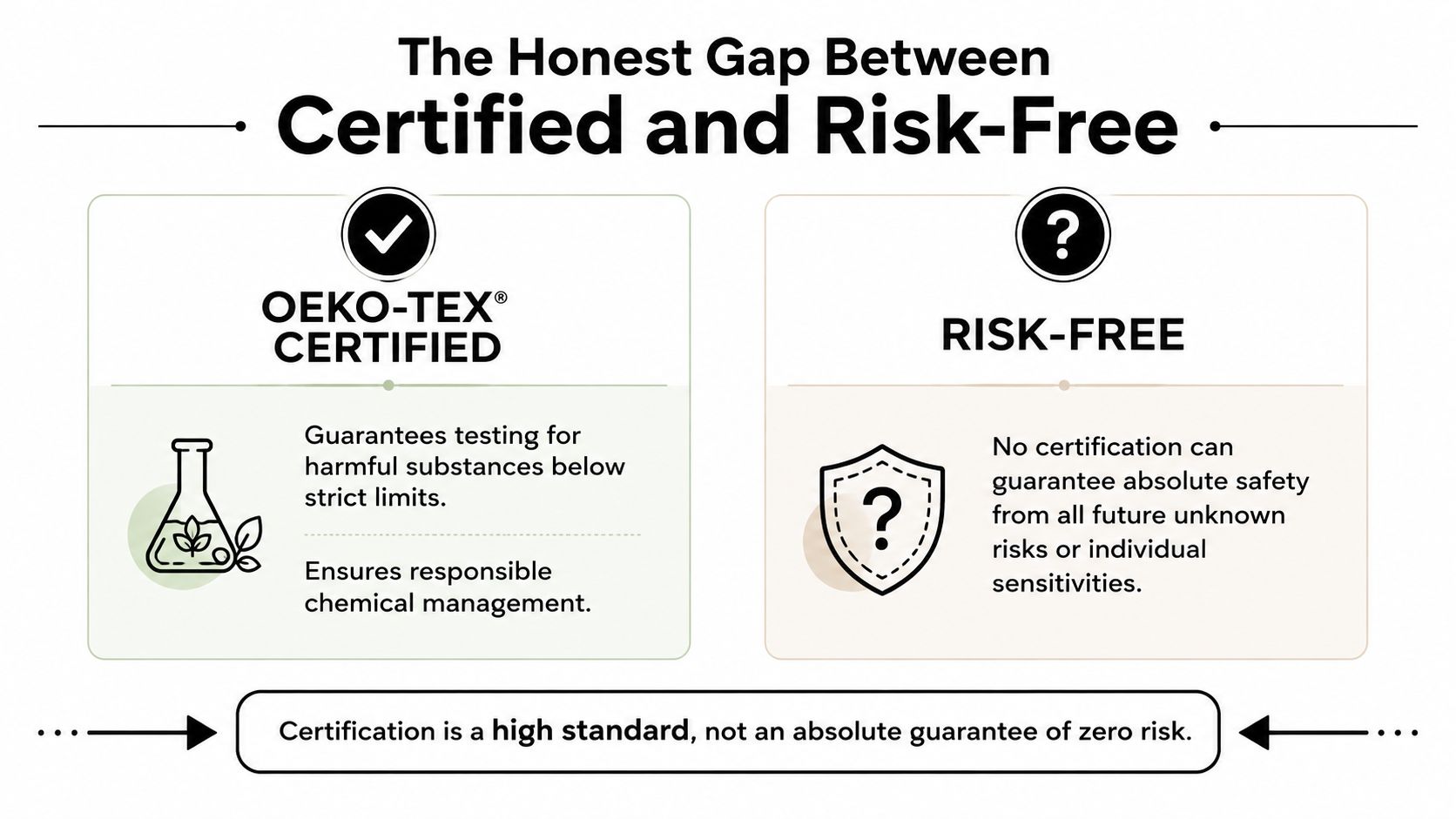
An OEKO-TEX® certificate is meaningful, but certified doesn't mean risk-free in every possible sense. The standard tests for specified substances under defined limits. It doesn't certify that the bamboo was grown organically, that the upstream viscose facility had a clean environmental record, or that every person involved in production was treated fairly.
Bamboo viscose can involve processing chemicals such as carbon disulfide and sodium hydroxide. A finished-product certification addresses the tested garment and its measured chemical requirements. It doesn't erase the manufacturing questions upstream. That's the central distinction many product pages leave unstated: safe on skin is not automatically the same as low-impact or ethically produced.
The infant-specific question
Parents of newborns and toddlers may reasonably ask whether general textile thresholds fully answer the question of prolonged infant exposure. One toxicology-focused discussion notes that OEKO-TEX allows up to 100 mg/kg of carbon disulfide in textile products, while also raising questions about whether that threshold is appropriate for infants because chronic dermal exposure assessments are limited. The discussion of bamboo viscose safety in infant and children's textiles presents that uncertainty directly.
That information shouldn't turn bedtime clothing into a source of panic. It should help you ask better questions. A Class I certificate is a substantial safeguard, but it's still one part of a responsible decision. If your child has eczema, recurrent rashes, or a known sensitivity, discuss persistent symptoms with a qualified healthcare professional rather than treating any textile label as medical advice.
What responsible reassurance looks like
A careful brand should be able to explain the fiber as bamboo viscose or another specific regenerated fiber, identify the relevant certification, and provide information about manufacturing and sourcing. It shouldn't imply that OEKO-TEX® proves organic agriculture or a clean production process.
Certification reduces uncertainty. It doesn't promise that uncertainty has disappeared.
That framing gives parents room to value comfort and testing without accepting exaggerated environmental or health claims.
How to Verify an OEKO-TEX Claim Before You Buy
Seeing the OEKO-TEX® logo on a product page is a useful start, but it isn't the same as verifying the claim. A brand may use imprecise language, show an old document, or display a certificate that applies to a different product. A quick check can help you separate a specific certification from general safety wording.
Use the label as your starting point
Look for the official OEKO-TEX® mark and a certificate number or label reference. The product description should identify the standard, not merely say “OEKO certified,” “tested fabric,” or “non-toxic.” Those phrases can sound reassuring without telling you which program tested the item.
Then use OEKO-TEX®’s official label-checking page to search the reference. Confirm that the certificate is current, that the product scope makes sense for the garment, and that the certifying institute is identified.
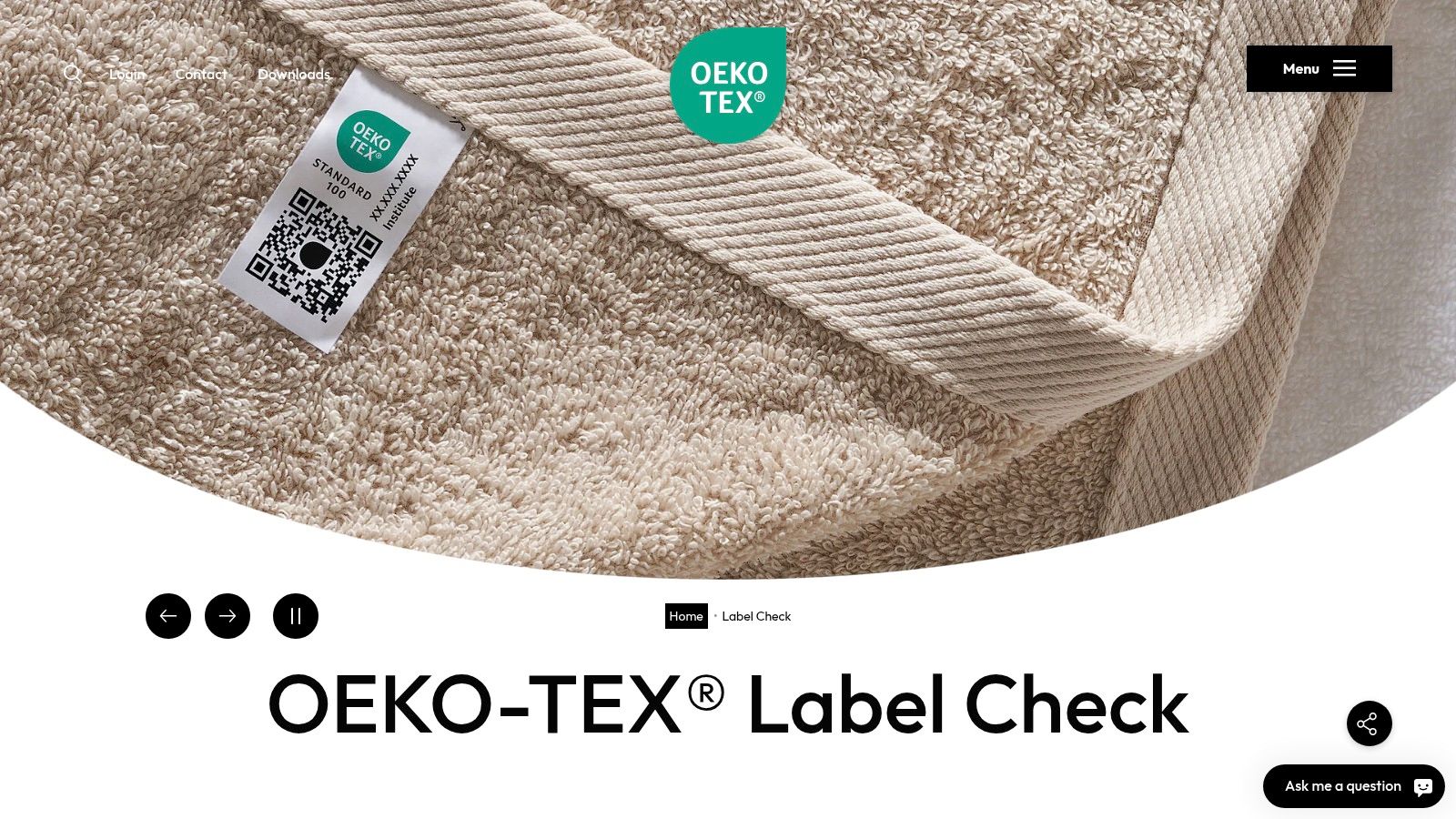
A quick shopping routine
- Find the certificate reference. Check the hangtag, care label, product page, or brand's certification page.
- Search the official database. Enter the reference rather than relying on a logo alone.
- Match the scope. Make sure it covers the clothing type or textile used in the item you want.
- Check the product class. For infant garments, look for Class I.
- Notice the wording. “Made with OEKO-TEX certified fabric” may describe material used in one product, while “this garment is certified” makes a narrower and more useful claim.
Be cautious with a downloadable PDF that has no visible validity information. A cached or outdated certificate can remain online after the product, factory, or certification period changes. A brand that responds clearly to a request for the certificate number is easier to evaluate than one that relies only on broad phrases.
For more context on evaluating a bamboo clothing company, Little Venture Co.’s bamboo clothing brand guide can help you think beyond the logo and examine the product description as a whole.
Buying and Caring for Certified Bamboo Clothing
Certification matters at the point of purchase, but everyday handling still affects how the garment feels and performs. Start with the product details, not just the fiber name. Confirm that the item is identified as bamboo viscose or another specific material, check the OEKO-TEX® claim, and look for a product class suited to infant use.
Pay attention to construction, too. Flat or covered seams can be more comfortable for babies, and secure snaps or zippers matter for practical use. Use the brand's size chart rather than guessing from age alone. If you're between sizes, allowing a little growing room can make sense, but don't choose sleepwear so loose that it creates a safety concern.
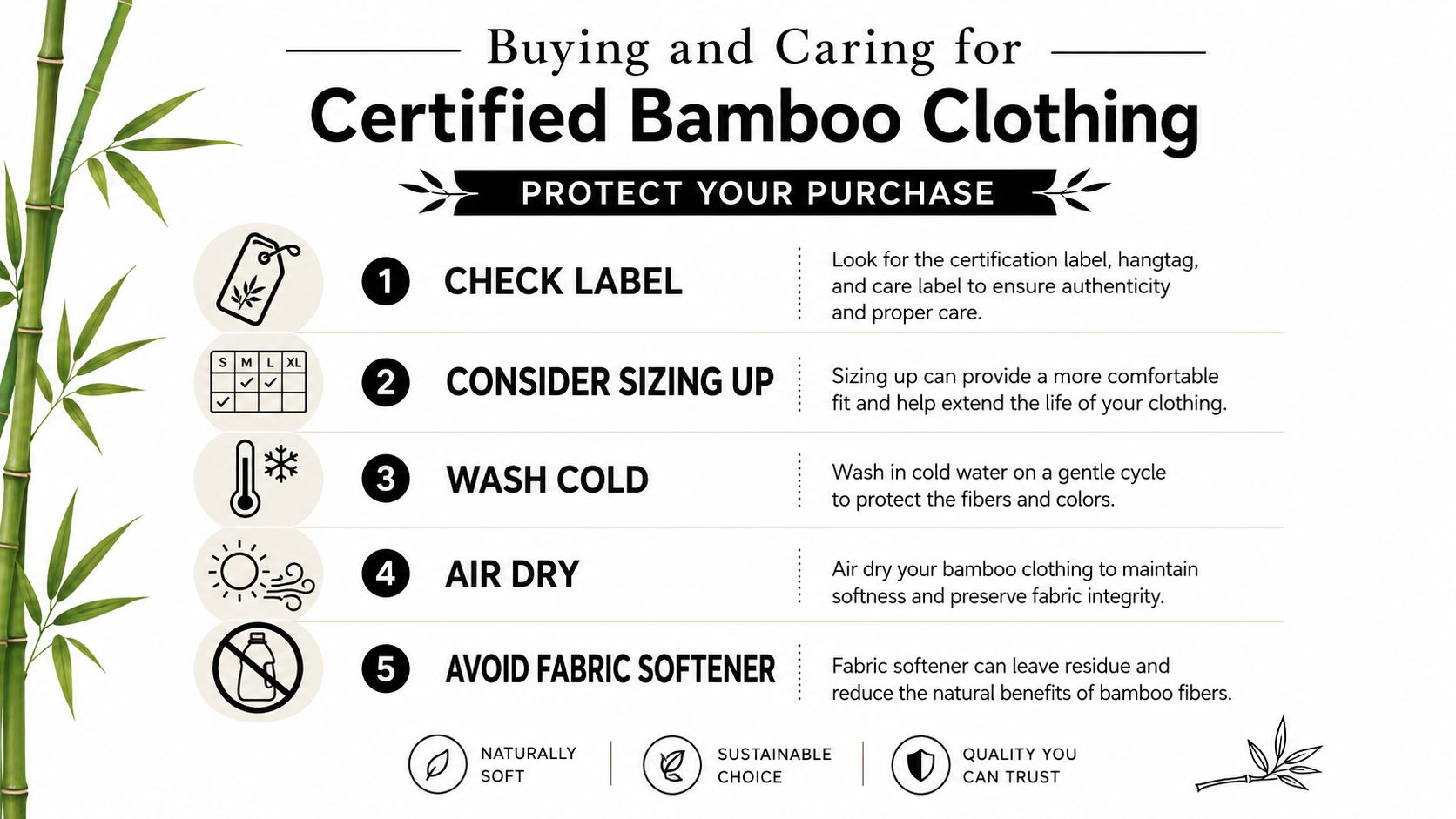
A gentle care routine
- Wash before first wear. This removes packaging dust, handling residues, and any smell from storage.
- Choose a fragrance-free detergent. It can be a sensible option when your child's skin is reactive.
- Skip fabric softener. Softener can leave a coating on fibers and add fragrance or other residues that aren't necessary for a comfortable garment.
- Use cooler water and a gentle cycle. Follow the care label, while avoiding harsher treatment that can shorten the fabric's useful life.
- Air dry when practical. Gentle drying can help preserve the fabric's feel and reduce unnecessary heat exposure.
Washing doesn't recreate the certification or extend it to unrelated products. It does help you avoid adding unnecessary fragrance and coating residues to a garment that was selected for close skin contact.
Here's a practical demonstration of a simple bamboo clothing care approach:
Bringing It All Together for Confident Choices
A calm buying decision can come down to three questions:
- Does the specific garment have a verifiable OEKO-TEX® Standard 100 certificate?
- Is it Class I if it's intended for infant contact or sleepwear?
- Does the brand explain the fiber and provide reasonable information about sourcing and manufacturing?
The first two address finished-product testing. The third helps you avoid assuming that a safety label also proves organic farming, low-impact processing, or ethical production. For broader guidance on making thoughtful clothing choices, this page description about shopping sustainably can provide additional context.
Little Venture Co. offers bamboo viscose sleepwear and daywear for babies and toddlers described as OEKO-TEX® Standard 100 certified, alongside a faith-inspired mission and charitable support for Heartbeat International. That combination may suit families who want soft children's clothing while keeping product-safety information visible and specific.
The goal isn't perfect shopping. It's knowing which questions a label answers, which ones it leaves open, and how to verify the difference.
Little Venture Co. offers faith-inspired bamboo sleepwear, rompers, two-piece sets, and children's accessories with OEKO-TEX® Standard 100 certified materials. Visit Little Venture Co. to explore comfortable baby and toddler clothing while choosing with clearer product-safety information.