

Ultimate 12 Month Sleeper Guide: Safety & Sizing Tips
You order pajamas for your baby's first birthday, open the package, and then notice the labels: 12M, “snug fit,” “flame resistant,” perhaps even a TOG rating you've never had to interpret before. The garment looks simple, but the decision suddenly feels bigger than choosing a cute print.
A 12 month sleeper sits at an important transition point. Your baby may be moving, cruising, standing, exploring, and needing easier diaper changes, while U.S. sleepwear rules become more relevant for garments sized beyond early infancy. The label is only a starting point. Fit, construction, warmth, materials, and local safety requirements all matter.
This guide explains how to measure your child, use a practical sizing decision tree, understand flammability rules, choose thermal weight, care for bamboo-viscose sleepwear, and select a meaningful faith-inspired gift. By the end, you'll have a calmer way to choose sleepwear that supports comfort, safe movement, and peace of mind.
Introduction to 12 Month Sleepers
Your baby's first birthday can expose a sizing problem quickly. A sleeper that fit last season may now pull at the ankles, feel tight over a diaper, or limit crawling and bending. The label 12M offers a starting point, not a guarantee, because brands use different proportions.
Twelve months also marks a change in sleepwear decisions. Safe-sleep guidance commonly recommends room-sharing with caregivers during the first 6 to 12 months. Guidance also indicates that parents may discuss introducing a small, thin blanket after a baby reaches 12 months. Before then, a fitted sleeper or wearable garment keeps warmth around the body without loose bedding in the crib. A useful rule of thumb is to dress the baby in about one more clothing layer than an adult would wear in the same room.
The legal picture shifts too. The United States introduced a federal flame-resistance standard for children's sleepwear in 1972 and amended it in 1996. That amendment exempted snug-fitting sleepwear and sleepwear for children 9 months old or younger. A garment labeled 12M generally falls beyond that age exemption, so check whether its design is snug-fitting or meets the applicable flammability requirements.
The age label works like a rough map. Your child's height, weight, body shape, and the garment's construction determine whether the destination is a safe fit.
The practical takeaway: “12M” suggests an age range, but it does not confirm a safe fit or compliance with every applicable rule.
A thoughtful choice brings several factors together. Leave enough room for movement and diaper changes, while avoiding excess fabric that can ride up. Match the sleeper's warmth to the room, look for skin-friendly components, and choose care instructions that fit your weekly routine. That approach also makes gift buying easier: use the child's measurements first, then select the size and message that suit the family.
How to Measure and Choose the Right Size
Age labels are useful shortcuts, but measurements are the safer starting point. A retailer's 12M listing may place the size around 28 to 30 inches in height and 20 to 24 pounds in weight, yet another brand may use different proportions. This 12M retail size listing illustrates why you should compare your child's measurements with the specific brand chart instead of buying by birthday alone.
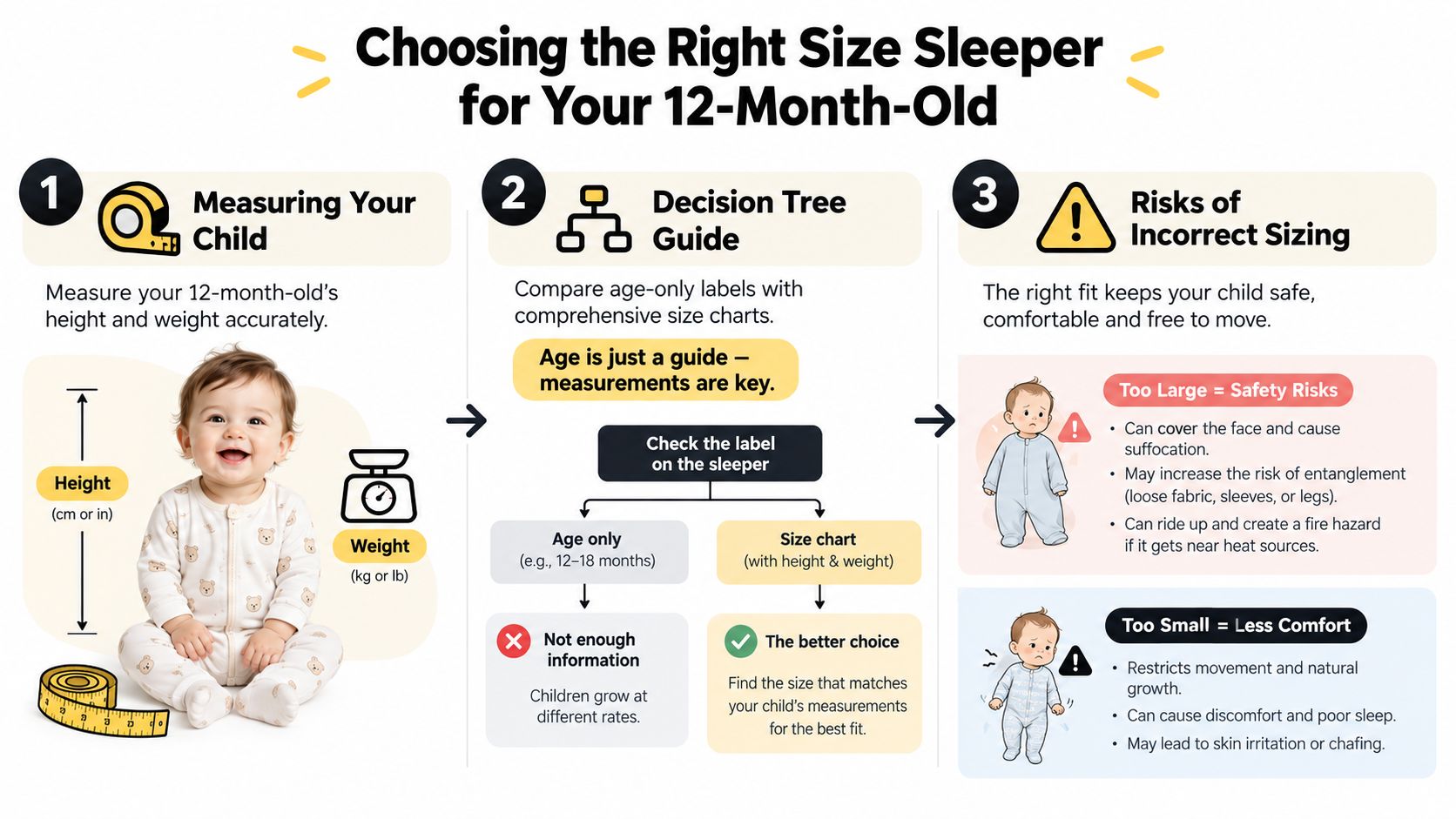
Measure height and weight first
Measure your baby without shoes and with as little bulky clothing as practical. For height, have your child stand against a wall if they can stand steadily. If they're still crawling or pulling up, lay them flat and measure from the top of the head to the heel, keeping the legs as straight as your child allows.
For weight, use a reliable baby scale or weigh yourself while holding your baby, then weigh yourself alone and compare the readings. The second method gives you an estimate, so use the brand's chart and your child's overall fit rather than treating the number as exact.
Record three observations alongside the measurements:
- Chest and torso: The fabric should lie close to the body without pulling across the chest.
- Arms and legs: Sleeves and legs shouldn't end so tightly that they restrict movement.
- Diaper area: You should be able to fasten the sleeper without compressing the diaper or stretching the zipper.
Use this sizing decision tree
Start with the manufacturer's complete chart. If the chart includes height and weight, use those measurements before the age label. If it only lists age, check the garment's fit notes, fabric content, and return policy before choosing.
Use this simple sequence:
- Does your child fit within the brand's height and weight range? Choose that size if the chest, arms, and diaper area also look comfortable.
- Do height and weight point to different sizes? Prioritize the measurement that affects garment safety and mobility most, then inspect the fit carefully.
- Is the sleeper loose around the neck, chest, or limbs? Don't rely on rolling or tucking excess fabric. Choose a closer-fitting option.
- Is it tight across the torso or diaper? Size up or choose a roomier cut, but confirm that the new size still fits securely.
- Does the fabric shrink? Follow the care label and account for possible shrinkage before deciding whether the garment already fits.
Oversized sleepwear can ride up over a baby's nose and mouth, while undersized sleepwear can restrict movement and make diaper changes uncomfortable. Canadian sleepwear safety guidance supports choosing sleepwear that's fitted and appropriate for the child's size.
For bamboo viscose, avoid buying dramatically large with the idea that your child will “grow into it.” A little practical room for movement is different from loose fabric around the neck, chest, or legs. If you're comparing several brands, a baby clothing size chart can help you organize measurements before you place an order.
Essential Safety Guidelines for Sleepwear
A 12 month sleeper is more than a soft outfit for bedtime. It may fall under a different safety category from clothing intended for younger infants. In the United States, children's sleepwear sized larger than nine months generally must meet flammability requirements unless it qualifies as flame resistant or meets the applicable tight-fitting criteria. The standards appear in 16 CFR 1615 and 16 CFR 1616, as explained in the NIST children's sleepwear compliance guidance.
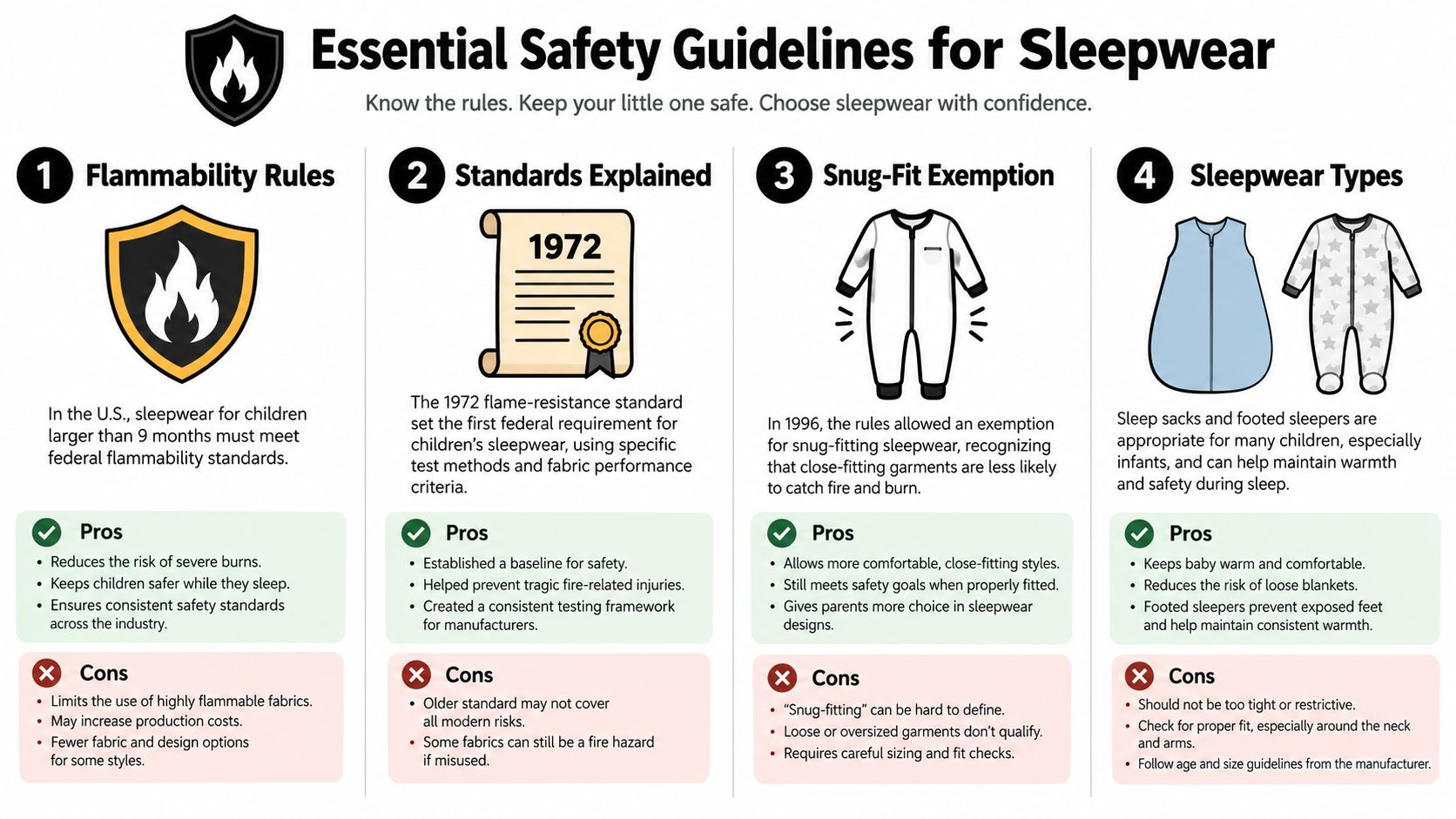
Understand the regulatory shift
The U.S. introduced a federal flame-resistance standard for children's sleepwear in 1972. In 1996, the Consumer Product Safety Commission amended the rule to exempt snug-fitting sleepwear and sleepwear for children 9 months old or younger. That change makes the 12-month point important: a garment labeled 12M generally falls beyond the early infant exemption, so its fit, construction, and compliance category deserve a closer look.
A brand should clearly identify whether the garment is:
- Tight-fitting sleepwear that qualifies for the relevant exemption.
- Flame-resistant sleepwear that has met applicable requirements.
- An infant garment category with a specific compliance basis.
The size label cannot answer these questions by itself. Seams, measurements, fabric behavior, closures, and trim may all affect how the garment is classified and used.
Check the design before bedtime
Inspect the sleeper in good light, much like checking a car seat before a trip. The neck opening should stay secure without pressing against the throat. Sleeves and cuffs should remain in place, while the torso should avoid ballooning with extra fabric. Test the zipper and snaps, examine decorative pieces for firm attachment, and remove the garment if loose threads could wrap around fingers or toes.
Use this quick checklist:
- Do choose: A close-fitting sleeper with secure seams, intact cuffs, and a closure free from sharp or loose components.
- Don't choose: A garment large enough for fabric to cover the face, bunch around the body, or move upward during sleep.
- Do check: Whether the product is marketed as sleepwear and what compliance information the seller provides.
- Don't assume: Soft fabric, a natural-fiber label, or an age marking automatically confirms compliance.
The crib area needs attention too. Keep loose blankets and other soft items out of the sleep space unless advice appropriate to your child's age and circumstances supports using them. A footed sleeper or sleep sack can provide warmth without a loose blanket, provided it fits correctly and does not compress the hips, chest, or neck.
Watch this practical overview before buying or using a new garment, particularly if you are unsure how a sleeper differs from general loungewear.
Parents comparing fabric choices and product descriptions can review this guide to flame-retardant-free pajamas for shopping context. Confirm the rules that apply where you live, because sleepwear requirements differ by country.
Understanding TOG Ratings and Room Temperatures
TOG, or Thermal Overall Grade, describes how much warmth a sleep garment provides. A higher TOG generally indicates a warmer garment, while a lower TOG suits a warmer room. The number is only one part of the decision because your child's base layer, the fit of the sleeper, and the room temperature all affect comfort.
A practical starting point is to dress your baby in about one more layer than an adult would wear in the same room. Guidance on 12-month sleepers and room temperature also notes that parents may discuss introducing a thin blanket once a baby is 12 months old and the room is above 70°F. Follow your pediatric professional's advice if your child has specific medical or temperature-regulation needs.
Use the room as your first reference
Rather than choosing a TOG rating from the calendar, check the nursery temperature and your child's chest or back. Cool hands and feet don't always mean your baby's core is cold, so feel the torso rather than relying only on fingers.
| Room condition | Possible sleeper approach | What to check |
|---|---|---|
| Warm room | A lighter, lower-TOG sleeper or a light base layer | Warm chest, sweating, flushed skin |
| Moderate room | A midweight sleeper with a suitable base layer | Comfortable torso and free movement |
| Cool room | A warmer sleeper or a correctly fitted sleep sack | Cold chest, bulky layering, restricted movement |
Retailers commonly describe lightweight garments with TOG values such as 0.5, midweight options as 1.0, and warmer garments as 2.5, but use the product's own guidance rather than treating those labels as universal temperature prescriptions. You can learn more about how the rating works in this explanation of what a TOG rating means.
Avoid solving a chilly room by piling on loose layers. Several thin garments may bunch under a sleeper, while a thick garment may cause overheating. Make one change at a time, check the fit around the diaper and neck, and keep the sleep space free of unnecessary soft items.
Benefits of Bamboo Viscose and OEKO-TEX Certification
Bamboo viscose appeals to many parents because it feels smooth against sensitive skin and can make a lightweight sleeper comfortable across changing indoor conditions. The fabric is often chosen for its breathability, moisture management, and soft drape, which can help a baby feel less clammy during sleep. Those qualities improve the wearing experience, but they don't replace fit checks or product-safety verification.
The phrase “bamboo” also needs careful interpretation. Bamboo viscose is a manufactured cellulosic fiber made by processing bamboo-derived material into a usable textile fiber. The finished fabric's softness and performance depend on the fiber blend, knit, weight, finishing, and garment construction, so read the product specification instead of assuming every bamboo garment behaves identically.
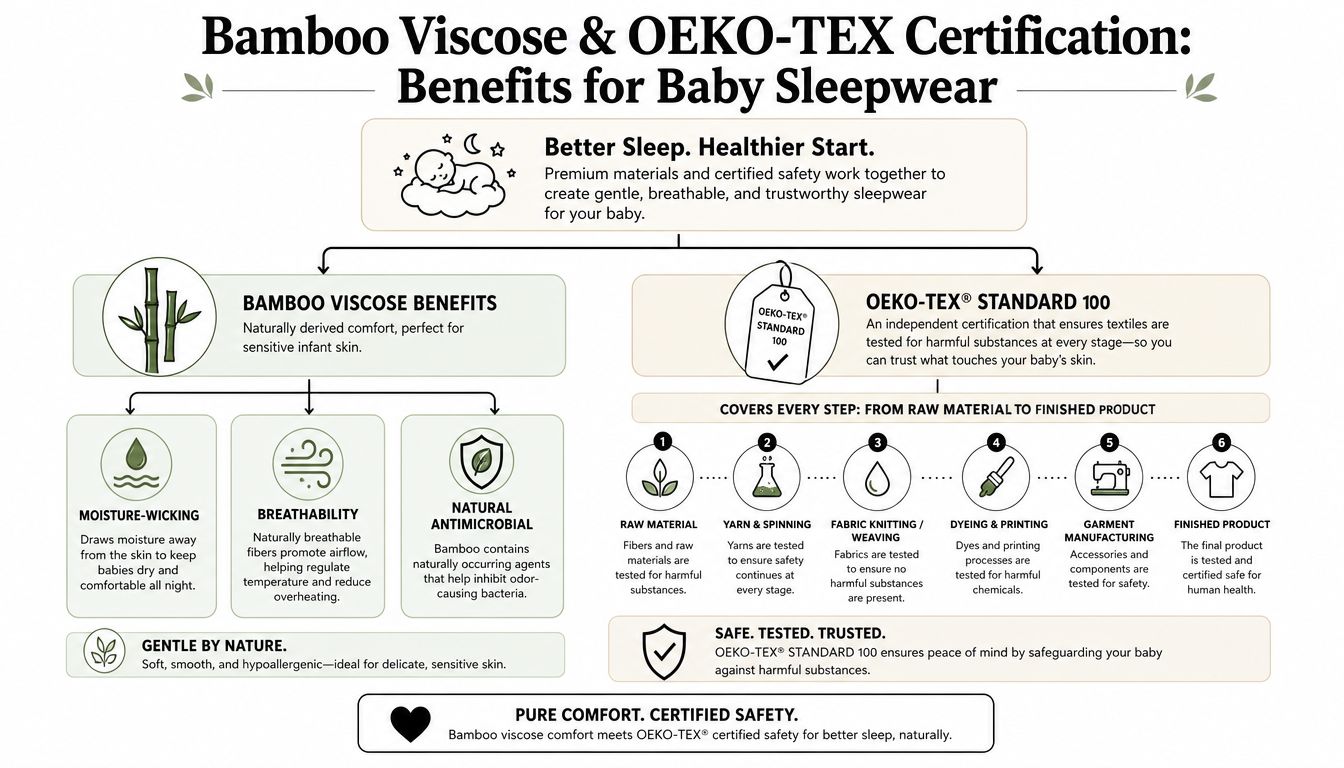
Look beyond the main fabric
For a baby garment, the fabric is only one point of contact. A zipper can touch the chin, thread can sit against the wrist, and printed designs can rest against the torso. That's why a fabric-only chemical claim gives you less information than a certification that evaluates the finished product and its components.
OEKO-TEX STANDARD 100 applies to textile products, accessory materials, and production stages. For baby products, its scope explicitly includes articles intended for children up to 36 months. The standard can cover the main textile as well as zippers, snaps, threads, prints, and other trim that may contact an infant's skin. The OEKO-TEX STANDARD 100 document provides the relevant standard information.
That distinction changes how you shop. Instead of asking only whether the sleeper is made from bamboo viscose, ask whether the finished garment and its components have been tested under a recognized standard.
For parents comparing materials, this overview of bamboo-viscose clothing can help explain why fiber feel, breathability, and certification should be considered together. Certification doesn't determine whether a sleeper fits your child or has the right warmth, but it adds a useful layer of verification to the purchasing decision.
Caring for Sleepers and Comparing Fits
Bamboo-viscose sleepwear needs gentle handling if you want to preserve its softness and shape. Start by checking the garment's sewn-in care label, then use a gentle wash cycle and mild detergent. Avoid harsh treatment that can weaken the knit or change the feel against your baby's skin.
Drying deserves equal attention. Use low heat in the tumble dryer or line-dry the sleeper, and remove it promptly when dry. High heat can encourage shrinkage or alter the fit, which matters when a close-fitting garment already has limited room around the chest, sleeves, and legs.
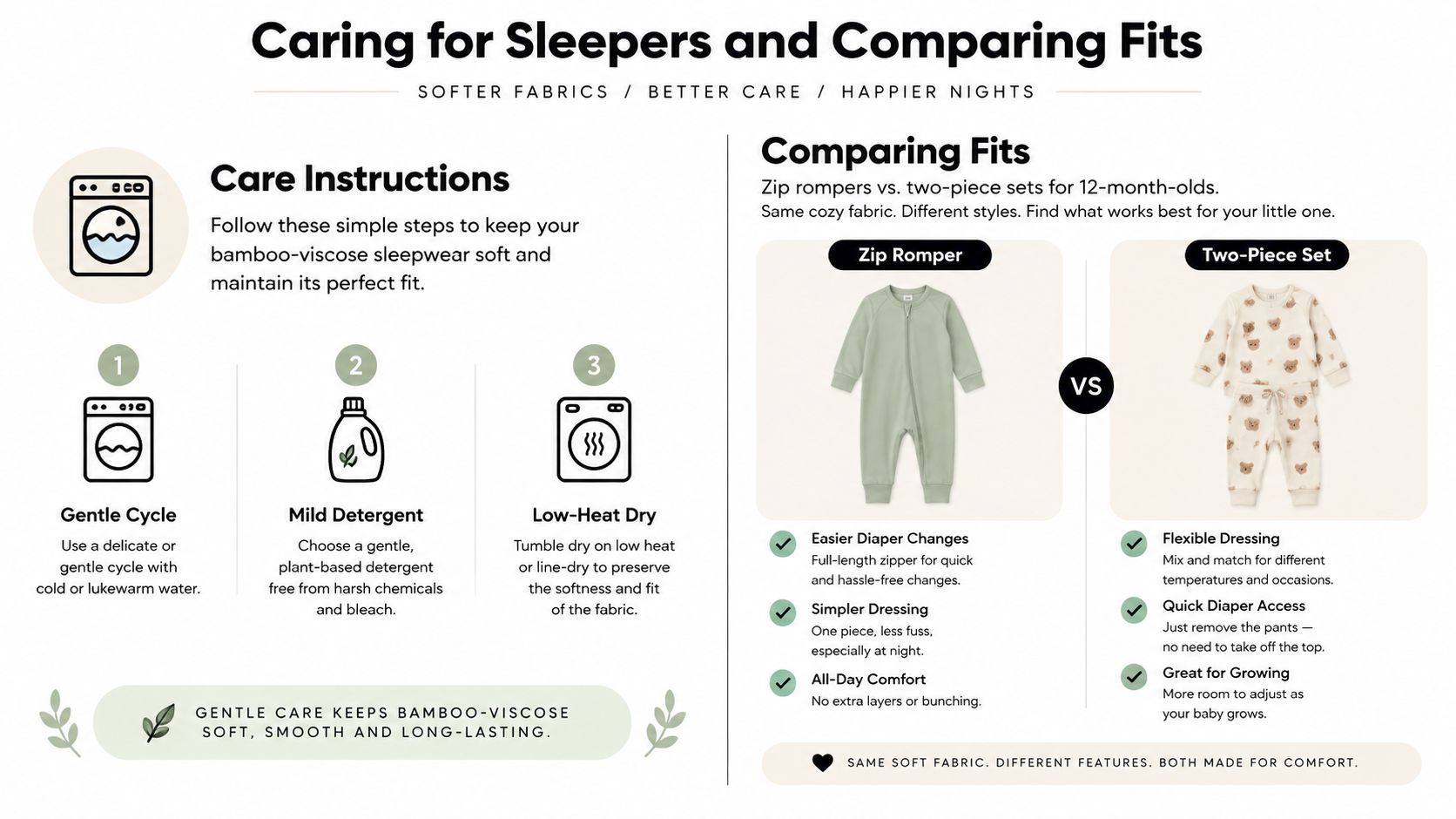
Match the style to your routine
A zip romper is a one-piece garment, so there's less to coordinate during a nighttime change. A two-piece set separates the top and bottom, which can make layering easier and may give a mobile baby more flexibility during daytime play. Neither style is automatically safer. The deciding factors are fit, secure construction, appropriate warmth, and whether the clothing stays in place.
| Feature | Zip Romper | Two-Piece Set |
|---|---|---|
| Diaper changes | One closure can make access quick, especially with a well-placed zipper | You may need to move both pieces, though the top can stay on |
| Dressing | One garment creates a simple bedtime routine | Separate pieces can be useful when temperatures or needs vary |
| Movement | A close-fitting cut can support crawling, standing, and cruising | A properly fitted waistband and top allow flexible movement |
| Layering | Easy to use as one coordinated layer | Easier to combine with a separate top or bottom when appropriate |
| Fit checks | Inspect zipper length, cuffs, and torso room | Check the waistband, shirt hem, and overlap between pieces |
A zipper that runs toward the ankle can simplify access, but it still needs a protective finish and secure construction near the face and neck. If the sleeper uses snaps, check every snap after washing. Replace a garment when a closure loosens, a seam opens, or trim starts to detach.
Keep care simple and consistent
Use this routine:
- Close closures: Fasten zippers and snaps before washing to reduce snagging.
- Wash gently: Use a gentle cycle with mild detergent and avoid overloading the machine.
- Dry carefully: Choose low-heat tumble drying or line-drying.
- Inspect afterward: Check the neck, cuffs, zipper, seams, and diaper area before the next wear.
- Recheck fit: A garment that shrinks or stretches may no longer sit correctly.
A zip romper may suit families who change diapers frequently overnight, while a two-piece set can work well for babies who need more flexible dressing during the day. Choose the design that fits your routine without compromising close, comfortable sleepwear fit.
Faith Inspired Gift Ideas for Christian Parents
A 12 month sleeper can be more than a practical present. It can mark a child's first birthday, a baptism, a baby shower, or a church welcome with a message that parents will remember each time they zip the garment before bed.
Choose gifts that connect comfort with a simple spiritual theme:
- Creation-inspired sleeper: Pair a soft sleeper with a card celebrating the wonder of a growing child.
- Hope-centered bundle: Add a small book or keepsake with a message about joy, hope, and the child's future.
- Blessing-themed blanket: If the family is ready for a thin blanket in an appropriate sleep setting, select a personalized keepsake separately from the fitted sleepwear.
- Nursery ministry set: Church groups can combine coordinated sleepwear with a practical note for new parents.
- Sibling gift: Match a baby's sleeper with a small accessory or coordinated item for an older sibling.
Write the message in your own voice rather than forcing a long quotation onto the gift. Examples include:
“May your little one sleep in comfort and grow surrounded by love, hope, and God's care.”
“A small reminder of the beauty of creation, wrapped for a very loved child.”
For nursery teams, choose consistent sizing, simple packaging, and a note that explains the garment's care instructions. A charitable contribution can make the gift feel even more purposeful. Little Venture Co. supports Heartbeat International, which aids pregnant women in need globally, so gift buyers can connect a child's new sleepwear with support for mothers and families.
For the child's room, a meaningful piece of art can complement clothing without turning the gift into a generic bundle. Browse Christian wall decor from Jessie's Home for faith-focused options that can suit a nursery, playroom, or family space.
Conclusion and Next Steps
Choosing a 12 month sleeper is easier when you treat sizing like checking a map. Start with your child's height and weight, then compare both measurements with the brand's chart. Use the age label only as a starting point. Before buying, check the chest, neck, arms, legs, and diaper area. Sleepwear should fit closely, because extra fabric can create safety concerns, and oversized clothing is not a reliable way to allow for growth.
The 12-month mark also changes the safety question. In the United States, sleepwear beyond the early infant category may need to meet flammability requirements or qualify as tight-fitting sleepwear. Read the product description and inspect closures, seams, and trim. A footed sleeper or sleep sack can add warmth without loose bedding.
For temperature, let the room guide your choice. Select a suitable TOG weight, dress your baby in roughly one more layer than an adult would wear, and check the torso for signs of overheating or coolness. Bamboo viscose can offer a soft, breathable option. OEKO-TEX STANDARD 100 certification provides information about tested components beyond the main fabric.
Care also affects fit. Wash gently with mild detergent, dry on low heat or line-dry, and inspect every closure and seam. For a gift, pair practical sleepwear with a personal blessing, a creation-inspired message, or a thoughtful nursery contribution.
Little Venture Co. offers bamboo zip rompers, two-piece sets, and children's daywear made with OEKO-TEX STANDARD 100 certified materials, including faith-inspired designs for babies and toddlers. Visit Little Venture Co. to explore sleepwear suited to your child's measurements and routine while supporting Heartbeat International's work with mothers in need.