

Flame Retardant Free Pajamas: A Parent's Safety Guide
You're standing beside your child's bed, smoothing a blanket over small shoulders, when you notice the pajama tag. It mentions snug fit, flammability, or fabric treatment, and suddenly a simple bedtime routine raises a bigger question: Can pajamas be free from added flame-retardant chemicals and still meet safety rules?
Yes, they can. The important distinction is that chemical-free does not mean regulation-free. Children's sleepwear can meet safety requirements through its fabric behavior and close fit, rather than through an added chemical treatment. Once you understand how those choices work, shopping becomes much less intimidating.
Why Parents Are Choosing Flame Retardant Free Pajamas
For many families, the concern starts with what touches a child's skin for hours at a time. “Flame retardant free” generally means the pajamas were made without added chemical treatments intended to slow combustion. Parents may prefer that approach because they want to reduce unnecessary finishes in clothing, especially when a child has sensitive skin or reacts easily to new textiles.
Some flame-retardant chemicals have raised questions about possible endocrine effects and skin irritation. Those concerns don't mean every treated garment is automatically dangerous, and they don't justify fear-based shopping. They do explain why families increasingly ask a more practical question: Can the garment meet the safety standard through construction instead of added chemicals?
What the label really means
A flame-retardant-free pajama set isn't ordinary clothing marketed for bedtime. In the United States, children's sleepwear must follow specific flammability rules. One compliant pathway uses tight-fitting construction, which reduces the loose fabric and air space that can help a flame spread.
That distinction matters for parents who shop for natural fibers, low-treatment clothing, or products aligned with faith-inspired values of careful stewardship. A useful starting point is this guide to chemical-free baby products, but always pair general material guidance with the actual sleepwear label and fit information.
Parents also don't need to treat the word “chemical” as a synonym for danger. Every material is made of chemicals in the scientific sense, including cotton and bamboo viscose. In this conversation, the relevant question is whether the garment contains added flame-retardant finishes, and whether the finished pajamas follow the applicable safety pathway.
A reassuring rule: Choose sleepwear that clearly identifies its compliance route, then check that the fit matches the label.
The rest of the decision comes down to three connected details: the regulation, the fabric, and the way the garment fits your child.
Understanding Flammability Standards and the Tight-Fitting Exemption
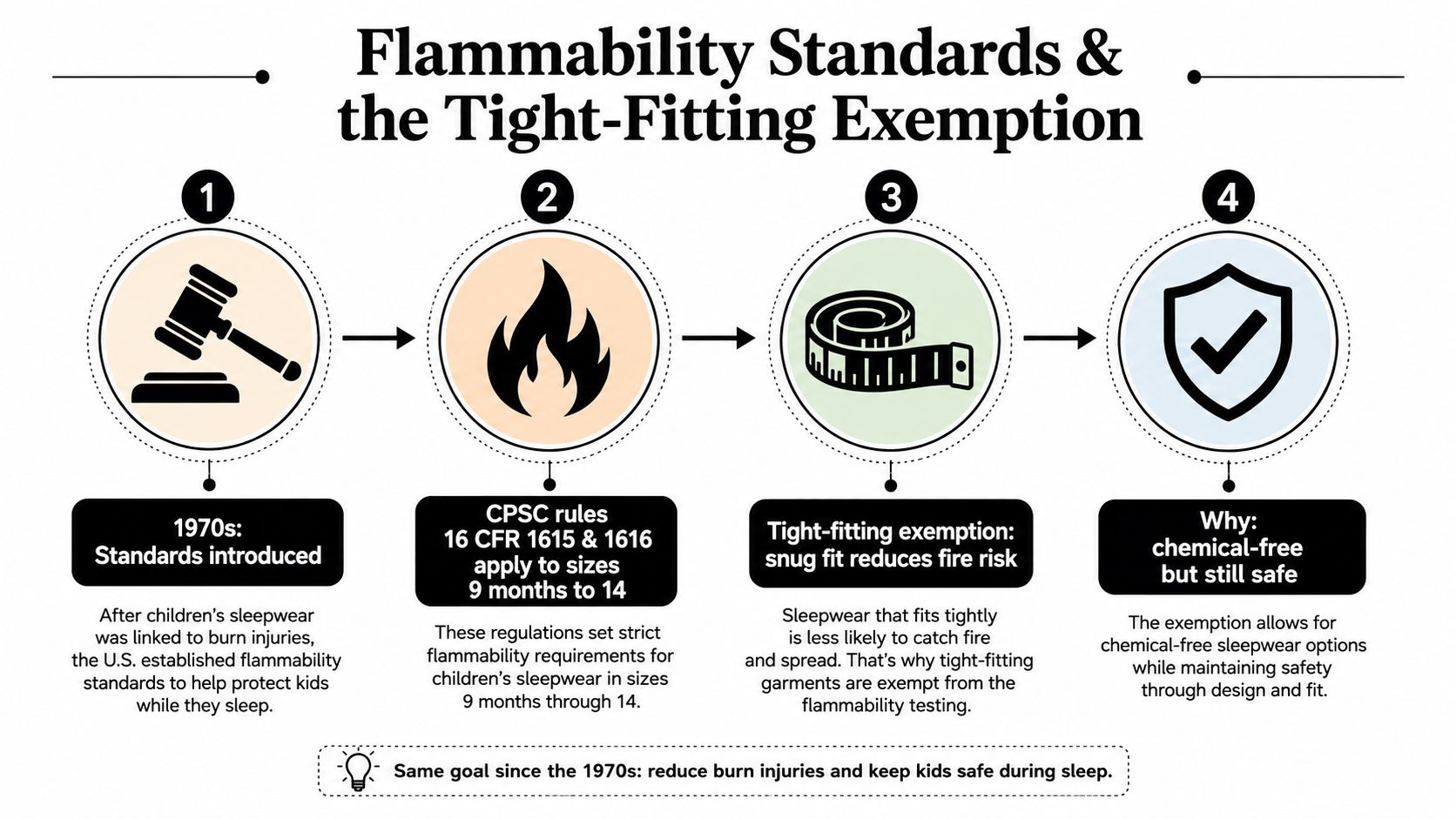
The United States has regulated children's sleepwear under federal flammability standards since the early 1970s. The standard for sizes 0 through 6X became effective in 1972, while the standard for sizes 7 through 14 became effective in 1975, as explained by the U.S. Consumer Product Safety Commission's children's sleepwear guidance. The current rules appear in 16 CFR Part 1615 and 16 CFR Part 1616.
Those rules protect children under 15 from death and serious burn injury caused by ignition from small open flames. They require covered sleepwear to follow one of two broad routes:
- Flame-resistant construction, where the garment is designed to resist ignition and self-extinguish.
- A tight-fitting exemption, where the garment's shape and dimensions meet the requirements for close-fitting sleepwear.
Why close fit changes the safety pathway
Loose sleepwear can create more space between the fabric and the body. That space can allow air to circulate around a flame and can give moving fabric more opportunity to come into contact with an ignition source. A close-fitting garment reduces that loose, billowing shape.
The tight-fitting exemption isn't a casual description such as “looks fairly fitted.” Manufacturers must design and evaluate garments against the applicable regulatory requirements, including prescribed dimensions and labeling. Parents typically won't calculate those measurements at home. Instead, they should look for the required snug-fit language, follow the manufacturer's sizing chart, and make sure the garment lies close to the body.
The flame-resistant sleepwear information from Little Venture Co. can help clarify the difference between sleepwear that relies on flame-resistant performance and sleepwear that uses a fit-based route.
The common misunderstanding
Many parents assume every child's pajama set must contain flame-retardant chemicals. That's incorrect. The CPSC rules allow compliant sleepwear to use either flame-resistant performance or the tight-fitting exemption, so chemical treatment isn't automatically required.
Canada's guidance makes a related point: removing flame-retardant chemicals doesn't remove the obligation to meet flammability requirements. Its children's sleepwear flammability guidance emphasizes that chemical-free sleepwear still needs compliant burn performance or a fit-based exemption.
That's why a snug-fit label is helpful. It tells you the garment's safety strategy is based on design, not on an assumption that ordinary loose clothing is suitable for sleep.
How Fabric and Fit Keep Kids Safe Without Chemicals
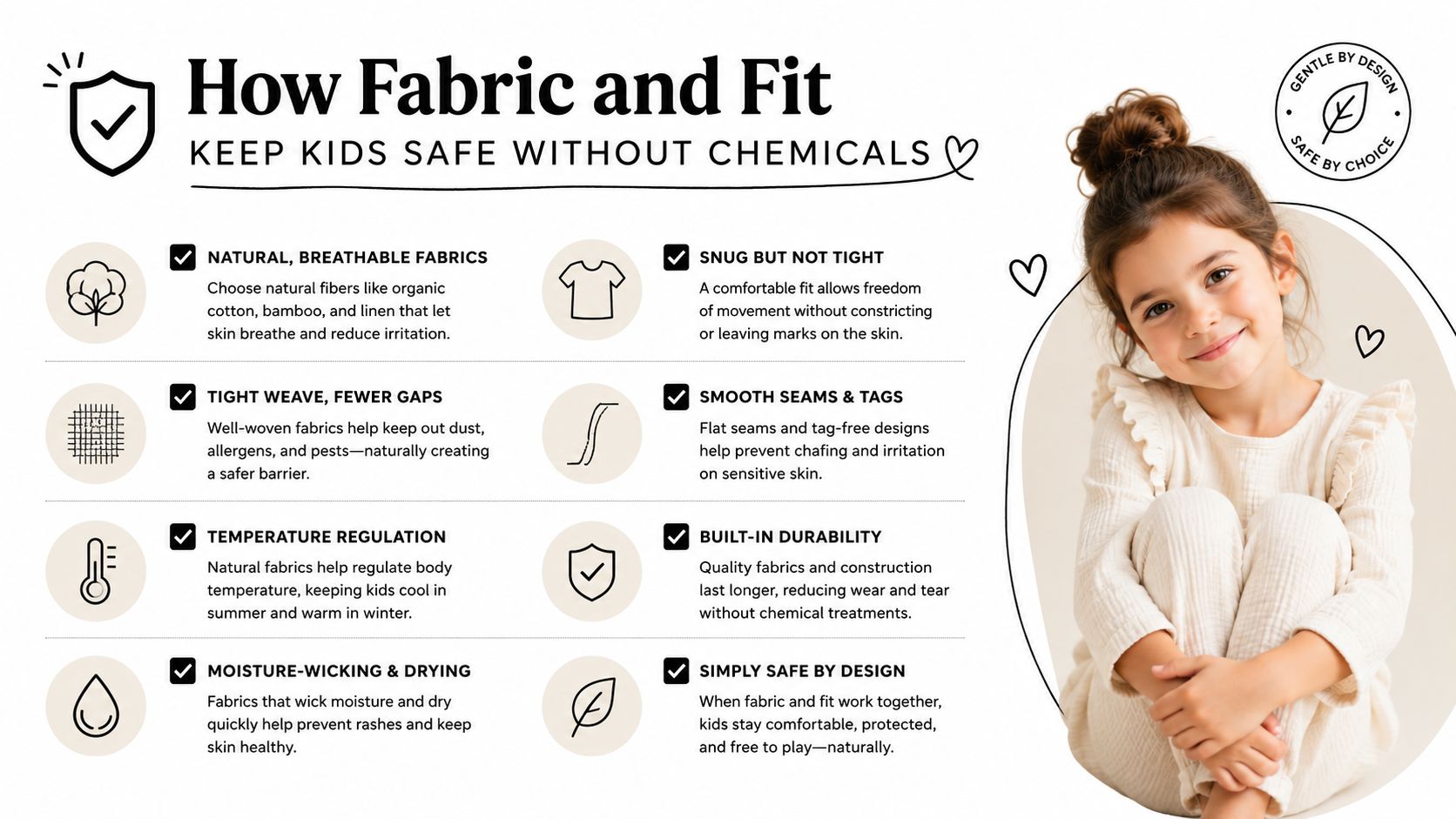
A safe choice starts with the garment as a whole, not with a single fiber name. Fit is the central variable for sleepwear using the tight-fitting exemption, while fabric construction affects comfort, durability, and how the material behaves near heat.
Cotton is familiar, breathable, and widely used in children's clothing. Bamboo viscose is also popular because it feels smooth against the skin and can provide a soft, lightweight option for children who dislike scratchy textures. Polyester may offer stretch and durability, but a parent shouldn't assume that any particular fiber automatically qualifies as compliant. The finished garment, its construction, and its labeling matter.
What to check before buying
Look at these details together:
- Fit language: Search for “snug fitting” or equivalent wording that identifies the garment's compliance route.
- Fiber content: Read the sewn-in label rather than relying only on phrases such as “natural” or “eco-friendly.”
- Stretch and construction: A close fit should still allow a child to bend, roll, climb, and move comfortably.
- Sizing guidance: Use the brand's measurements and compare them with your child's current body size. Don't buy several sizes too large if the garment depends on snug construction.
- Condition: Watch for stretched waistbands, thinning fabric, or seams that have lost their original shape.
Bamboo viscose can be a practical choice for families seeking a soft, breathable fabric with a smooth hand feel. It's often selected for babies and toddlers with delicate or eczema-prone skin, although no fabric is guaranteed to suit every child. Wash a new garment before wearing it, and stop using anything that causes visible irritation or discomfort.
For families sewing nursery clothing or comparing natural textiles, this guide to baby-safe quilting cottons offers useful background on fabric selection. It isn't a substitute for sleepwear compliance information, but it can help you think more carefully about fiber, weave, and skin contact.
The same principle applies when considering bamboo baby pajamas. Softness is valuable, but it shouldn't replace checking fit, labeling, and the manufacturer's safety information.
The video below provides another visual way to think about children's sleepwear materials and construction.
Practical rule: A natural fiber can support comfort, but only the finished garment's design and compliance information tell you whether it's appropriate sleepwear.
Comparing Fabrics and Certifications for Peace of Mind
Parents often face a crowded label: bamboo viscose, organic cotton, polyester, OEKO-TEX®, GOTS, snug fitting, and perhaps several sustainability claims. These terms answer different questions. A fiber label describes the material, a textile certification may address substances or production practices, and flammability compliance addresses the garment's safety performance or regulatory route.
| Fabric / Certification | Breathability | Chemical Risk | Skin Sensitivity | Compliance Notes |
|---|---|---|---|---|
| Cotton | Often comfortable and breathable, depending on construction | Depends on dyes, finishes, and manufacturing | Frequently chosen for soft skin, but individual reactions vary | Must still follow the applicable sleepwear pathway |
| Polyester | Can be durable and stretchy, with comfort depending on knit and finish | Depends on finishes and processing | May suit some children and bother others | Fiber alone doesn't establish compliance |
| Bamboo viscose | Smooth, lightweight, and commonly selected for breathable sleepwear | Depends on processing, dyes, and finishes | Often chosen for delicate skin, but monitor each child's response | Must be paired with compliant construction and labeling |
| OEKO-TEX® Standard 100 | Not a breathability certification | Addresses tested harmful substances within its certification scope | Can offer useful material-screening information | Doesn't replace sleepwear flammability compliance |
| GOTS | Not a breathability certification | Covers defined organic textile and processing requirements within its scope | May help families seeking controlled textile inputs | Doesn't by itself prove a garment qualifies for the tight-fitting exemption |
| CPSC compliance labeling | Not a fabric characteristic | Doesn't mean the garment is free from every substance | Doesn't predict individual sensitivity | Look for the applicable snug-fit or flame-resistant pathway |
Reading certifications without overreading them
OEKO-TEX® Standard 100 is useful when your priority is screening textiles for harmful substances covered by that standard. You can find a plain-language explanation in this overview of OEKO-TEX® Standard 100. It still doesn't answer every question about fire safety, fit, or how a child's skin will respond.
GOTS can help shoppers evaluate organic textile claims and processing requirements, while CPSC-related labeling helps identify the sleepwear safety route. Neither label should be treated as a universal guarantee. A garment can carry a textile certification and still need separate flammability compliance.
Marketing language deserves the same care. “Natural,” “clean,” and “eco-friendly” may sound reassuring, but those phrases don't explain whether a garment contains added flame-retardant treatment or qualifies as tight-fitting. For background on cotton as a sewing material, this discussion of the benefits of organic cotton for sewing can add useful context, while the pajama label remains the deciding document for sleepwear use.
Aligning Sleepwear Choices with Family Values
A pajama purchase can reflect more than a preference for a particular color or print. For many Christian families, caring for a child's body is part of faithful stewardship. That may mean choosing soft materials, paying attention to avoidable treatments, and learning enough about safety standards to make a calm, informed decision.
The choice doesn't need to become a test of moral perfection. Families have different budgets, laundry routines, skin concerns, and access to products. A thoughtful approach asks whether the garment is comfortable, appropriately fitted, clearly labeled, and consistent with the household's priorities.
Turning a purchase into a lesson
Children learn from repeated family choices. When parents explain why they read labels, choose a proper fit, or care for clothing instead of replacing it quickly, children see responsibility in action. That lesson can extend from personal health to consideration for workers, communities, and the wider world.
Some families also look for brands whose purpose includes helping other people. Readers exploring values-centered baby goods may find ideas in beautysecrets.agency's luxury baby line, while remembering that any product still deserves an independent check of its materials and compliance details.
A meaningful purchase can support compassion without turning safety into a marketing slogan. Look for transparent information, modest claims, and a clear explanation of how the sleepwear meets the relevant standard.
Family value in practice: Care means asking good questions, not creating fear around every unfamiliar label.
Practical Tips for Buying and Caring for Safe Sleepwear
Start with the label, then check the garment in your hands. Look for language identifying the pajamas as snug fitting or flame resistant, along with fiber content and care instructions. If the product page makes broad safety promises but doesn't explain its sleepwear compliance route, contact the manufacturer before buying.
A simple shopping routine
- Measure thoughtfully. Use the brand's sizing chart and your child's current measurements. Age ranges can't show whether a pajama sleeve, waist, or torso will fit closely.
- Inspect the shape. The garment should follow the body without restricting movement. Excess fabric, loose cuffs, or a stretched neckline deserve attention.
- Read the sewn-in label. Keep the compliance language and fiber information available, especially if the pajamas are handed down.
- Check certifications separately. OEKO-TEX® or GOTS can provide useful textile information, but neither replaces flammability labeling.
- Observe comfort after dressing. Red marks, digging waistbands, overheating, or restricted movement indicate that the size or design may not be right.
Hand-me-downs need the same inspection as new clothing. Fabric can stretch, seams can weaken, and repeated wear can change the original fit. Washing doesn't turn a compliant garment into a different regulatory category, but damage or distortion can affect whether it still fits as intended.
Caring for bamboo viscose and similar fabrics
Follow the care label first. In general, cool washing and gentle detergents can help preserve soft fibers, while harsh detergents, fabric softeners, bleach, and excessive heat may weaken fabric or leave unwanted residue. Air-drying or low-heat tumble-drying is often gentler than high heat, and high-temperature ironing can compromise delicate materials.
A quick laundry checklist helps:
- Wash gently: Follow the garment's instructions and avoid aggressive cycles.
- Skip fabric softener: It can coat fibers and alter their feel.
- Avoid bleach: Use it only when the care label specifically permits it.
- Dry carefully: Choose air-drying or low heat when allowed.
- Retire damaged pieces: Don't rely on a label if the garment has become loose, thin, or misshapen.
Answers to Common Questions About Chemical-Free Pajamas
Are snug-fitting pajamas as safe as chemically treated pajamas?
They can be compliant through a different route. Federal rules allow sleepwear to qualify through flame-resistant performance or through the tight-fitting exemption, so the relevant question is whether the finished garment meets its stated requirements.
How can I verify compliance without added chemicals?
Look for clear snug-fit language, the required safety labeling, fiber information, and sizing guidance. A retailer's phrase such as “non-toxic” isn't enough by itself. If the label is unclear, ask the manufacturer which compliance pathway the pajamas use.
Are bamboo viscose pajamas risk-free?
No clothing material should be described as risk-free for every child. Bamboo viscose may feel comfortable and gentle, but check the garment's processing information, certifications, fit, care instructions, and your child's individual response.
Does “chemical-free” mean non-compliant?
No. It means the garment is described as free from added flame-retardant treatment. It still must meet the applicable flammability requirement, often through close-fitting construction.
What does “For child's safety, garment should fit snugly” mean?
It's a safety instruction, not a warning that the pajamas are defective. The garment depends on close fit, so sizing up excessively can undermine the design.
Do hand-me-downs remain safe?
Only if they remain in good condition and still fit closely. Check for stretching, thinning, damaged seams, and loose areas before using them.
Informed parents don't have to choose between wellness and safety. They can select flame retardant free pajamas by checking the compliance route, evaluating the fit, and choosing fabrics that suit the child.
Little Venture Co. offers bamboo viscose pajamas and daywear for babies and toddlers, with materials described as OEKO-TEX® Standard 100 certified and free from added flame retardants. Visit Little Venture Co. to explore soft, faith-inspired sleepwear while checking each product's fit and safety information for your child.