

Your Bible Study Journal: A Guide for Busy Parents
Some mornings, opening a Bible study journal feels less like a peaceful spiritual habit and more like one more thing sitting on an already crowded counter. The baby is awake early. Someone needs a snack. Your coffee is cooling off for the second time. You want to be faithful, but you also need something that works in real life.
That's where a simple journaling practice can help. Not a pretty, polished, color-coordinated project. Just a small place to slow down, notice what God is saying, and answer Him on paper before the day runs away from you. For parents of babies and toddlers, that kind of practice matters because it can fit into the scraps of time you have.
A Bible study journal doesn't need to turn you into a scholar or an artist. It just gives your attention somewhere to land. A verse. A prayer. A sentence about what you need today. That's enough to begin.
Giving Yourself Grace to Get Started
If you've been waiting for a quiet season to begin, you may wait a long time. Parenting little ones is holy work, but it's rarely quiet work. A good Bible study journal practice starts when you stop measuring it against an ideal version of someone else's routine.
Good enough is often the most faithful place to begin. If you have five minutes, use five minutes. If all you can manage is one verse and one honest prayer, that still counts as time with God. According to Barna's State of the Bible 2021, 181 million U.S. adults opened a Bible in the past year, and 16% read it most days of the week, up from 12% the prior year. That tells me you're not strange for wanting steady Scripture in your life. You're part of a very real hunger for God's Word.
What grace looks like in practice
Perfectionism usually shows up disguised as seriousness. It says, “If I can't do this well, I should wait.” That mindset works against consistency.
Try this instead:
- Lower the entry point: Keep your journal open where you already sit in the morning.
- Write short on purpose: One sentence is easier to repeat than a whole page.
- Expect interruptions: If your toddler climbs into your lap halfway through, your time with God didn't fail. It just became noisier.
Practical rule: Don't build your routine around your best day. Build it around a normal one.
For new moms especially, spiritual habits can feel fragile in a season where your body, sleep, and attention are already stretched. If that's your current reality, this gentle devotional for new moms can meet you there without piling on guilt.
A simple starting point
Open your journal and write three lines:
- The date
- One verse or short passage
- One sentence that begins with “Lord, help me…”
That's a real beginning. It's not small because it's short. It's small because it's sustainable.
Choosing Your Journal Style and Tools
The best Bible study journal is the one you'll keep reaching for. That usually means choosing tools that fit your season, not your fantasy self. A parent with toddlers doesn't need a setup that requires clearing the table, uncapping ten markers, and protecting every page from little hands.

Four common options
Some people do best with complete freedom. Others need structure so they don't stare at a blank page.
| Journal type | Best for | Trade-off |
|---|---|---|
| Blank notebook | Parents who want flexibility and low pressure | Can feel too open-ended on tired days |
| Guided journal | Beginners who want prompts | Less room for your own format |
| Digital notes app | Parents who always have a phone nearby | Easier to get distracted |
| Journaling Bible | Readers who like notes beside the text | Harder to use if little hands are nearby |
A plain notebook is still the easiest place to start. It's forgiving. You can skip pages, scribble half-thoughts, or change methods without wasting anything. Guided journals are helpful if blank space makes you freeze. Digital journaling works best when convenience matters more than atmosphere.
Why structured tools appeal to some parents
Bible journaling has become more structured over time. Crossway's ESV Journaling Study Bible introduction describes a format with more than 12,000 study notes, nearly 900 special facts, and 120 Bible character profiles. That shift matters because many readers don't just want space to write. They want help noticing what they're reading.
If you enjoy a little support but don't want a highly designed system, a sturdy notebook can be the middle ground. Some parents like a clean hardcover because it feels durable enough to live on a nightstand, kitchen counter, or diaper bag. If you want something simple and polished for daily use, you could elevate productivity with this journal and use it strictly for Scripture notes and prayer responses.
What actually works best in a busy season
Choose based on friction.
- If you resist clutter: use one notebook and one pen.
- If you need prompts: pick a guided option with room for short answers.
- If you journal during school pickup or nap time in the car: digital may be the most realistic.
- If you love writing beside the text itself: a journaling Bible can feel more immersive.
The right tool should invite you in, not make you feel behind before you begin.
Pretty supplies can be fun. They're just not the engine of the habit. Ease is.
Simple Journaling Methods for Busy Schedules
When parents say they want to start a Bible study journal, what they often mean is, “I don't know what to write once I sit down.” That's why a repeatable method helps. It removes decision fatigue. You don't have to invent a process every morning.
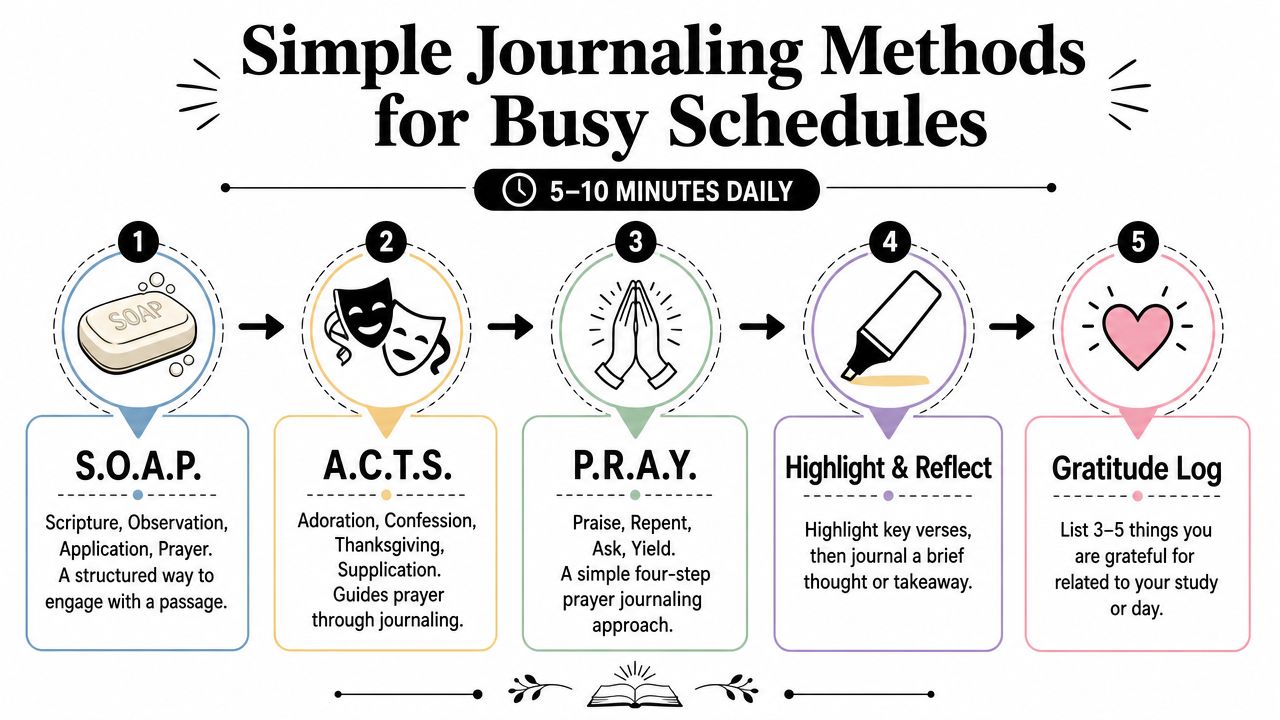
One practical guide to the SOAP method recommends keeping daily sessions to 5–10 minutes and using short notes in a plain notebook. That advice fits family life well because it keeps the practice from turning into a project.
Try SOAP when your brain feels tired
SOAP stands for Scripture, Observation, Application, Prayer.
It works because each step is small.
-
Scripture
Write one verse or a short passage. Not a whole chapter unless you want to. -
Observation
Ask, “What stands out?” Maybe it's a repeated word, a command, or a comfort. -
Application
Write how it meets your actual life today. Keep it concrete. -
Prayer
Turn the verse into a brief response to God.
Here's what that can look like in real life:
- Scripture: “Cast all your anxiety on him because he cares for you.”
- Observation: God doesn't only tolerate my worries. He invites me to bring them.
- Application: I'm carrying the mental load for my family in a clenched way. Today I can name my fears instead of pretending I'm fine.
- Prayer: Lord, help me give You the worries I keep recycling in my mind.
Other low-pressure methods
If SOAP doesn't click, use something even shorter.
- Highlight and reflect: Underline one phrase and write one takeaway.
- Prayer list journaling: Write the names and needs on your heart, then add one sentence from Scripture beside each.
- Gratitude response: Note what the passage shows about God, then thank Him for it.
- Question journal: Write what confuses you. You don't need immediate answers for the time to matter.
A short entry you actually finish will help you more than a detailed plan you avoid for two weeks.
Simple Journaling Prompts for Any Passage
| Prompt Type | Question to Ask |
|---|---|
| Notice | What word or phrase stands out first? |
| Learn | What does this passage show me about God? |
| Reflect | What does this reveal about my heart today? |
| Respond | What is one action or attitude to carry into the day? |
| Pray | How can I turn this verse into a simple prayer? |
Some days, the prompt itself is enough. You don't need all four parts of SOAP every time.
Keep the writing short and specific
The biggest mistake busy parents make is trying to capture everything. You don't need a complete study note set. You need a faithful response.
Write like this:
- “I'm rushing and this verse is slowing me down.”
- “I need patience with my child, not just efficiency.”
- “God's care is steady even when my mood isn't.”
That's Bible journaling too. Honest, brief, and grounded in the text.
Creating a Realistic Journaling Routine
A strong routine doesn't come from picking the perfect time. It comes from picking a time that survives real interruptions. For parents, that usually means attaching journaling to something that already happens.
Maybe it's the first few minutes after you pour coffee. Maybe it's when the baby starts morning feed time. Maybe it's a Sunday evening reset when the house finally settles. The point is less about ideal timing and more about a repeatable cue.
Three rhythms that tend to work
Early morning rhythm
You wake up before the kids if that season allows it. You read a short passage, write a few lines, and stop before the routine turns into pressure.
Nap time rhythm
You don't use the whole break for chores. You take the first minutes for Scripture before doing anything else.
Evening rhythm
You journal after bedtime with lower expectations. The entry can be more reflective because the day already happened.
None of these is spiritually superior. They fit different households.
HEAR works well when you need focus
The HEAR method gives your writing a clear lane: Highlight, Explain, Apply, Respond. The guide from Replicate on the HEAR journal method recommends keeping the Apply section to 2–5 sentences, which is helpful when your time is limited and your thoughts are scattered.
That length matters. It keeps you from drifting into vague ideas or overexplaining everything. A focused application is easier to remember while you're changing diapers, loading dishes, or walking a fussy toddler around the living room.
A flexible week looks better than a perfect day
Some parents do better with a daily touchpoint. Others do better with a looser weekly pattern.
Try one of these:
- Three short entries during the week: helpful if daily consistency feels fragile
- One longer entry on the weekend: better if weekdays are unpredictable
- A mixed rhythm: short notes on busy days, deeper reflection when space opens up
If you want a gentle companion for days when attention is thin, this daily devotional reading option can pair well with journaling without making the routine feel heavy.
If your routine has to be rescued every time life gets messy, it's too rigid for this season.
A realistic Bible study journal habit leaves room for missed days. It doesn't collapse when the week gets hard. It bends and keeps going.
Involving Your Little Ones in Devotional Time
Most advice about Bible journaling assumes silence. Parents of toddlers know that silence is not a reliable spiritual resource. If you keep waiting for uninterrupted time, you may end up believing your faith only counts when the house is calm.
It doesn't.
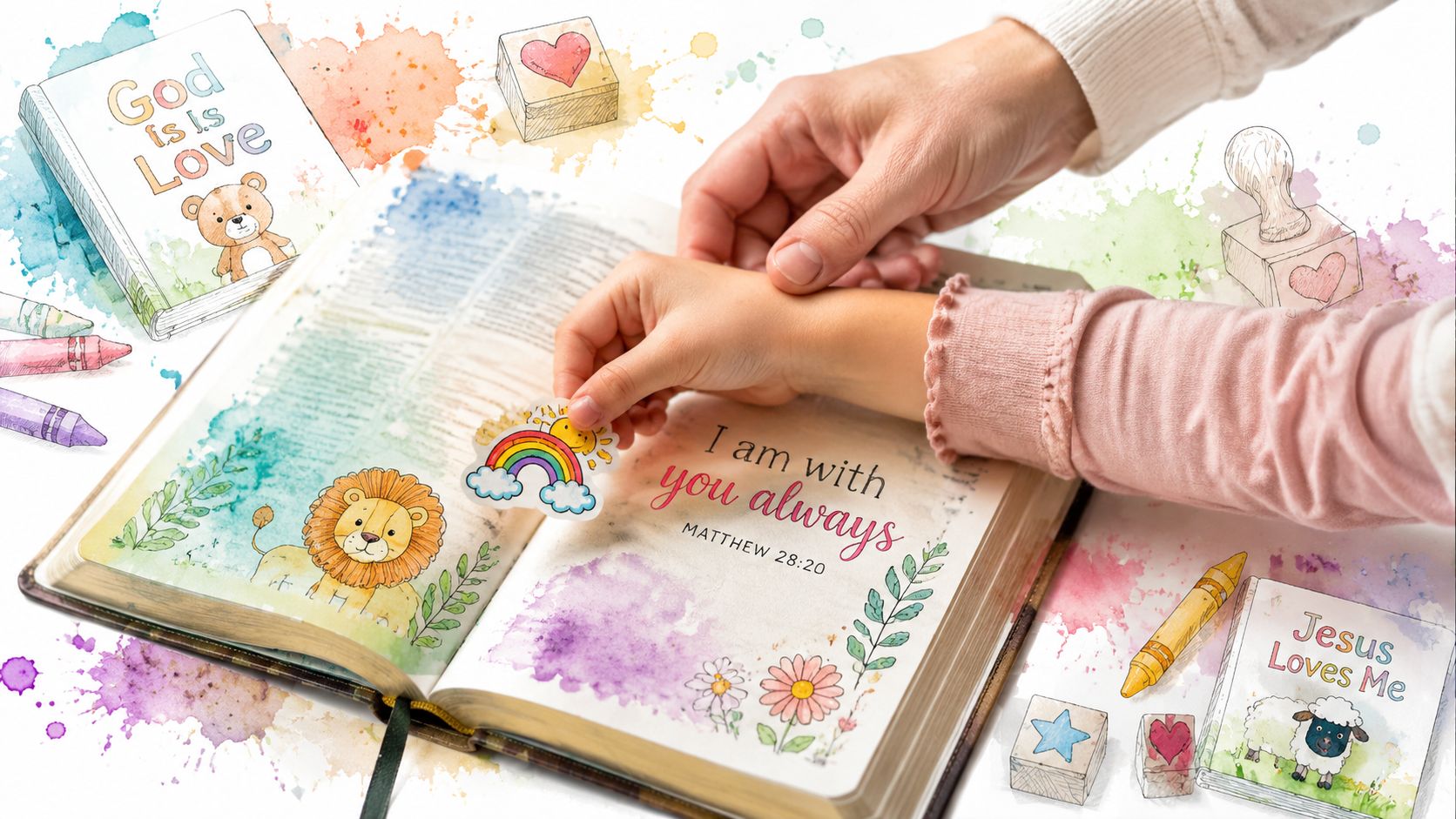
A more useful approach is to treat journaling as a micro-practice that can sometimes include your children. That's especially important because a lot of existing journaling advice leans toward deep solitary study and doesn't address the practical needs of parents, as discussed in this conversation about family-life constraints and journaling.
What this can look like with toddlers
You do not need to turn your quiet time into a formal lesson. You're letting your child see that time with God belongs inside ordinary family life.
Try simple pairings like these:
- You write, they scribble: Give your toddler a notebook and crayons while you write your own few lines.
- Read one verse out loud: Keep it short and ask, “What did you hear?”
- Let them draw a response: If the verse mentions light, love, sheep, water, or joy, they can draw what they imagine.
- Use one repeat phrase: “God is with us” or “Jesus loves us” can become the anchor for both your page and their participation.
Keep expectations low and warm
Children don't need polished devotionals from us. They need a lived faith they can see.
What usually doesn't work:
- expecting long attention spans
- correcting every silly answer
- choosing too much material
- getting frustrated when the moment feels messy
What usually does work:
- one verse
- one question
- one small activity
- a fast ending before everyone melts down
Your child doesn't need to remember the whole passage. Seeing you return to God in ordinary moments is its own lesson.
A short family devotional rhythm can also support your personal journaling by keeping Scripture language in the home. If you want another gentle resource to build that habit, this daily devotional encouragement for families fits well alongside simple journaling.
Give them a role, not a performance
Toddlers love participation more than instruction. Let them place a sticker on the page. Let them circle a word with a washable marker in their own notebook. Let them hold the Bible while you read.
Here's a simple idea you can use this week:
- Read one short verse.
- Write one sentence in your Bible study journal.
- Ask your child to draw what they heard.
- End with one spoken prayer together.
Later, if you want a visual example of a simple family-friendly faith activity, this short video can spark ideas without making it feel complicated.
Messy participation still forms memory. In many homes, it forms it better than a perfect setup ever could.
How to Give a Bible Journaling Starter Kit
A Bible study journal makes a thoughtful gift because it says more than “I thought of you.” It says, “I want to encourage your soul in the middle of real life.” For a busy parent, that kind of gift can feel unusually personal.

A starter kit works best when it removes friction. It shouldn't be stuffed with extras that look impressive but never get used. Give a few pieces that make it easy to begin right away.
What to include
A practical kit could hold:
- A notebook or guided journal: Keep it approachable, not intimidating.
- Pens that feel smooth to write with: Good pens make a bigger difference than people expect.
- A short handwritten note: Include one simple method such as SOAP or a one-line journaling prompt.
- A bookmark or verse card: Helpful for a parent who wants to pick up where they left off.
- One comforting touch: Tea, a mug, hand cream, or another simple item that signals rest.
If the person you're gifting loves study resources, you can also point them toward trustworthy Bible study recommendations so they can grow the practice over time without feeling overwhelmed by random choices.
Why this gift lands well for parents
Parents often receive gifts for practical care, which is wonderful. A journaling kit adds spiritual encouragement without demanding a major commitment. It conveys, “You matter too, not just the tasks around you.”
It's also easy to tailor:
- For a new mom: keep it gentle and simple
- For a friend in a hard season: add a note focused on comfort and honesty
- For a church small group gift: keep the supplies consistent and include the same journaling method card for everyone
A gift basket format works especially well when you want it to feel warm rather than formal. If you want ideas for how to package it in a thoughtful way, these gift basket ideas for new moms can help you think beyond just putting a notebook in a bag.
The handwritten note matters most
The most meaningful part is usually the note tucked inside. Write something like:
I know your days are full. I hope this gives you a small place to meet with God without pressure. One verse, one prayer, one honest page at a time.
That's the spirit of the whole practice. Not performance. Not polish. Presence.
If you're building a faith-filled home in the middle of diapers, dishes, and bedtime routines, Little Venture Co. offers faith-inspired pieces for babies and toddlers that fit the warmth and meaning many Christian families want to cultivate at home.