

Your Guide to Wake Windows by Age From Newborn to Toddler
A wake window is simply the stretch of time your baby is awake between one nap and the next. Keeping an eye on these windows, which change like crazy as your baby grows, is the secret to avoiding an overtired, fussy baby and getting more predictable sleep.
For a tiny newborn, this window might only be 45 minutes, while a toddler can easily stay awake for over 5 hours. Nailing these timings can make all the difference. This guide has a handy chart to help you get in sync with your little one's natural sleep rhythm.
Wake Windows By Age Reference Chart
Let's dive right in. The whole idea behind a wake window is to find that perfect moment when your baby is tired enough to sleep well, but not so exhausted that they become a screaming, wired mess. Get it right, and they'll drift off more easily and often stay asleep longer.
Think of this chart as your go-to cheat sheet. It lays out the recommended awake times, how many naps to expect, and the total amount of sleep your child needs in a day. It’s all about finding a gentle, predictable flow that works for both of you.
| Age Range | Recommended Wake Window | Number of Naps Per Day | Total Sleep in 24 Hours |
|---|---|---|---|
| Newborn (0-8 wks) | 45-60 minutes | 4-6+ naps | 16-18 hours |
| 2-3 Months | 60-90 minutes | 4-5 naps | 15-17 hours |
| 4-6 Months | 1.5-2.5 hours | 3-4 naps | 14-16 hours |
| 7-9 Months | 2.5-3.5 hours | 2-3 naps | 13-15 hours |
| 10-12 Months | 3-4 hours | 2 naps | 13-14 hours |
| 13-18 Months | 4-5 hours | 1-2 naps | 12-14 hours |
| 18-24 Months | 5-6 hours | 1 nap | 12-13 hours |
| 2-3 Years | 5.5-7 hours | 1 nap (or none) | 11-13 hours |
Remember, these are just averages! Every baby is different, so use this as a starting point and watch your little one for their unique sleepy cues.
Here’s a great visual that pulls it all together, showing how wake windows, nap frequency, and total sleep all connect as your baby grows.
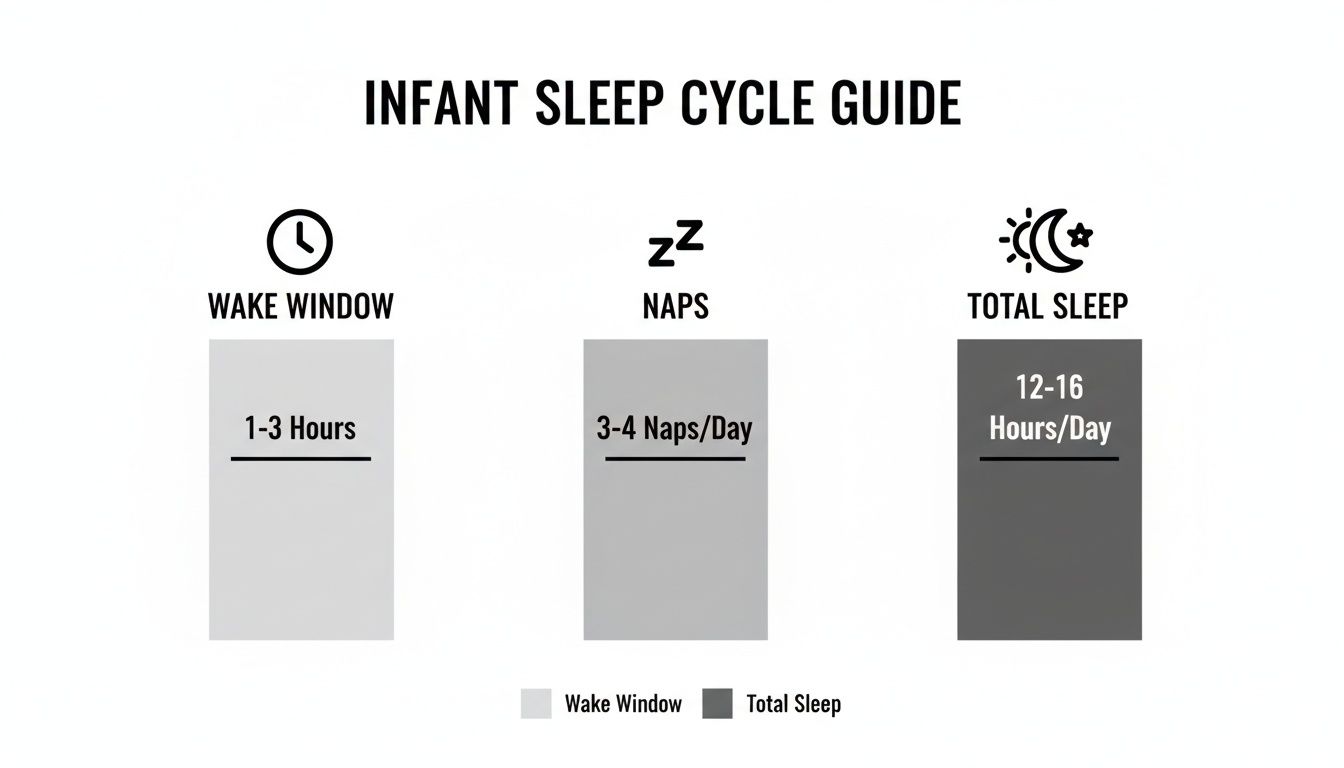
You can see the pattern pretty clearly: as babies get older, their wake windows stretch out, they drop naps, and the total amount of sleep they need in a 24-hour period slowly decreases. It's a gradual but consistent shift.
Why Do Wake Windows Get Longer As My Baby Gets Older?
Ever look at your two-month-old, who's ready for a nap after just an hour, and then at your ten-month-old, who's still going strong after three hours, and wonder what's going on? It's not just you! This change is a huge, and totally normal, part of their development. Seeing those wake windows by age stretch out is actually a great sign of healthy growth.
It all boils down to two big biological players: sleep pressure and the circadian rhythm.
Think of sleep pressure like a sleepy timer. The longer your baby is awake, the more a sleep-inducing chemical called adenosine builds up in their brain. The more adenosine, the sleepier they get. As babies mature, their brains get much better at handling this pressure, letting them stay awake and happy for longer stretches.
A tiny newborn's system is brand new, so that sleep pressure builds up super fast. That's why their wake windows feel impossibly short—a quick feed and a cuddle is about all they can manage before they're ready to crash again.
Their Body Clock is Starting to Tick
At the same time this is happening, your baby’s internal clock—their circadian rhythm—is starting to figure things out. For the first couple of months, this internal clock is all over the place, which is why newborn sleep feels like a chaotic free-for-all.
But then, somewhere around the 3 to 4 month mark, a little switch flips. Their body really starts to learn the difference between daytime (for playing) and nighttime (for longer stretches of sleep).
As their circadian rhythm matures, they begin to bunch their sleep into bigger chunks, especially overnight. And because they're getting more restorative sleep at night, they can naturally handle being awake for longer during the day. Their naps start to get longer and more predictable, too, which also helps push those wake windows out.
The bottom line: Lengthening wake windows are a direct result of your baby's brain and body maturing. It's the natural way they learn to consolidate their sleep, which leads to better naps and (hooray!) more sleep at night.
This whole process is fueled by a few key things happening behind the scenes:
- Brain Maturation: The parts of your baby's brain that control sleep and wakefulness are getting stronger and more organized.
- Growing Stamina: As they get bigger, stronger, and more mobile, they simply have more physical energy for playtime and exploring.
- Nap Consolidation: Those 30-minute catnaps slowly start turning into longer, more restorative naps. A good nap resets their sleepy timer, allowing them to stay awake longer afterward.
Navigating Newborn Wake Windows: 0 to 3 Months
Ah, the fourth trimester. This is a time when your days and nights blur into a beautiful, exhausting cycle of eat, sleep, and repeat. Forget about a rigid schedule; your brand-new baby runs the show. Understanding their "wake window" is more about being a detective than a drill sergeant.

In these first three months, your baby has the tiniest wake window of all—typically just 45 to 60 minutes. That's it. It’s barely enough time for a feed and a diaper change before they’re ready to snooze again.
This super-short awake time is completely normal. Newborns need a massive 14-17 hours of sleep in a 24-hour period, and their tiny tummies mean they need to eat every 2-3 hours. Their internal body clock (circadian rhythm) is still under construction. Pushing them past that one-hour mark almost guarantees an overtired, fussy baby—in fact, some studies show it leads to meltdowns in over 70% of cases.
The real secret to a calmer day is learning to spot your baby's unique sleepy cues before they get cranky.
Spotting Those Subtle Sleepy Cues
Instead of staring at the clock, start by watching your baby. Their first hints of tiredness are often super subtle and easy to miss if you're not paying close attention.
Here's what to look for:
- The Thousand-Yard Stare: Does your baby suddenly look "zoned out" or stare blankly into space? That's a classic sign.
- Becoming Still: They might lose interest in your face or their surroundings and get very quiet and still.
- The First Yawn: A tiny yawn is your golden ticket. It's the perfect cue to start winding things down for the next nap.
- A Little Grizzle: This isn't full-on crying. It’s more of a faint whimper or a slight change from their happy, content mood.
Once you see these signs, it's go-time. If you wait until you see frantic arm-waving, back-arching, or loud crying, you’re already behind. An overtired baby is much harder to settle down for a nap.
A Newborn's Day in Action: Let's say your baby wakes up at 7:00 AM. A typical cycle would be feeding until 7:20 AM, followed by a diaper change. After that, you might get just 20-30 minutes of quiet awake time—maybe some cuddles or looking at a simple black-and-white toy. By 7:50 AM, you're already starting your simple nap routine to get them back to sleep.
Tips for Surviving the Newborn Phase
This stage is a marathon, not a sprint. Focus on endless snuggles and simply responding to what your baby needs in the moment.
Swaddling can be a game-changer during this time. It helps newborns feel snug and secure, just like they were in the womb, which often leads to better, longer stretches of sleep. If you're wondering about the right time to transition out of it, our guide on when to stop swaddling can help.
Most importantly, be flexible. One day the wake window might be exactly 45 minutes; the next, it might stretch to 65. Follow your baby's lead, give yourself plenty of grace, and know that you're building a wonderful foundation for healthy sleep. You've got this.
Navigating Wake Windows from 4 to 11 Months
Once you're out of the newborn haze (congratulations!), your baby's days start to feel a little more predictable. This is a huge period of change, where you'll see those short awake times stretch out and naps become more consolidated. Basically, you're moving from chaos to a real rhythm. Your baby is so much more interactive now, and their sleep patterns are evolving just as quickly.

During these months, you'll watch their wake windows lengthen quite a bit. They'll go from roughly 2 hours at 4 months all the way up to 3.5 hours by the time they're 11 months old. It’s a clear sign that their sleep cycles are maturing and their brain is developing right on track.
The Big Four-Month Shift
Ah, the infamous "four-month sleep regression." I always tell parents it's less of a regression and more of a permanent progression in how your baby sleeps. Their sleep cycles suddenly start to look a lot more like ours, with lighter and deeper phases. The catch? If they haven't figured out how to link those cycles together, they can wake up frequently.
This is when a consistent routine becomes your absolute best friend. Honoring those wake windows is so important right now to avoid an overtired baby, which just makes night wakings a whole lot worse.
Expert Tip: That last wake window of the day—the one right before bedtime—is often the most critical. You're aiming for that sweet spot. Not so long that they're overtired and wired, but long enough that they've built up enough sleep pressure to go down easily and stay asleep.
What a Typical Day Might Look Like
Every baby is different, of course, but sometimes seeing a sample schedule makes it all click.
- For a 5-Month-Old (on 3 naps): A common pattern for wake windows is something like 2 / 2.25 / 2.25 / 2.5 hours. That means the first window of the day is 2 hours, the next is 2 hours and 15 minutes, and so on, with the last one being the longest.
- For a 9-Month-Old (on 2 naps): By now, the wake windows have gotten much longer. You might see a schedule like 3 / 3.5 / 3.5 hours, which gives you two solid naps and plenty of time for playing and learning before bed.
Babies from 4-11 months need between 12-16 hours of sleep a day (naps included), and wake windows of 2-3.5 hours help them get there. Their brains are developing at an incredible rate—doubling neural connections by age one! That's why getting the balance of awake time and rest right is so key. It helps prevent the sleep issues that a 2019 study found in 67% of families worldwide.
Making the Leap From Three Naps to Two
Sometime between 7 and 9 months, most babies are ready to drop that third catnap and move to a two-nap schedule. I won't lie, this transition can be a little bumpy and often takes a few weeks to iron out.
You'll get some pretty clear signs they're ready, like:
- Consistently fighting that third nap.
- Taking a super short third nap that pushes bedtime way too late.
- Suddenly starting to wake up for the day at the crack of dawn.
To smooth things out, you'll want to slowly start stretching the wake windows between the first and second naps. It's a game of trial and error, so give yourself (and your baby) some grace. For a deeper dive into this stage, our detailed 10-month-old sleep schedule has some fantastic, practical advice for navigating the two-nap life.
Navigating Toddler Wake Windows: 1 to 3 Years
Just when you feel like you've got this whole sleep thing figured out, your baby becomes a toddler, and everything changes again. This stage is dominated by one huge milestone that can feel a little intimidating for parents: dropping from two naps down to just one.
Getting the timing right on this transition is key. It paves the way for happier afternoons, fewer meltdowns, and much smoother bedtimes for everyone.

Most toddlers are ready for this big move sometime between 14 and 18 months, but as with everything, your child is on their own unique schedule. You’ll see their wake windows by age get noticeably longer, stretching from about 4-5 hours around their first birthday to a solid 5-6 hours as they get closer to two. That's a massive jump in how long they can happily stay awake.
Telltale Signs Your Toddler Is Ready for One Nap
Whatever you do, don't rush it! Dropping that morning nap too early is a classic recipe for an overtired, grumpy toddler. This can backfire, causing them to struggle through the afternoon and even lead to early morning wake-ups.
Before you make any big changes, look for these signs to show up consistently for a week or two.
Your toddler is probably ready if they are:
- Consistently fighting the morning nap: Are they just playing in their crib for ages or refusing to sleep at all?
- Taking a super long morning nap, then refusing the afternoon one: This is a dead giveaway. They simply can’t squeeze in two naps anymore.
- Suddenly stalling at bedtime or waking up super early: A solid nap schedule is the foundation for good nighttime sleep. If nights are suddenly a mess, it's time to look at the daytime schedule.
If you're nodding along to these points, it’s probably time to start making the switch to a one-nap day.
How to Build a One-Nap Schedule That Actually Works
The whole point of a one-nap schedule is to have a single, long, restorative nap right in the middle of the day. This one sleep session needs to be robust enough to carry them all the way to bedtime without them falling apart.
Most of the time, this nap will fall somewhere between 12:00 PM and 1:00 PM.
Pro-Tip: During the transition phase, don't be afraid to move bedtime earlier by 30-60 minutes. This is a lifesaver for preventing overtiredness while their little body adjusts to the new routine. An early bedtime can seriously help prevent meltdowns and protect that precious night sleep.
A solid, calming pre-sleep routine is more important now than ever. Active toddlers need very clear signals that it’s time to wind down from play mode. Something as simple as reading a book, singing a quiet song, or having a cuddle can work wonders. If you're looking for more ideas, our guide on different toddler sleep training methods can offer some gentle and effective strategies. It's all about finding a peaceful rhythm that fits your family.
Learning to Read Your Baby's Unique Sleep Cues
While the wake windows by age chart is an incredible tool, think of it as a guide, not a rulebook. The real magic happens when you become an expert on your baby. It’s all about learning to tune into their subtle little signals that say, "I'm getting sleepy," often well before the clock tells you it's naptime.
Responding to these cues is how you find that sweet spot for sleep, dodging those overtired meltdowns and creating a calm, predictable rhythm. Recognizing these non-verbal hints is also a huge part of supporting children's emotional development in general. When you show them you understand their needs, you're building a rock-solid foundation of trust and security.
Early Sleep Cues: The Green Light for Sleep
Think of these as the gentle whispers that sleepiness is just around the corner. Catching these signs is your best shot at a smooth, fuss-free transition into the crib. They can be pretty subtle and quick, so you’ll have to put on your detective hat.
Keep an eye out for these "green light" signals:
- The "Zoned Out" Stare: Your baby might suddenly look away, lose interest in their toys or your face, and just stare off into the distance. It's a classic.
- Red Eyebrows or Eyelids: A faint pink or reddish hue around their eyes is one of the most reliable tells that they're getting tired.
- The First Yawn: This one’s the most obvious. A single yawn is your signal to start winding things down right away.
- Decreased Activity: A baby who was happily wiggling and kicking might suddenly become still and quiet.
When you spot any of these, that's your cue. It’s the perfect time to start your pre-nap routine.
Late Sleep Cues: The Red Light for Overtiredness
If you miss those early whispers, you'll start seeing these much louder signals. These are the flashing red lights screaming that you've officially entered the overtired zone. An overtired baby's body gets pumped full of cortisol, a stress hormone that works like a shot of adrenaline, making it so much harder for them to settle down and fall asleep.
Late cues are hard to miss: fussing, jerky movements, arching their back, and then, of course, full-on crying. At this point, they're already past their ideal window, and getting them to sleep is going to be a much bigger challenge.
Don't beat yourself up if you end up here—it happens to every single parent! The goal is simply to start recognizing those earlier signs more often, letting your baby’s unique language guide you through the day.
How to Troubleshoot Common Wake Window Problems
Let's be real—even when you’re following the wake windows by age chart down to the minute, some days just fall apart. A baby who fights every single nap or only snoozes for 30 minutes at a time can make you feel like you're doing something wrong. But don't worry, you're not. Most of these super common issues just need a few small tweaks to get back on track.
The first thing to figure out is whether your baby is overtired or undertired, because honestly, the symptoms can look almost identical. An overtired baby often gets a fussy, wired second wind that makes it impossible for them to settle. On the flip side, an undertired baby just hasn't built up enough sleep pressure to fall asleep, so they'll protest, play, or just fuss in their crib.
The Mystery of Short Naps or 'Catnaps'
Chronic short naps—those frustrating 20-40 minute dozes—are one of the biggest headaches for parents. They’re pretty normal for newborns, but if your baby is over five months old and still catnapping all day, it's time to play detective.
Here are a few likely culprits and how to fix them:
-
Problem: The wake window is too short. If your little one isn't awake long enough, they simply won't have the sleep pressure needed for a long, deep nap.
- Solution: Try stretching their wake window by just 10-15 minutes. Stick with it for a few days and see if that next nap gets any longer.
-
Problem: The sleep environment is just too interesting. A little bit of light peeking through the blinds or the sound of the dishwasher can be enough to jolt a baby awake between sleep cycles.
- Solution: Your goal is a pitch-black cave. Blackout curtains are a game-changer for this. A white noise machine is also fantastic for drowning out household sounds. And don't forget to make sure they're comfy—you can learn all about the right layers in our guide on how to dress your baby for sleep.
-
Problem: They need your help to fall asleep. If your baby is used to being rocked or fed to sleep, they'll probably look for that same help when they stir between sleep cycles.
- Solution: This is all about practice. Try putting your baby down in their crib when they're drowsy but not completely out. This is how they start to learn the incredibly valuable skill of falling asleep on their own.
When Your Baby Fights Naps Completely
Nap resistance is so tough, but it’s usually a big, flashing sign that the schedule needs a little adjustment. If your baby goes from happy and playful to screaming the second you start the nap routine, it's almost always a timing issue.
A Simple Test: If you've been trying to get your baby down for a nap for 20 minutes with no luck, just stop. Take a break. Go into a different room, do a calm activity for 15-20 minutes, and then try the nap routine again. Sometimes that little reset is all they need.
If nap battles are happening every single day, it could mean your little one is getting ready to drop a nap or simply needs longer wake windows across the board. Take a peek back at the age chart, watch your baby for cues, and don’t be afraid to experiment a little.
At Little Venture Co., we design our ultra-soft bamboo sleepwear to create the coziest, most calming sleep environment possible, helping you and your little one get the restorative rest you both deserve. Explore our faith-inspired collections today.