

Your Guide to a 10 Month Old Sleep Schedule
By the time your little one hits the 10-month mark, you're looking at a sweet spot for sleep. They generally need about 13-15 hours of total sleep over a 24-hour day. This usually means a solid 10-12 hours overnight and two good naps during the day, adding up to another 2.5-3.5 hours.
What Your 10-Month-Old’s Sleep Really Looks Like

Ten months old often feels like you can finally take a breath. That chaotic third "catnap" is a distant memory, and your baby has likely settled into a much more predictable two-nap routine. This is when your days start to feel a lot more structured, and planning an outing doesn't feel like a high-stakes gamble anymore.
Most sleep experts, like those at Taking Cara Babies, suggest that about 14 hours of total sleep is the ideal target for this age. This is typically split between that long overnight stretch and two daytime naps.
Getting this balance right is everything. If they don't get enough daytime sleep, you're staring down the barrel of an overtired baby who fights bedtime and wakes up all night. But let them nap too much, and they might think 5 AM is the perfect time to start the day. It's a delicate dance!
Key Sleep Numbers for a 10-Month-Old
Instead of getting hung up on rigid rules, think of these numbers as a helpful guide to build a routine that actually works for your baby.
- Total Daily Sleep: The goal is 13-15 hours in a 24-hour period.
- Nighttime Sleep: Aim for a solid 10-12 hours.
- Daytime Naps: Around 2.5-3.5 hours, split into two separate naps.
- Wake Windows: Your baby can probably stay awake and happy for about 2.5 to 3.5 hours between sleeps. The wake window before bed is usually the longest, while the one in the morning is often the shortest.
A huge piece of the puzzle is the sleep environment. A dark, quiet room set to a comfortable temperature sends a powerful signal to your baby’s brain that it's time to rest. If you're wondering what that perfect temperature is, we've got you covered in our guide on the best temperature for baby sleep.
Paying attention to these wake windows—more than just the clock—is how you'll unlock better sleep for everyone. It’s all about spotting those tired cues within these timeframes.
Sample 10-Month-Old Daily Sleep Schedule
So, what does this actually look like in practice? Here’s a sample schedule to give you a starting point. Remember to tweak it based on your baby’s unique rhythm.
This simple table shows how the wake windows and naps fit together throughout the day.
| Time | Activity |
|---|---|
| 7:00 AM | Wake Up & Morning Feed |
| 9:45 AM - 11:15 AM | Nap 1 (after a ~2.75 hr wake window) |
| 2:30 PM - 4:00 PM | Nap 2 (after a ~3.25 hr wake window) |
| 7:30 PM | Bedtime (after a ~3.5 hr wake window) |
This kind of structure creates a predictable 10 month old sleep schedule. When you focus on hitting those wake windows and making sure naps are restful, you’re setting the stage for more peaceful nights and much happier days.
Say Goodbye to That Third Nap (Without Losing Your Mind)

Around ten months old, something magical often happens: your baby settles into a solid two-nap day. That pesky third catnap that always felt like a gamble finally disappears, and your daily schedule starts to feel way more predictable.
But if you’re in the thick of this transition, it probably feels more chaotic than magical. I get it. Dropping a nap is a messy business, often filled with short naps, grumpy afternoons, and bedtime showdowns.
The trick is to see this as more than just cutting out a nap. You're actually re-calibrating your baby's entire 24-hour sleep clock. It takes a little detective work and a solid game plan to stretch their awake time without them turning into a fussy, overtired mess. The goal is a new 10 month old sleep schedule with two chunky, restorative naps and peaceful nights.
Are They Really Ready for Two Naps?
It’s so easy to mistake a rough nap week for a sign that your baby is done with their third nap forever. But if you drop it too soon, you can end up with an overtired baby who starts waking up more at night. Not what you want.
Before you make any big changes, look for a consistent pattern of these signs over a week or two. One or two off days don't count!
- The Afternoon Nap Strike: The biggest clue is when they consistently fight or flat-out refuse that late afternoon nap. They might just play in their crib the whole time or protest loudly.
- New Bedtime Battles: Is your usually good sleeper suddenly putting up a huge fight at bedtime? If they're still taking that third nap, they might not be tired enough to settle down easily.
- Weirdly Short Naps: You might notice their first two naps get shorter, or that third "nap" becomes a pointless 15-minute snooze that just messes with bedtime.
- They’re Happy Without It: If your baby wakes up from their second nap in a great mood and can cruise through the afternoon until bedtime without a meltdown, they’re probably ready to make the switch.
A classic mistake is reacting to a few days of nap resistance. True readiness is a trend, not a fluke. Give it a week or two to make sure this is the new normal before you overhaul their whole routine.
How to Make the Transition to Two Naps
Okay, you've seen the signs and you're confident it's time. The mission now is to gently stretch their "wake windows" (the time they're awake between sleeps). This isn't about forcing them to stay up; it's about adding small bits of time so their day naturally shifts to a two-nap rhythm.
Start by adding just 15 minutes of awake time before their first and second naps. So, if their morning wake window was 2.5 hours, aim for 2 hours and 45 minutes. Distraction is your absolute best friend here. A new toy, a quick walk around the block, or even just watching the dishwasher get loaded can work wonders.
Focus on stretching the first two wake windows of the day. As you do that, the third nap will naturally fall away, and the final stretch before bedtime will get longer on its own.
Taming the Late-Afternoon Grumpies
That pre-bedtime stretch of the day can be the absolute worst during this transition. Your baby is tired, but it's too late for another nap. What do you do?
Your new secret weapon is an earlier bedtime.
Seriously, moving bedtime forward by 30-60 minutes can be a total game-changer. An overtired baby fights sleep, but putting them down a little earlier helps them drift off more easily and often leads to better sleep overnight. This is just a temporary fix! As they get used to their longer wake windows over the next week or two, you can slowly creep bedtime back to its normal spot.
Here are a few other tricks for that witching hour:
- Quiet Time: Don’t ramp things up. Wind down with calm activities like looking at picture books, listening to some gentle music, or just having a good cuddle on the couch.
- Change of Scenery: Sometimes all it takes is moving to a different room or stepping onto the porch for a breath of fresh air to reset a fussy mood.
- The Power of a Bath: A warm bath is super soothing and a fantastic signal that the day is winding down and sleep is coming soon.
By watching your baby's cues and making these small, intentional tweaks, you can guide them to a solid two-nap day. This transition is a key step in building a predictable and restful 10 month old sleep schedule that works for the whole family.
Creating a Bedtime Routine That Actually Works

A solid bedtime routine is so much more than just a quick bath and a story. Think of it as a conversation with your baby’s internal clock, sending consistent, calming signals that it's time to wind down. When you get this part of the 10 month old sleep schedule right, you're not just checking boxes. You're building a powerful, positive association with sleep that can turn bedtime from a nightly battle into a peaceful retreat.
And let's be clear: this doesn't need to be some elaborate, hour-long production. The best routines are simply predictable, soothing, and just long enough to work their magic. For most families, a consistent 20-30 minute wind-down is the sweet spot.
This sequence of quiet activities helps your baby's brain make the crucial shift from the busy stimulation of playtime to the calm restoration of sleep. It’s all about creating reliable sleep cues they quickly learn to recognize and respond to.
Building Blocks of a Soothing Routine
You absolutely don't have to do everything on this list. The real secret is to pick a few calming activities that feel right for your family and then—this is the important part—do them in the exact same order every single night. That consistency is where the magic happens.
Here are a few ideas to mix and match for your own perfect sequence:
- A Warm, Calming Bath: The way a baby's body temperature drops slightly after a warm bath is a natural sleep inducer. Just be sure to keep the lights dim and the vibe relaxed. This isn't the time for splashy, exciting games.
- Getting Dressed for Sleep: Slipping into pajamas and a sleep sack is such a clear signal that the day is officially over. It’s also the perfect moment to check that they’re comfortable for the night. You can find some great advice on how to dress a baby for sleep to make sure they're cozy but not too warm.
- Gentle Massage: A few minutes of applying lotion with slow, gentle strokes can be incredibly soothing. It's also a beautiful way to connect and bond after a busy day. Focus on long, smooth motions on their legs, arms, and back.
- Quiet Cuddles and Stories: Reading one or two familiar books in a dimly lit room is a classic for a reason. The sound of your voice is one of the most comforting things in their entire world.
- Calming Music or White Noise: Turning on the same lullaby or firing up the white noise machine can become a powerful audio cue that says, "it's time for sleep now."
Your final routine might look something like this: bath, pajamas, feeding in a dim room, one short story, a quick cuddle while a specific lullaby plays, and then right into the crib. Simple and effective.
Common Routine Mistakes to Avoid
Even with the best of intentions, it's surprisingly easy to accidentally sabotage your own efforts. Sometimes, just a few small tweaks can make all the difference in how smoothly your evening goes.
One of the biggest culprits? Making the routine too long or too stimulating. A 45-minute affair with tickle fights or exciting new books can easily backfire, leaving you with a baby who is more wired than sleepy. Keep it low-key.
Another huge one is inconsistency. If Mom's routine is completely different from Dad's, or if you just skip it on nights when you're tired, it loses its power. A baby's brain learns through repetition, so sticking to the same steps in the same order is non-negotiable.
Bedtime routines are not just for the baby; they're for you, too. They create a predictable end to the day, which helps you mentally switch gears and ensures you're sending calm, confident signals to your little one.
Finally, watch out for the classic trap of feeding to sleep. While that last feeding is often a key part of the routine, you want to make sure your baby goes into the crib drowsy but still awake. This is what teaches them how to self-soothe—an essential skill for connecting sleep cycles through the night. If they always drift off on the bottle or breast, try moving that feeding to the beginning of the routine. It's a small shift that can be an absolute game-changer.
Troubleshooting Common 10 Month Old Sleep Problems
Just when you think you’ve finally cracked the code on your baby’s sleep, everything falls apart. One minute you're celebrating solid naps and peaceful nights, and the next you're pacing the floor with a baby who is protesting bedtime, partying at midnight, or waking up before the sun.
If this sounds a little too familiar, take a deep breath. You’re not doing anything wrong! The ten-month mark is a hotbed of developmental leaps that can absolutely wreak havoc on sleep. From newfound separation anxiety to the irresistible urge to practice standing in the crib, these disruptions are frustrating but completely normal.
Think of this as your survival guide. We’ll unpack why these things are happening and, more importantly, give you practical strategies to get your routine back on track without creating new habits you’ll just have to break later.
The Clingy Stage: Separation Anxiety
Does your baby suddenly burst into tears the second you try to leave their room at bedtime? That's classic separation anxiety, and it often peaks right around this age. Your baby now fully understands that you exist even when you're not in sight, and they have a very strong opinion about it—they want you to stay!
It’s totally normal for this developmental leap to cause a temporary spike in night wakings. Your baby is recognizing you as their safe person and gets distressed when you leave. The goal is to help them settle with a consistent routine, using your presence as a reassuring signal without becoming a crutch.
The key is to offer reassurance without undoing all the hard work you've put into independent sleep. Here’s how to handle it:
- Offer Quick Comfort: If your baby is hysterical, it's okay to go in. Keep the lights low, use a calm and boring voice, and offer brief physical comfort—a pat on the back or a quick shush—before leaving again.
- Play Peek-a-Boo: This isn't just a fun game; it reinforces the concept of object permanence in a low-stakes way during the day. Hiding your face and then reappearing teaches them, "Hey, when they leave, they always come back!"
- Keep Your Goodbyes Short: At bedtime, have a consistent parting phrase like, "I love you, goodnight!" and then leave confidently. Lingering in the doorway can actually make their anxiety worse.
It's so tempting to bring your baby into bed with you or rock them to sleep out of sheer desperation. While it might solve the problem tonight, it can quickly become a new sleep association that's a whole other battle to change down the road.
When Teething Pain Strikes
Teething is the go-to scapegoat for every sleep issue, and you know what? Sometimes, it really is the culprit. Those emerging molars and canines can be genuinely painful, making it tough for your little one to settle down and stay asleep.
If you suspect teething pain is the problem, first look for the other classic signs—excessive drooling, chewing on everything, or red, swollen gums. If you've confirmed it's teething, focus on comfort measures that won't derail your entire routine.
You can try offering a cold teething toy before bed or, on particularly rough nights, talk to your pediatrician about using a weight-appropriate dose of infant pain reliever. The goal is just to manage the discomfort so they can sleep, not to introduce new habits.
The Crib Acrobat: New Skills
Is your baby treating their crib like a personal gym? The sudden ability to pull up to standing is a massive milestone, but it's a huge pain when it happens at 2 AM. Babies love to practice new skills, and they honestly don't care what time it is.
The novelty will wear off, I promise. But in the meantime, you need a plan. When your baby stands up in the crib, calmly go in and lay them back down without much interaction. You might have to do this a few times (or a dozen), but they will eventually learn that standing doesn't get them a fun reaction from you.
Also, make sure you're giving them tons of floor time to practice this new skill during their awake periods. The more they stand and cruise during the day, the less exciting it will be to do it in their crib at night.
Short Naps and Early Wake-Ups
Few things are more soul-crushing for a parent than a 30-minute "disaster nap" or a 5 AM wake-up call. If this is happening consistently, it's time to play detective. The cause is almost always related to their schedule or their sleep environment.
Run through this troubleshooting checklist:
- Is the Room Dark Enough? I mean, really dark. Even a sliver of morning light can signal your baby's brain that it's time to get up. Use blackout curtains to make the room pitch-black.
- Are They Dressed Comfortably? Being too hot or too cold is a major, often-overlooked sleep disruptor. Understanding what TOG ratings mean for sleepwear can be a game-changer for dressing them appropriately for the room's temperature.
- Are Wake Windows Correct? An undertired baby might take a short nap, while an overtired baby might wake up super early. It might be time to gently stretch their wake windows by 15-20 minutes.
Even though you’re dealing with a 10-month-old, understanding the principles behind navigating sleep regressions in general can be super helpful, as the core ideas often overlap. By systematically addressing these common hurdles, you can get your predictable and restful 10 month old sleep schedule back on solid ground.
Putting It All Together With Sample Schedules
Alright, let's move from theory to reality. It's one thing to talk about wake windows and nap lengths, but seeing how a balanced 10 month old sleep schedule actually works in a real day is what makes it all click.
To give you a clearer picture, I've put together a couple of sample schedules. Think of these less as strict rules and more as flexible starting points. You know your baby best, so you can and should tweak these to fit their personality and your family’s unique flow.
We’ll look at two common scenarios: one for the early birds who are up with the sun, and another for babies who prefer a slightly later start.
The Early Riser Schedule
If your little one is bright-eyed and ready to go at 6:00 AM, their whole day will naturally shift earlier. The big challenge here is protecting those wake windows so they don't crash and burn from exhaustion by late afternoon. An early start usually means an earlier bedtime is necessary to lock in that critical 10-12 hours of overnight sleep.
Here’s what a typical day might look like for a 6:00 AM riser:
- 6:00 AM Wake up, followed by a bottle or nursing session.
- 7:30 AM Breakfast time with solids.
- 9:00 AM - 10:15 AM First nap of the day (after a 3-hour wake window).
- 10:15 AM Another bottle or nursing session.
- 12:45 PM Lunch with solids.
- 1:45 PM - 3:00 PM Second nap (after a 3.5-hour wake window).
- 3:00 PM Bottle or nursing.
- 5:00 PM Dinner time!
- 6:15 PM Last bottle or nursing session of the day.
- 6:45 PM Bedtime (after a 3.75-hour wake window).
Don't be surprised if this routine gets a little rocky. Around 10 months old, you're often dealing with a perfect storm of developmental leaps, teething pain, and a sudden bout of separation anxiety.
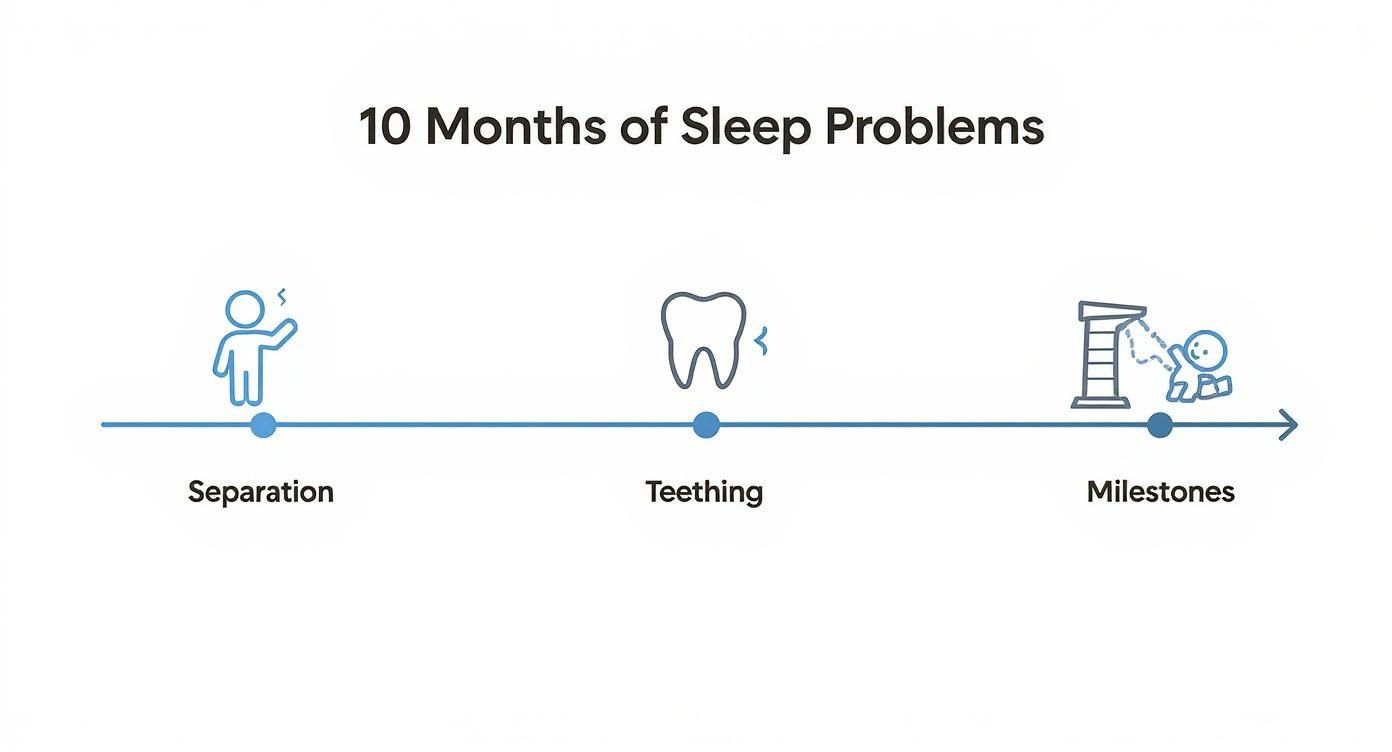
As you can see, these issues are all connected. Your baby's brain is exploding with new awareness, which is amazing, but it can definitely lead to some temporary sleep hiccups.
The Later Riser Schedule
Now, what if your baby likes to sleep in a bit? No problem. Their entire day just gets pushed back. The wake windows stay the same, but naps, meals, and bedtime all happen later. This kind of schedule often slots in perfectly with families who have later work schedules or just aren't morning people.
Here’s a potential schedule for a baby who wakes around 7:30 AM:
- 7:30 AM Good morning! Time for a bottle or nursing.
- 9:00 AM Breakfast with solids.
- 10:30 AM - 11:45 AM Nap 1 (after a 3-hour wake window).
- 11:45 AM Another bottle or nursing session.
- 2:15 PM Lunchtime.
- 3:15 PM - 4:30 PM Nap 2 (after a 3.5-hour wake window).
- 4:30 PM Bottle or nursing.
- 6:30 PM Dinner.
- 7:30 PM Final bottle or nursing of the evening.
- 8:00 PM Bedtime (after a 3.5-hour wake window).
Early Riser vs. Later Riser Schedule Comparison
Seeing the two schedules side-by-side really highlights how the same core principles apply, just at different times of the day. It’s all about adapting the structure to your baby’s natural rhythm.
| Time | Early Riser (6:00 AM Wake-Up) | Later Riser (7:30 AM Wake-Up) |
|---|---|---|
| Wake-Up | 6:00 AM | 7:30 AM |
| Nap 1 | 9:00 AM - 10:15 AM | 10:30 AM - 11:45 AM |
| Nap 2 | 1:45 PM - 3:00 PM | 3:15 PM - 4:30 PM |
| Bedtime | 6:45 PM | 8:00 PM |
As you can see, the "magic" isn't in the specific time on the clock, but in the consistent wake windows and flow of the day.
The most important thing to take away from these examples is the pattern, not the precise times. Watch your baby, learn their tired cues, and honor their individual need for awake time.
Your little one might need slightly different wake windows than what’s shown here, and that’s more than okay. If you want to dig a little deeper, getting a broader perspective on how to create a sleep schedule for your baby can be a huge help. Ultimately, the goal is to build a predictable rhythm that makes your baby feel secure and brings a little more calm to everyone's day.
Your 10-Month-Old Sleep Questions Answered
Even with the perfect schedule on paper, real life with a 10-month-old can throw you some serious curveballs. Let's dig into some of the most common questions and "what-if" moments that pop up around this age, so you can handle them like a pro.
What About Night Feedings?
By 10 months old, the vast majority of healthy babies don’t need calories overnight. They’re getting more than enough from their daytime milk and solid food to keep them going for a solid 10-12 hours at night.
Of course, that doesn't mean they don't want that middle-of-the-night snack! It’s often more about habit than hunger. If you and your pediatrician have given the green light to wean night feedings, a gradual approach is usually best. You can slowly reduce the amount in the bottle or the time spent nursing over a few nights until the feed is gone.
How Do We Handle Travel or Sickness?
Life happens! A family vacation or a bout with a nasty cold can absolutely derail your beautifully crafted 10 month old sleep schedule. The main goal here is simple: prioritize sleep however you can get it.
When your baby is sick or you're traveling, it's okay to bend the rules. Offer extra cuddles and support. The goal is to get back to your consistent routine as soon as everyone is healthy and back home.
As soon as you walk back in your front door, jump right back into your normal routine. Don’t hesitate. It might take a few days for things to click back into place, but babies are incredibly resilient and actually crave that predictability.
Why Is My Baby Fighting the Second Nap?
This is a classic parent panic moment. The afternoon nap suddenly becomes a battleground, and you immediately think, "Are they ready to drop to one nap?!"
Slow down! It's extremely rare for a 10-month-old to be truly ready for a single nap. This resistance is almost always a sign of something else going on.
- Your wake window might be off. Try adding just 15-20 minutes of awake time between the first and second nap.
- They're practicing new skills. Is your baby spending the entire nap time pulling up to stand and cruising around the crib? It's exciting stuff, and sometimes that novelty is more interesting than sleep.
- It could be a developmental leap. A brief "nap strike" is a common blip on the radar during major cognitive bursts. If you stay consistent, it usually passes within a week or so.
Is It Too Late to Sleep Train?
Absolutely not! In fact, ten months is a fantastic age to work on independent sleep skills. Your baby is old enough to understand routines and has the capacity to learn how to self-soothe.
You’re not behind at all. There are many gentle and effective ways to approach this. If you’re ready to take that step, a great place to start is by exploring different toddler sleep training methods to find a style that fits your family's philosophy.
At Little Venture Co., we believe that peaceful nights start with comfort. Our ultra-soft bamboo sleepwear is designed to be gentle on your baby's skin, helping them stay cozy and settled all night long. Explore our collection and wrap your little one in comfort at https://littleventureco.com.