

Two Piece Sets Shorts and Top: A Parent's Buying Guide
The changing mat is already a wrestling ring. Your toddler is twisting away, one leg is kicking, and the shirt you picked has a neckline that refuses to stretch over a round head. Then the shorts go on, and the waistband leaves a red mark before breakfast. You reach for the nearest clean separates and call it an outfit.
That routine is exactly why two piece sets with shorts and a top earn a place in a small child's wardrobe. The matching pieces remove one decision, but the primary value has little to do with looking coordinated. A good set should feel soft, move with a diaper or busy body, survive washing, and give you clear information about fabric and safety instead of vague marketing promises.
I'm approaching this like the parent-friend who has learned that a cute print can't rescue a scratchy seam. We'll look at fabric performance, fit, certifications, care, versatility, and meaningful gifting so you can buy one reliable set instead of cycling through several disappointing ones.
The Outfit Struggle Every Parent Knows Too Well
Some mornings begin with a calm child and a cooperative outfit. Most don't. A toddler sees the changing mat, decides personal freedom matters more than clothing, and turns a simple shirt change into a full-body escape attempt. If the top feels stiff, the neck opening is narrow, or the shorts pinch around the diaper, you're negotiating before anyone has eaten.
Parents usually solve the problem by grabbing whatever is clean. A printed tee meets unrelated shorts, a pajama top becomes a daytime shirt, and a once-planned outfit disappears under the realities of daycare, spills, and rushed departures. That works in an emergency, but it creates a wardrobe full of pieces that don't necessarily work together.
A coordinated set removes one small but persistent task. The top and shorts already share a fabric, color story, or print, so you can dress a child quickly without building an outfit from scratch. You can also separate the pieces later, which keeps the purchase practical rather than precious.
Parent-tested rule: Matching is useful only after comfort, fit, and washability have passed inspection.
The set format helps with more than mornings. It makes daycare changes easier to pack, keeps travel outfits visually organized, and gives relatives a clear gift choice when they don't know your child's entire wardrobe. Still, “matching” shouldn't persuade you to ignore a bad waistband or a questionable label.
The right buying order is simple:
- Feel the fabric first: Softness matters, but look for a fabric that manages moisture and doesn't cling uncomfortably.
- Inspect the construction: Check seams, waistbands, neck openings, snaps, and any decorative elements.
- Verify safety claims: A certification you can check is more useful than “gentle” printed on a product page.
- Plan repeat wear: Choose a color or print that works with layers and separates already in the drawer.
A set should make life easier after purchase, not merely look appealing in a product photo.
What Counts as a Two Piece Set Shorts and Top
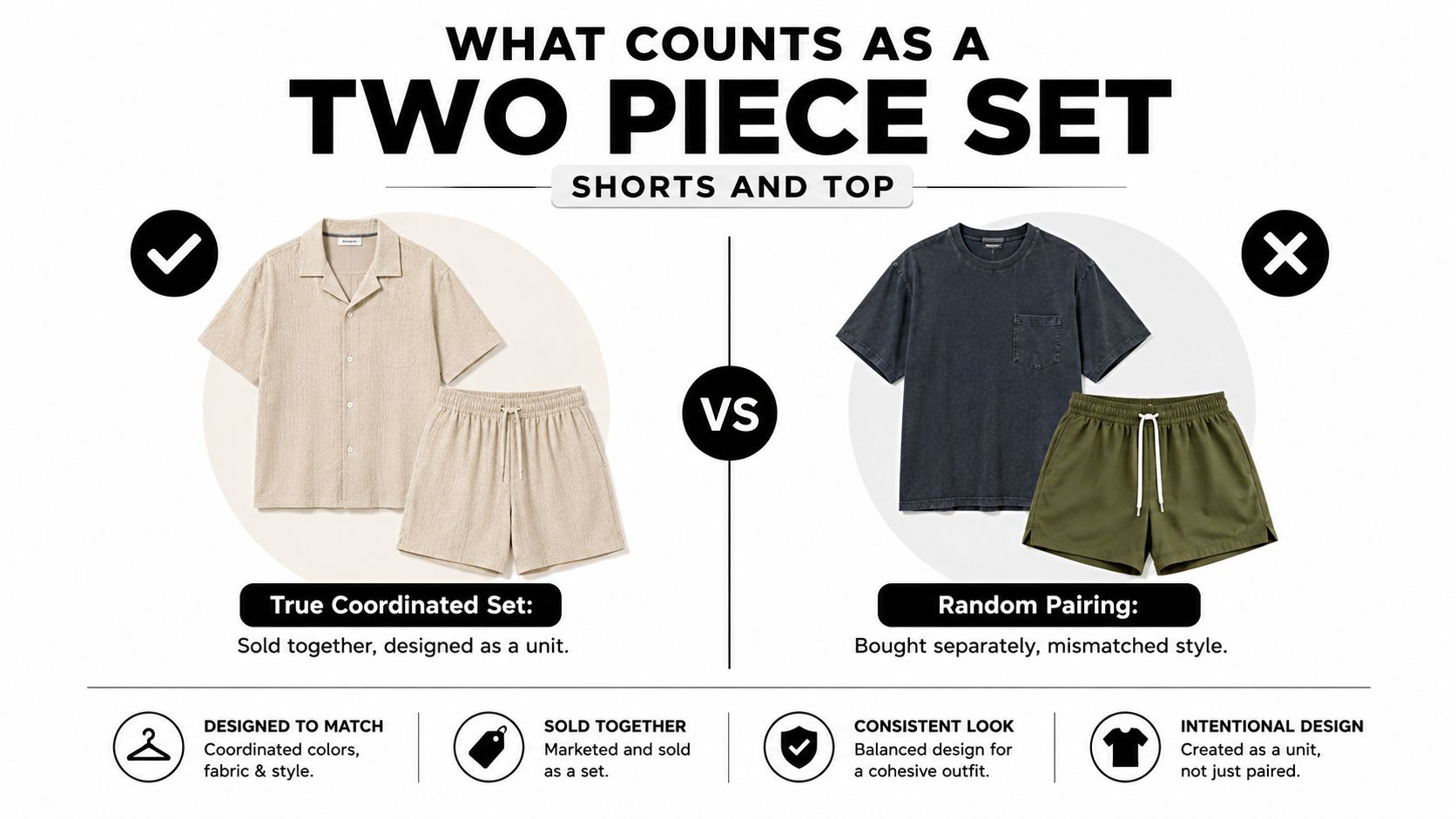
A true set is a coordinated top and shorts pairing sold, photographed, or designed to function as one outfit. The top might be a tee, tank, or short-sleeve pullover. The bottom is usually an elastic-waist short, though the details vary by age and brand.
The important distinction is intentional design. Two garments don't become a set just because someone placed them beside each other in a flat-lay photograph. A real coordinated set shares a print, fabric, trim, color family, or design language. The pieces should look natural together and remain useful apart.
The matching-coord tradition
Coordinated dressing has a long history in Western fashion. Fashion historians trace matching ensembles to the 16th and 17th centuries, when European men wore coordinated doublets and hose. In the 1920s, Coco Chanel helped popularize matching cardigan-and-skirt sets in patterned jersey, and the 1930s twinset established another familiar version of coordinated womenswear. The modern shorts-and-top set is part of that recurring tradition, not a brand-new idea (The New York Times' fashion history of matching sets).
For children, the common silhouettes are straightforward:
- Relaxed tee and elastic-waist shorts: The safest everyday choice for play, daycare, and quick changes.
- Cropped top and high-rise shorts: More fashion-led, and worth checking carefully for coverage during crawling, bending, or climbing.
- Ribbed knit pair: Stretchy and visually polished, though rib structure can feel warmer depending on thickness.
- Tank and pull-on shorts: Useful in hot weather when arm coverage isn't needed.
The set shouldn't lock you into one look. A matching top can work with denim, leggings, or plain cotton shorts, while the original shorts can pair with a simple tee. That flexibility is what separates a useful set from a novelty purchase.
Why Bamboo Viscose Performs on Sensitive Skin
A toddler comes in sweaty from play, then needs to wear the same set through a nap. In that situation, fabric comfort matters more than a trendy “cooling” label. Bamboo viscose is a regenerated cellulose fiber, made by processing cellulose into a usable textile fiber. Its practical advantage in a shorts-and-top set is moisture management, not a promise that it will keep every child cool in every condition.
Commercial moisture-regain values for viscose and rayon-type fibers are typically about 11.0% to 13.0%, compared with roughly 7.0% to 8.5% for cotton (bamboo and cotton material comparison). That difference helps explain why bamboo viscose can feel drier against skin during sweating, naps, or warm play.
The thermal claim needs a careful reading. Comparative research found that regenerated bamboo and viscose-bamboo knits can improve absorbency, wettability, and moisture-vapor transmission compared with standard viscose. Peer-reviewed comfort testing did not find a statistically significant thermal-resistance advantage over comparable cotton constructions, so knit structure, fabric thickness, and garment design still affect the result (comparative study of regenerated bamboo, cotton, and viscose).
What parents should feel and inspect
A well-made bamboo viscose set usually feels smooth and offers useful stretch. Check the garment itself, not just the fiber name. Run your hand over the seams, inspect the rib knit, check the waistband finish, and see whether the fabric clings after movement. Softness helps, but it does not prove that the set will suit your child.
For a plain-language overview, read this explanation of what bamboo viscose fabric is. Then judge the specific garment's construction.
Sleep-related comfort research also identifies thickness and thermal conductivity as direct comfort variables. Tested textiles in preschool sleep studies ranged from 0.6 to 5.6 millimeters in thickness and 0.06 to 0.09 W/(m·K) in thermal conductivity (material and comfort discussion). Treat those figures as a reminder that a fiber label cannot describe the whole wearing experience.
| Property | Bamboo Viscose | Cotton |
|---|---|---|
| Moisture behavior | Often manages sweat effectively because viscose-type fibers have higher moisture regain | Reliable absorbency, with lower typical moisture-regain values |
| Thermal behavior | Can feel cool at first touch, but does not guarantee lower thermal resistance | Can be comfortable across many constructions |
| Handfeel | Usually smooth and drapey | Varies widely by weave, finish, and fiber quality |
| What matters most | Knit structure, thickness, seams, and care | Knit structure, thickness, seams, and care |
Choose bamboo viscose when sweat management and a smooth feel are priorities. Ignore “cooling” hype if the set fits poorly, clings, or cannot handle regular washing.
Safety and Certifications Worth Checking Before You Buy
Your toddler's set may look soft and harmless, yet the label alone cannot confirm that. “Hypoallergenic” is marketing language unless the brand supports it with a verifiable certification or clear testing information. Choose specific documentation over a long list of soothing adjectives.
The three labels that deserve attention
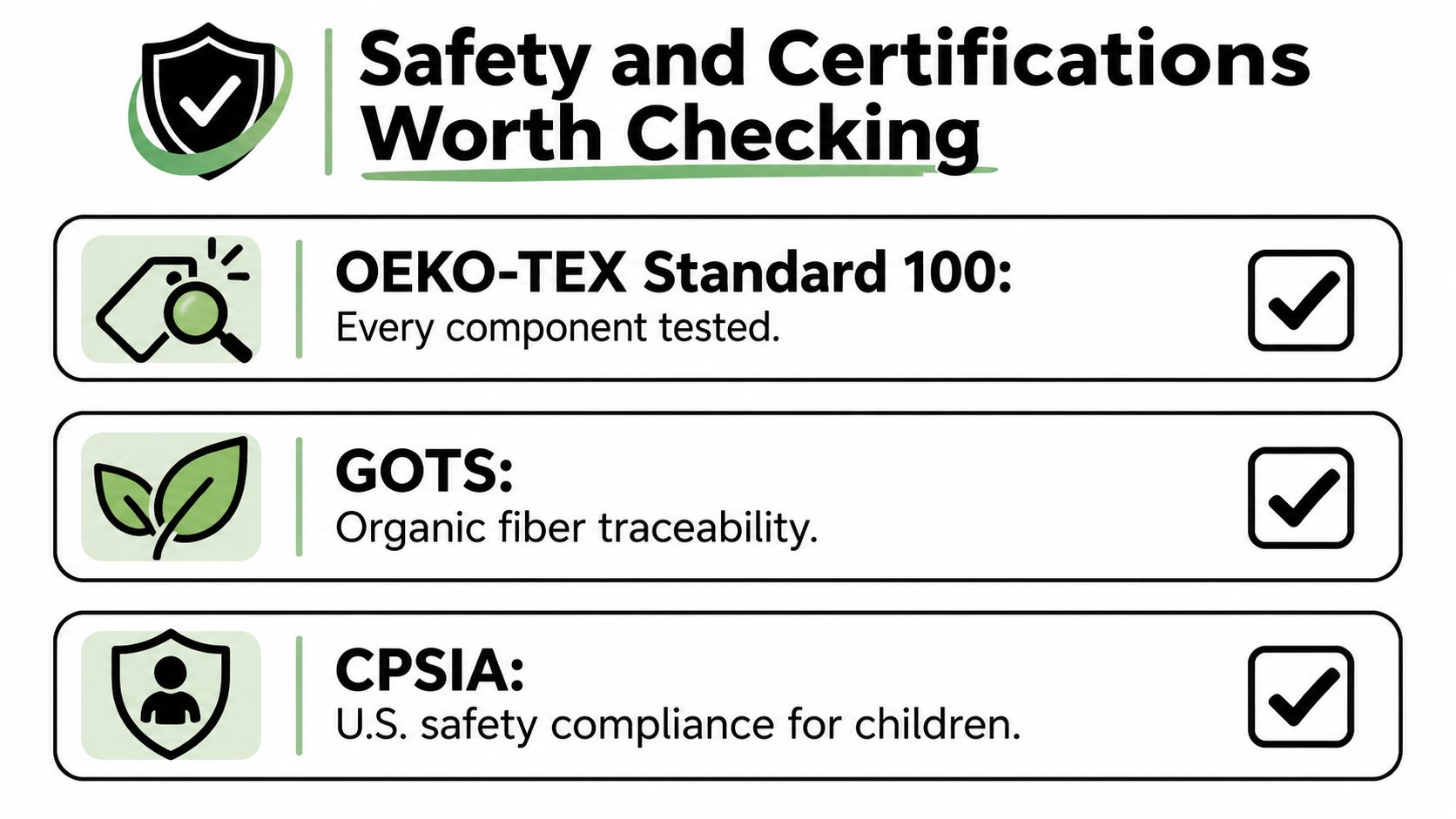
OEKO-TEX Standard 100 evaluates the finished textile and its components, not only the main fabric. Look for coverage of the thread, labels, elastic, snaps, and other parts. A brand should provide a certificate number or product-specific verification details that you can check through the OEKO-TEX system. This OEKO-TEX Standard 100 guide explains what the standard covers.
GOTS addresses organic-fiber traceability and processing requirements. If organic sourcing matters to your family, confirm that the actual product carries a valid certification claim. “Organic-inspired” wording does not establish certified organic content.
CPSIA concerns U.S. children's product safety requirements. Check it closely when the garment includes snaps, zippers, trims, or other components that may raise concerns about lead or restricted substances. The documentation should apply to the product, not make a general statement about the company.
A physical inspection still matters
Certification does not replace your own check. Run your fingers over the labels and seams, then look for loose threads, peeling decorations, and hardware that could irritate skin. For toddler shorts, choose a drawstring-free waistband. Tug gently on decorative pieces before the first wear to see whether they are securely attached.
Use this checkout checklist:
- Can I find a specific certification or test reference?
- Does the claim apply to the finished garment and its components?
- Are the snaps, trims, and elastic covered by the product information?
- Does the waistband avoid functional drawstrings?
- Will the care instructions help preserve the fabric and construction?
Little Venture Co. publishes OEKO-TEX information for its bamboo viscose garments. That gives shoppers a concrete detail to verify instead of asking them to rely on “hypoallergenic” alone.
For faith-inspired gifting, certifications also add a practical layer to a meaningful present. A set chosen for a baby dedication, birthday, or family celebration should feel thoughtful, wash well, and give parents clear safety information. The message matters, but the garment still needs to pass a real-world inspection.
Sizing and Fit That Grows With Your Toddler
A toddler set can look right on the hanger and fail during the first car ride. Torso length and height determine where the shorts sit, where the sleeves end, and whether the neckline stays comfortable under a harness. Weight only narrows the size range. It cannot show whether the diaper area has enough room.
Measure from the shoulder through the body, then compare the result with the brand's chart. Leave ease across the chest and thighs for crawling, climbing, and sitting. Avoid sizing so generously that the shorts slide or the neckline gaps. Bamboo viscose offers some stretch, but it will not correct a waistband that rolls or a rise that cuts across a diaper.
The fit check before removing tags
- Chest: The top should skim the body without pulling. Lift both arms and check whether the hem rides sharply upward.
- Neckline: It should pass over the head without a struggle, then sit close enough to avoid gaping around the belly.
- Waistband: It should rest at the natural waist and remain flat. Rolling points to elastic that is too tight, too narrow, or poorly finished.
- Rise: The shorts need room over the diaper and enough coverage for crawling, climbing, and sitting.
- Inseam: The leg opening should clear the diaper line while covering the thigh comfortably, without squeezing it.
- Sleeves: Short sleeves that barely reach the shoulder can pull during movement and feel restrictive beneath a car-seat harness.
A fold-over waistband can provide useful adjustment as your child grows. Treat it as a feature, not a promise of longer wear. Check the fabric's recovery and the stitching after stretching it gently.
For special-event outfits, choose accessories that coordinate without creating extra fuss. kids bridal accessories can help when a child's set needs a small ceremony-ready detail.
| Age Range | Typical Height (in) | Top Chest Fit (in) | Shorts Waist (in) | Inseam (in) |
|---|---|---|---|---|
| Infant and toddler sizing varies by brand | Check the brand chart | Measure the child | Measure at the natural waist | Measure from rise to hem |
Room to grow should mean comfortable movement, not excess fabric. If the set fits perfectly on the first day, it may soon feel tight. If it hangs loosely, the child may trip, the shorts may sag, and the top may twist.
Use the brand's own baby clothing size chart with your measurements, especially when buying a gift.
Matching the Set to the Moment
A shorts-and-top set can handle several jobs, but not every silhouette handles every job equally well. The right purchase depends on what your child does in the clothes, not just how the outfit looks in a styled photograph.
For everyday play, choose a relaxed tee, secure elastic, and a fabric that doesn't feel precious around snacks and outdoor mess. A ribbed set can look pulled together, but deep ribs or dense construction may not be your first choice for a very warm day. For sleep and lounge use, seams and labels become more important than decorative details.
Travel is where coordinated sets make the strongest practical case. One outfit is easy to identify in a suitcase, and separate pieces can be recombined with familiar basics. If you're gifting, neutral colors, cheerful motifs, and useful sizing information are safer choices than a highly specific fashion silhouette.
Match the features to the occasion
| Scenario | Key Set Features | Why It Matters | Nice-to-Have |
|---|---|---|---|
| Everyday play | Relaxed cut, secure waistband, durable seams | Supports crawling, climbing, and frequent changes | Stain-friendly color |
| Sleep or lounge | Smooth seams, soft handfeel, minimal labels | Reduces irritation during rest | Matching pajama styling |
| Travel | Easy pull-on design, flexible fabric, pieces that separate well | Simplifies packing and outfit changes | Coordinating cardigan |
| Gifting | Clear size details, wearable palette, presentable packaging | Helps the recipient use the gift instead of storing it | Faith-inspired message |
| Church or family photos | Coordinating solids, modest neckline, neat finish | Looks intentional without restricting movement | Sun hat or cardigan |
For church, baptism-related gatherings, or family photographs, a coordinated solid or restrained print usually works better than an outfit overloaded with novelty details. Add a cardigan for indoor air conditioning or a sun hat outside. The child remains comfortable, and the set still looks considered.
A good bamboo set can move from morning errands to a family visit with a layer change. That flexibility is more valuable than owning several outfits that all serve the same warm-weather purpose. Think in terms of roles, then buy the set that covers a real gap.
Care, Styling, and Getting More Out of One Set
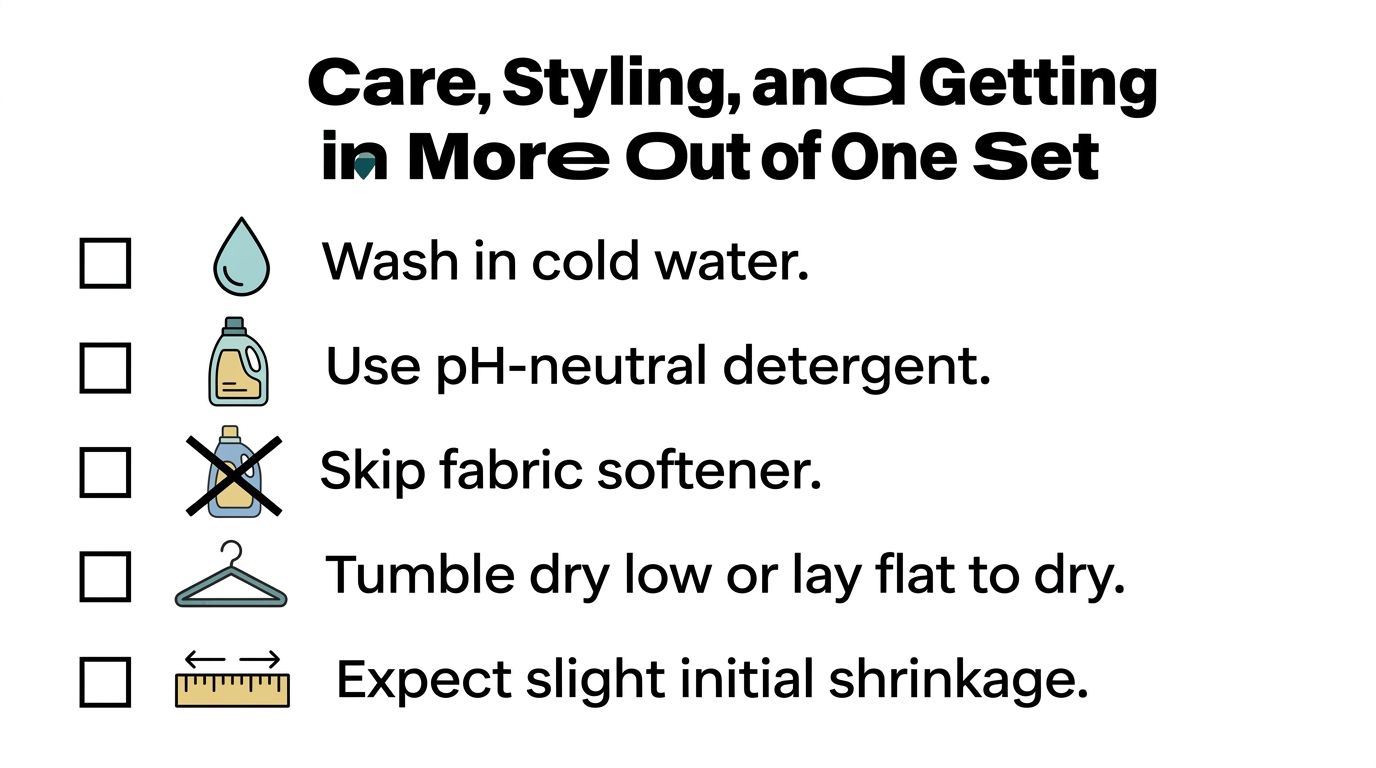
Care determines whether bamboo viscose stays soft and wearable. Read the garment label first. If it allows, wash the set in cold water with a mild, pH-neutral detergent. Skip fabric softener. It can coat the fibers without fixing damage caused by rough washing or too much heat.
Lay the pieces flat to dry when possible. Use a low tumble-dry setting only when the label permits it, and expect slight initial shrinkage if the set receives more heat than recommended. Avoid optical brighteners. Temperature, friction, and harsh additives matter more than aggressive cleaning.
Use this routine:
- Wash cold: Cold water is gentler on color and fiber structure.
- Use mild detergent: A pH-neutral option reduces unnecessary harshness.
- Skip softener: Let the fabric's own handfeel do the work.
- Dry carefully: Choose low heat or lay the garment flat.
- Check the first wash: Compare the fit before putting the set into heavy rotation.
For step-by-step guidance, use this guide to washing bamboo clothing. Check the fit after the first wash, especially around the waistband and leg openings, before relying on the set for regular wear.
Style beyond warm weather
A shorts set can work beyond hot days. Layer a long-sleeve bodysuit underneath, add a cardigan or zip hoodie, and pair the shorts with leggings in a related color when bare legs are uncomfortable. The top also works with plain trousers or denim. The shorts can pair with a basic tee.
Neutral pieces give you more outfit combinations. A plain top balances printed bottoms, while patterned shorts add interest to a simple bodysuit. Separate use also helps parents spot whether one piece is wearing out faster than the other.
A soft set can serve as relaxed weekend clothing when its coverage and construction fit the activity. The goal is practical rotation, not forcing one outfit into every situation. Choose pieces that remain comfortable, washable, and useful after the original matching look has been worn.
Choosing a Set That Means Something
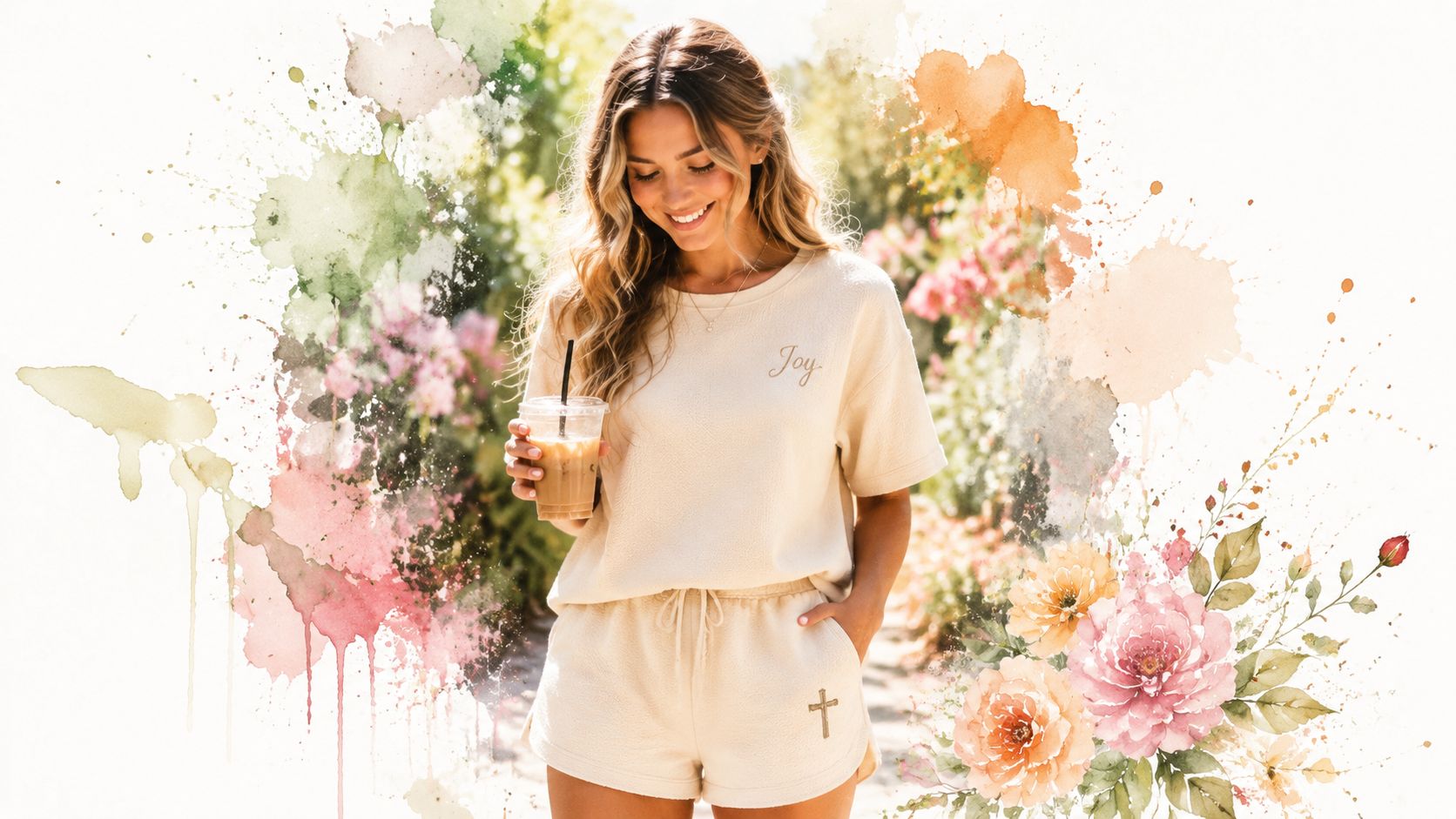
A child's outfit can carry a small message without becoming a costume. Faith-inspired children's clothing often uses scripture references, kindness cues, or uplifting themes to connect everyday dressing with the values a family is already teaching. For a baby or toddler, that message is mostly for the adults around them, but it can still shape how a gift is received and remembered.
A two-piece set becomes more than a convenient purchase. A soft top and shorts can support sensitive skin, while a thoughtful design can give grandparents, godparents, or church friends a meaningful story to share. The clothing still has to work first. No inspirational phrase makes up for a tight waistband, unsafe trim, or care routine that leaves the fabric rough.
What to look for in a values-led purchase
Start with the garment itself. Look for soft construction, sensible coverage, clear sizing, and a verifiable safety certification. Then consider whether the brand explains its materials and purpose plainly. A mission should be visible in the company's information, not implied through vague emotional language.
Little Venture Co. offers faith-inspired bamboo viscose daywear and sleepwear for babies and toddlers, including two-piece designs such as Fruit of the Spirit Two-Piece Pajamas and Sea World Two-Piece Pajamas. Its product information describes OEKO-TEX Standard 100 certification for its materials and a contribution from sales to Heartbeat International, which supports pregnant women in need globally.
That combination gives parents several practical reasons to consider a mission-driven brand:
- Comfort: Bamboo viscose can provide a smooth feel and useful moisture management.
- Verification: A named certification gives you something concrete to check.
- Gift meaning: Faith-inspired themes can make a baby shower, holiday, or church gift feel personal.
- Modeling generosity: A purchase connected to charitable support can open a simple conversation about caring for others.
The best two piece set shorts and top purchase balances all three decisions: comfort, safety, and meaning. Trend appeal comes last. If the set fits well, washes properly, and reflects what your family values, it has a much better chance of becoming a favorite instead of clutter.
Little Venture Co. offers faith-inspired bamboo viscose daywear and sleepwear, including coordinated two-piece options for babies and toddlers. Visit Little Venture Co. to compare soft, OEKO-TEX certified styles that make everyday dressing more comfortable and meaningful.