

How to Get Sleep with Newborn: Essential Tips for Exhausted Parents
If you're reading this in the quiet chaos of a 3 AM feeding, I want you to know one thing: you are not alone. Getting any real sleep with a newborn feels like an impossible dream, but the path to more rest starts with a massive shift in your mindset.
This isn't about finding some magic trick. It's about letting go of expectations and learning to maximize even the smallest windows of sleep. Think of this phase as pure survival and bonding, not perfection.
Embracing the Beautiful Chaos of Newborn Sleep

The journey into parenthood is a beautiful, blurry whirlwind of joy, love, and exhaustion so deep you feel it in your bones. The real first step to getting more sleep is to release the pressure you feel to have it all figured out right away.
Your baby isn't operating on a 24-hour clock. They're living in a simple world of immediate needs—food, comfort, and closeness. Trying to force a rigid schedule on a tiny human who literally doesn't know day from night is a recipe for frustration.
Instead, try thinking of this time as the fourth trimester. Your baby just spent nine months in a warm, dark, constantly moving space. Your job now is to gently ease them into this big, bright, loud world by responding to their cues and finding a rhythm that works for your family.
Newborn Sleep Realities vs Common Expectations
It's so easy to get caught up in what we think newborn sleep should look like. Let's get real for a second. Here’s a quick look at common hopes versus the biological reality, which can really help you adjust your mindset.
| Common Expectation | Newborn Reality | A More Realistic Approach |
|---|---|---|
| "My baby will sleep through the night by 6 weeks." | Waking every 2-3 hours is normal and necessary for feeding. | Celebrate a 4-hour stretch like it's a national holiday. Focus on creating one longer sleep period. |
| "I can put my baby on a strict schedule from day one." | Newborns have no concept of time; their internal clocks are undeveloped. | Follow their lead. Look for sleepy cues (yawning, rubbing eyes) and create a gentle routine, not a rigid schedule. |
| "If I'm a good parent, my baby will sleep well." | Sleep is developmental, not a reflection of your parenting skills. | Give yourself grace. Responding to your baby's needs is good parenting, even if it means you're up all night. |
Adjusting your expectations from the get-go can completely change your experience. It replaces frustration with acceptance, which is a huge win for your mental health.
Why Newborn Sleep Is So Erratic (It's Biology, Not You!)
Understanding the "why" behind your baby's wild sleep patterns can bring a surprising amount of peace. I promise, it’s not something you’re doing wrong—it's pure biology.
For starters, their stomachs are tiny. By day ten, their tummy is only about the size of a ping-pong ball, so it needs constant refilling. Waking up to eat isn't a personal mission to disrupt your REM cycle; it's a survival instinct.
Newborns sleep a lot—typically 16-17 hours a day—but they do it in short, frustrating bursts. Their sleep cycles are only about 50-60 minutes long. Plus, their internal clock (the circadian rhythm) is completely undeveloped, so they have no idea that nighttime is for long stretches of sleep. This is why waking up two or three times for a lengthy feed is totally normal.
You can learn more about healthy sleep patterns and the critical importance of back-sleeping on the BC Children's Hospital's website.
The goal isn't to get eight uninterrupted hours of sleep for yourself right away. The real win is finding moments of peace, learning to rest whenever you can, and soaking in the precious, fleeting moments of this season.
This period is temporary. Instead of fighting it, try to lean into the rhythm of round-the-clock care. See it as a unique time for bonding, endless snuggles, and learning the secret language of your new baby. Chasing a perfect night's sleep will only exhaust you more. Embracing the beautiful, messy reality is where you'll find your strength.
Creating a Peaceful and Safe Sleep Sanctuary

Setting up your baby’s sleep space is one of the most practical things you can do to get everyone a little more rest. Think of it as creating a tiny, peaceful retreat that signals it's time for calm and sleep. This goes way beyond cute decorations—it’s about building an environment that’s soothing and, above all else, incredibly safe.
The foundation of this little sanctuary is built on a few non-negotiable safety rules. Let's walk through the essentials every single parent needs to have on lock.
The ABCs of Safe Sleep
When it comes to your baby’s sleep, nothing matters more than safety. The easiest way to remember the most important guidelines is with the simple acronym ABC: Alone, on their Back, in a Crib. This isn't just some catchy phrase; it's a life-saving practice recommended by pediatricians to drastically reduce the risk of Sudden Infant Death Syndrome (SIDS).
Here’s a quick breakdown of what that means for you:
- Alone: The crib needs to be totally clear of loose items. That means no blankets, no pillows, no bumpers, and no soft toys. They might seem cozy, but they are serious suffocation hazards. Your baby should be the only thing in their sleep space.
- Back: Always, always, always place your baby on their back to sleep—for every nap and every night. Even if they've started to roll over, you still put them down on their back to start. This position is the safest for keeping their airway clear.
- Crib: Your baby needs to sleep on a firm, flat surface in a safety-approved crib, bassinet, or play yard with nothing but a fitted sheet. Never let them sleep on a soft surface like a couch, an armchair, or your bed.
I can't stress this enough. The "Back to Sleep" campaign in the 1990s, which first promoted this, cut SIDS rates in the U.S. by over 50%. That statistic alone shows just how powerful these simple rules are. For more information from global health experts, you can explore the WHO’s recommendations for safe infant sleep.
Recreating the Comfort of the Womb
Beyond the critical safety rules, the goal is to make the room feel a lot like the womb. Your newborn just spent nine months in a dark, noisy, and snug environment. Bringing some of those elements into their nursery can work wonders for helping them settle down.
Think about what they can see and hear. Blackout curtains are a total game-changer for creating a dark space, which helps signal to your baby’s developing brain that it's rest time, even for naps during a bright day.
A white noise machine is another must-have. It provides a steady, shushing sound that mimics the constant hum they heard inside you. It’s also brilliant at blocking out all the random household noises—the doorbell, a dog barking—that can jolt a baby awake. Just aim for a volume similar to a running shower.
A baby's room that is dark, cool, and filled with a gentle, consistent sound can feel like a familiar, safe haven, making it much easier for them to drift off to sleep and stay asleep longer.
Choosing the Right Temperature and Materials
The temperature of the room is another big piece of the puzzle. A cool room, somewhere between 68 and 72 degrees Fahrenheit (20-22 degrees Celsius), is considered ideal. Overheating is a known risk factor for SIDS, so you want to be really careful not to overdress your baby in too many layers.
This is where the right PJs make all the difference. The clothes your baby wears to sleep are their own little micro-environment. Choosing fabrics that are breathable and help regulate body temperature is key for both comfort and safety.
For instance, sleepwear made from bamboo viscose is incredibly soft and naturally temperature-regulating. It helps keep your baby from getting too hot or too cold by wicking moisture away from their skin. Finding that sweet spot can be tricky, but you can always check out our guide on the best temperature for baby sleep for more detailed tips.
When you're shopping for pajamas or sheets, keep an eye out for an OEKO-TEX® STANDARD 100 certification. This label means the fabric has been tested for a long list of harmful substances, so you know it's safe for your baby’s sensitive skin. It’s the kind of peace of mind every parent deserves.
Finding Your Nighttime Rhythm That Actually Works

Okay, so you've got the bassinet set up and the room is perfectly dark and quiet. Now what? The next piece of the puzzle is finding a gentle rhythm for your nights.
Forget those complicated, multi-step routines you see on social media. In these first few weeks, it’s all about creating simple, calming cues that whisper to your baby’s brand-new brain, "Hey, it's time to wind down." This isn't about forcing sleep; it's about making the environment so soothing that sleep just naturally follows.
Building a Simple Wind-Down Ritual
Your baby doesn't need an elaborate spa treatment before bed. A great wind-down ritual can be as short as 15-20 minutes and just involves a few loving, consistent actions. The magic is in the repetition, not the complexity.
Here are a few gentle ideas you can mix and match to see what your little one loves:
- A Warm, Calming Bath: There’s something so relaxing about warm water. Keep the lights low and your voice soft, and let the water work its magic.
- A Gentle Lotion Massage: After the bath, a slow, gentle massage with baby-safe lotion is a beautiful way to bond and calm their tiny nervous system.
- Slipping into Soft Pajamas: Changing into cozy sleepwear, like a buttery-soft bamboo romper, can become a powerful sleep cue. That familiar feeling of the fabric helps signal that a long, restful stretch is on its way.
- A Quiet Lullaby or Story: Don't worry about being a perfect singer. The soft, rhythmic sound of your voice is one of the most comforting things in the world to your baby.
With my first, our "magic" routine was a quick diaper change, slipping him into his bamboo PJs, and then me humming "Twinkle, Twinkle, Little Star" while swaying next to his bassinet. It was that simple, but it worked because we did it every single night.
Mastering the Art of the Ninja-Like Night Waking
When your baby inevitably wakes up in the middle of the night, your mission is to be a sleep-friendly ninja. The goal? Meet their needs—usually a feeding or a diaper change—without fully waking them (or yourself) up.
Keep things minimal and all-business. This isn't the time for playful cooing or bright overhead lights. Use a dim nightlight, change the diaper efficiently, feed them in near silence, and get them right back into their sleep space. This approach gently reinforces the idea that nighttime is for sleeping, not for hanging out.
Womb-Like Soothing Techniques
Newborns are wired to respond to sensations that mimic the womb. If you can tap into those instincts, you've found a superpower for settling a fussy baby.
The most effective techniques usually involve a combination of these:
- A Snug Swaddle: A good swaddle recreates that tight, secure feeling of the womb and helps control the Moro reflex—that startling reflex that can jolt them awake.
- Gentle Shushing: Making a loud, consistent "shushing" sound right near their ear mimics the whoosh of blood flow they heard 24/7 inside you.
- Rhythmic Rocking: Whether you're swaying, using a rocking chair, or gently bouncing on an exercise ball, that steady motion is pure gold for calming a baby.
Finding your baby's unique comfort trigger is a process of loving experimentation. What works for one baby might not work for another, and that’s perfectly okay. The goal is to be responsive and patient as you learn their language.
Data shows that newborns from 0-2 months old get about 8-10 hours of sleep at night, but it's broken into many small chunks. You can discover more insights about newborn sleep patterns from Parenting Science. To get into a better rhythm, focus on responsive settling with tools like a snug swaddle and breathable, Oeko-Tex certified fabrics. It’s also incredibly important to room-share without bed-sharing, a practice proven to cut the risk of SIDS by as much as 50%.
If you're really struggling with a fussy baby during these late-night hours, it can feel so isolating. There are many gentle ways to help calm them down. For some deeper insights and practical tips, you can learn more about how to soothe a fussy baby in our article. Remember, you’re not just trying to stop the crying; you're teaching your baby that you are their safe place, and that trust is the foundation for peaceful sleep.
How to Actually Sleep When the Baby Sleeps
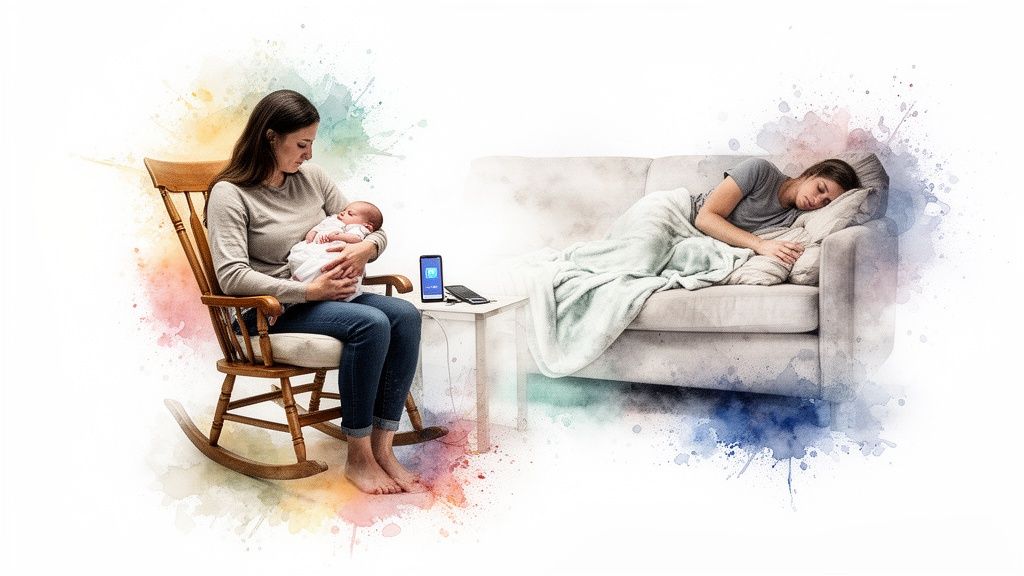
"Sleep when the baby sleeps." It's the most common piece of advice new parents hear, and honestly, it can be the most infuriating. While the intention is good, it completely ignores the mountain of laundry, the empty fridge, and your own desperate need for a shower.
This is where the theory smacks into reality. To actually get some rest, you have to get strategic. It’s not about finding more time in the day—it's about radically shifting your priorities to use the small windows of quiet you get.
Remember, this isn't selfish; it's about survival. A rested parent is a more patient and present parent. Choosing a 20-minute nap over folding onesies isn’t a luxury. It’s essential fuel for the marathon ahead.
Implement a Tag-Team Sleep System
Stop thinking you both need to be "on duty" 24/7. That's a fast track to burnout. One of the best things we ever did was create a shift system with my partner. It ensures each of you gets a solid, uninterrupted block of sleep, which is far more restorative than dozing off and on.
Here’s how it could work: one person is the primary caregiver from 9 PM to 2 AM, handling every feeding, diaper change, and soothing session. The other person is completely off the clock—sleeping in another room with earplugs if you have to. Then you swap. The second person takes the 2 AM to 7 AM shift while their partner gets a real chunk of deep sleep.
This isn't just about sharing the work. It’s about gifting each other the kind of restorative sleep that’s impossible to get when you’re half-listening for every tiny grunt from the bassinet. Even a four-hour consolidated block can feel like a full night's rest.
If you’re a single parent or your partner works nights, this "shift" can be with a family member or a close friend who can stay over. The key is to clearly define who is responsible so the "off" person can truly switch off without guilt or anxiety.
Learn to Accept and Direct Help
When friends and family ask, "How can I help?" it’s so easy to reflexively say, "We're fine!" Don't do that. People genuinely want to support you, but they rarely know what you actually need.
The solution? Have a list of specific, easy tasks ready to go.
Instead of a vague "we could use some help," try being direct:
- "Could you hold the baby for an hour so I can please take a nap?"
- "Would you mind folding that basket of laundry? It would be a game-changer."
- "Could you run to the store for milk and bread? We're completely out."
This removes the guesswork for them and gets you exactly what you need—which is often just a small break to close your eyes. For some families facing extreme exhaustion, looking into a guide to night nurses for newborns can offer a lifeline of peace and proper rest.
Redefine What "Productive" Means
Your definition of a productive day has to change. Right now, productivity isn't a sparkling clean house or an empty email inbox. Productivity is taking a shower. It’s eating a meal with both hands. It is, most definitely, sleep.
Let the non-essentials go. A perfectly tidy home can wait. Elaborate meals can be replaced with simple, nourishing snacks you can eat one-handed. Your only jobs are to care for your baby and care for yourself. Everything else is secondary.
To make this happen, create a "nap station" for yourself. Keep a comfy pillow, a blanket, an eye mask, and earplugs right next to the sofa or your bed. The moment the baby is down, you don't waste precious minutes getting comfortable. You can just lie down and seize that small window of opportunity.
Navigating Common Newborn Sleep Hurdles
Just when you think you’ve finally cracked the code, your newborn decides to rewrite the rulebook. One night, you get a glorious four-hour stretch of sleep, and the next, they’re up every 45 minutes. Sound familiar? This is completely, totally normal.
These little challenges aren't a reflection of your parenting. They’re just predictable phases every baby (and parent) goes through. Your only job is to roll with it, stay flexible, and keep reminding yourself that this won't last forever.
Decoding Day-Night Confusion
One of the first hurdles you'll likely face is day-night confusion. Your baby sleeps like a log all day, but the second your head hits the pillow, they’re wide-eyed and ready to party. This is simply because their internal clock, or circadian rhythm, hasn't kicked in yet.
The key is to gently teach them the difference.
- Daytime vibes: Keep the house bright and filled with the usual sounds of life—the dishwasher, music, your other kids. Let them nap in a sunlit room. There’s no need to tiptoe around. When they’re awake, talk to them and play.
- Nighttime mode: Do the complete opposite. Keep the lights as dim as possible, turn on a white noise machine, and keep your interactions short and sweet. Feedings and diaper changes should be quiet and all-business, signaling that it’s time for rest, not play.
This consistent contrast will help their little brain sort things out, encouraging those longer stretches of sleep right when you need them most.
Surviving Cluster Feeding and the Witching Hour
Ever felt like you've been nursing your baby for hours on end, without a break? That's cluster feeding. It often peaks in the evening and is a perfectly normal way for newborns to fill up for the night, which also helps boost your milk supply.
This often happens right around the infamous "witching hour"—that fussy, inconsolable period in the late afternoon or evening. It can feel like it will never end, but you can get through it.
Remember, cluster feeding and evening fussiness are not signs of a low milk supply or that something is wrong. They are common, temporary, and actually serve a developmental purpose.
My best advice? Set up a "nursing nest" on the couch. Get your snacks, a giant bottle of water, and the remote all within arm's reach. Then, just surrender to it.
- Wear your baby: A soft, comfortable carrier can be a game-changer, keeping your baby soothed while you get your hands back.
- Change the scenery: Sometimes, just walking outside for a few minutes or moving to a different room can hit the reset button on the fussiness.
- Tag in your partner: Don't be a hero. Let your partner, a friend, or a family member take over for a bit with some rocking or swaying.
Swaddling can also be a lifesaver during these tough moments, giving your baby that snug, secure feeling they had in the womb. But you have to know when it's time to stop for safety reasons. You can learn more about when to stop swaddling in our detailed guide.
When to Call for Backup
While most of these sleep hurdles are par for the course, never ignore your gut instinct. If your baby's crying seems pained or excessive, or if you're worried about feeding, like a poor latch or slow weight gain, it's always the right move to call in a professional.
Don’t ever hesitate to reach out to:
- Your Pediatrician: They can help rule out any medical issues like reflux or allergies that might be causing discomfort.
- A Lactation Consultant (IBCLC): An absolute must if you're breastfeeding and have any concerns about supply, your baby's latch, or potential tongue ties.
Trust yourself. You're the expert on your baby. Advocating for them—and for your own sanity—is one of the most important things you can do. You’re not supposed to have all the answers, but you are more than capable of finding them with the right support.
Your Burning Questions About Newborn Sleep
When you're running on fumes, you just need straight answers. There's no time for fluff—just practical advice for the questions that keep new parents up at night (when they aren't already up with the baby, of course). Let's dive into some of the most common newborn sleep dilemmas.
Is It Okay to Wake a Sleeping Newborn for a Feeding?
Yes, absolutely. In fact, you'll probably have to, especially in those first few weeks. Most pediatricians recommend waking a newborn for a feeding if they've slept longer than 4 hours.
This is crucial until they get back to their birth weight. Their tiny stomachs empty fast and need to be refueled constantly—we're talking 8-12 times every 24 hours—to stay hydrated and grow. Once your doctor gives you the green light, you can finally start letting them sleep for longer stretches at night, guilt-free.
How Should I Dress My Baby for Sleep?
Figuring out what a baby should wear to bed can feel like a high-stakes guessing game. You want them to be cozy, but not too warm, since overheating is a risk factor for SIDS. A good rule of thumb is to dress them in one more layer than you would comfortably wear in the same room.
A lightweight, breathable sleeper made from bamboo viscose is an amazing choice. The material is naturally temperature-regulating, so it wicks away moisture and helps prevent your baby from getting too hot or too cold. To get this just right, you can learn what TOG means and match their sleepwear to the room temperature.
A simple onesie paired with a swaddle or sleep sack is often the perfect combination. Always check for signs of overheating, like a sweaty neck or chest, and adjust accordingly.
My Partner and I Disagree on Night Wakings What Do We Do?
This is so common and almost always fueled by sheer exhaustion. The trick is to have this conversation during the day when you’re both calmer and not in the heat of a 3 AM meltdown. Start by reminding each other you're on the same team with the same goal: getting the baby (and yourselves) some sleep.
From there, work out a simple, unified plan you can both stick to.
- Try the Tag-Out Method: Agree that one person tries their soothing technique for ten minutes. If it's not working, tag your partner in to try their go-to method. No arguments, just a swap.
- Set Up a Shift System: One parent is "on duty" from 9 PM to 2 AM, and the other takes the shift from 2 AM until morning. This guarantees each of you gets a solid block of uninterrupted rest.
A little communication, teamwork, and a whole lot of grace will get you through it. Remember, you're in this together.
When Will My Baby Finally Sleep Through the Night?
Ah, the million-dollar question every sleep-deprived parent asks! The truth is, "sleeping through the night" means something totally different for a newborn than it does for an older baby. For a newborn, a solid 5-hour stretch is a massive victory worth celebrating.
Most babies aren't developmentally ready to sleep for 8-10 hours without a feed until they are at least 4-6 months old, and for many, it's even later than that. Try to focus on progress, not perfection. Every baby is on their own unique timeline. Trust the process, know this season is temporary, and give yourself credit for every little win along the way.
At Little Venture Co., we design our OEKO-TEX® certified bamboo sleepwear to give your baby the softest, safest, and most comfortable sleep possible, helping you all get a little more rest. Wrap your little one in comfort at https://littleventureco.com.