

How Can I Be Closer to God: Tips for Busy Parents
The house is finally quiet. There's a cup on the counter you forgot to finish, toys still under the couch, and a low-grade ache in your body from carrying small children all day. Then the thought shows up, honest and uncomfortable: How can I be closer to God when I can barely finish a sentence, let alone have a quiet time?
If that's where you are, I want to say this plainly. You are not failing because your spiritual life doesn't look neat right now. You're raising babies and toddlers. Your days are chopped into tiny pieces. The usual advice about long morning devotions, extended journaling, and uninterrupted prayer often doesn't fit real family life.
That doesn't mean closeness with God is out of reach. It means you need a different approach. A smaller one. A gentler one. One that works in the kitchen, in the car, during nap time, and while you're folding tiny pajamas you're pretty sure you just folded yesterday.
Embracing Faith in the Midst of Chaos
A lot of parents ask the question, “How can I be closer to God?” when they're already running on fumes. Not because they don't care. Because they do care, and they feel the gap.
You might love God profoundly and still feel spiritually thin. That happens when your mind is constantly tracking snacks, sleep schedules, diapers, laundry, appointments, tantrums, and whether anyone has brushed their teeth. The struggle to find time and mental space for spiritual habits is a real barrier for parents, and advice built around ideal routines often misses what life with little kids truly feels like. A more helpful path is using micro-practices that fit caregiving life, like quick prayers during naps or listening to Scripture while doing chores, as noted in this practical reflection on growing closer to God as a parent.
Your longing is not a problem
That ache you feel when you realize it's been a while since you sat with God on purpose? Don't treat it like shame. Treat it like hunger. Hunger isn't proof you're doing badly. It's proof you still want the right thing.
I've seen parents assume they need a spiritual reset that looks dramatic. A new planner. A strict wake-up time. A complete overhaul. That usually collapses by Tuesday because babies don't care about your new routine.
Practical rule: Don't build your spiritual life around your ideal day. Build it around your actual day.
That means your faith may grow in fragments for a while. A whispered prayer while warming milk. One verse taped near the sink. A moment of thanks while your toddler points at the moon. That counts.
God is present in ordinary rooms
You do not need a retreat center to meet with God. You need awareness. Sometimes a visual reminder helps more than a long reading plan. If it helps you keep truth in front of tired eyes, something as simple as framed Scripture verses for your home can quietly call your heart back when your brain feels scattered.
Here's what I want you to stop believing:
- “I need a long block of silence.” You might not get that in this season.
- “If I can't do it properly, I shouldn't do it at all.” That mindset starves your soul.
- “The mess in my house means the mess in my spirit is my fault.” No. It means you're human, and probably tired.
Closeness with God in early parenthood usually looks humble. Repetitive. Unimpressive from the outside. But that's often how strong faith is built anyway.
Create a Simple Rhythm with Spiritual Anchors
You don't need a rigid schedule. You need anchors. Small moments of connection tied to things you already do every day.
That's the only approach I recommend for parents of babies and toddlers. If a habit requires ideal conditions, it won't survive your real life. If it attaches to routines you already have, it has a chance.
A simple daily rhythm built around Scripture, intentional prayer, and brief evening reflection is a strong method for spiritual growth, and the key is consistency over complexity, as explained in this teaching on sustainable daily spiritual rhythms.
What a spiritual anchor looks like
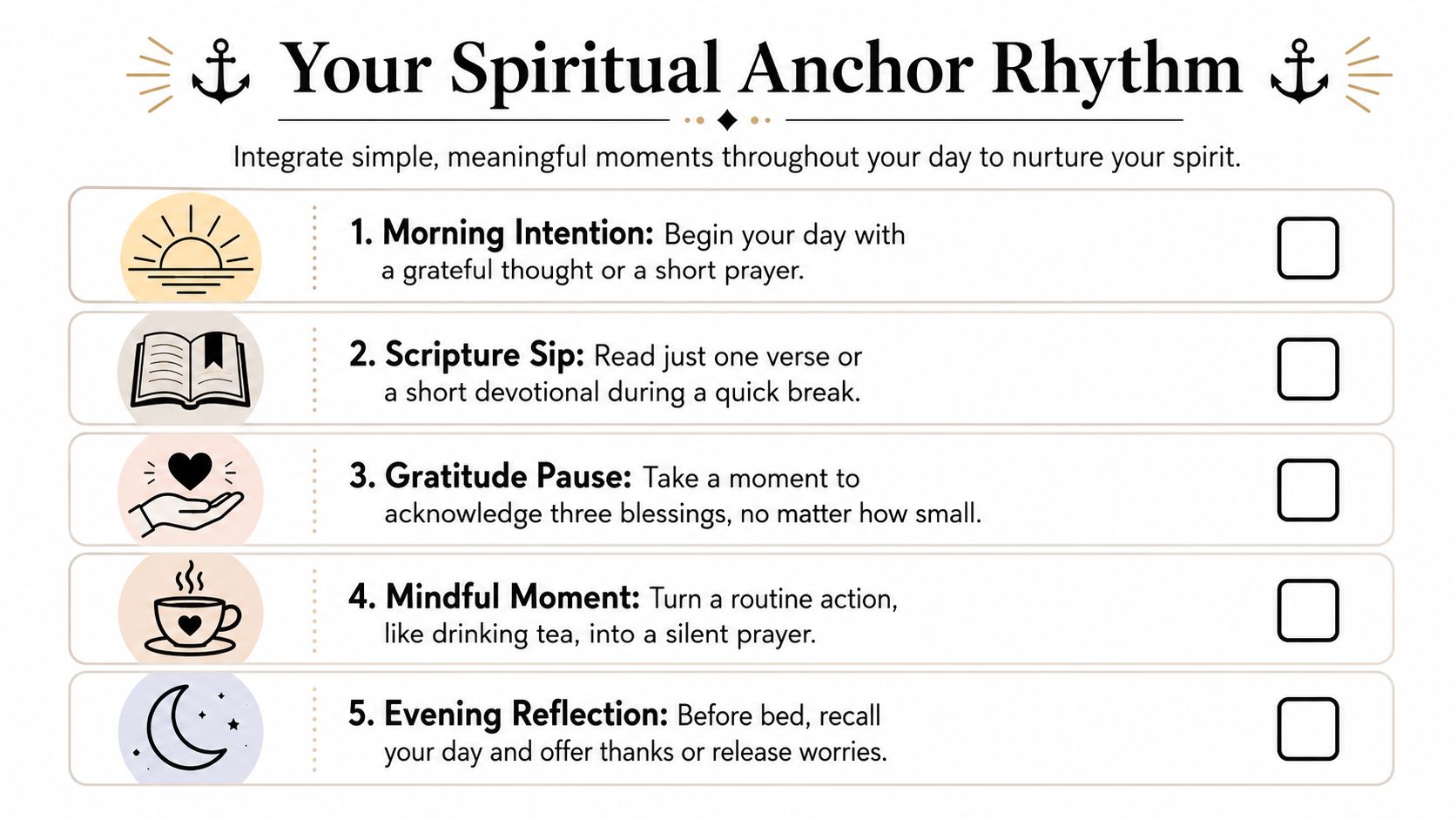
A spiritual anchor is a tiny faith practice linked to a normal part of your day. Not extra. Attached.
Try something like this:
- Coffee anchor. When the coffee starts brewing, say one sentence: “Lord, give me patience and peace for today.”
- High chair anchor. While buckling your child in for breakfast, read a paragraph from a devotional or one short passage from the Gospels.
- Laundry anchor. Listen to audio Scripture while folding clothes instead of scrolling.
- Car seat anchor. Before you start driving, thank God for one thing you almost missed.
- Bedtime anchor. After the kids are asleep, review the day and ask, “Where did I feel close to God, and where did I drift?”
Start smaller than you want to
Most parents sabotage themselves by making the plan too ambitious. They choose a routine that sounds holy instead of one they can repeat.
Use this simple pattern:
| Time of day | Anchor | Keep it short |
|---|---|---|
| Morning | Read a few lines of Scripture | A paragraph is enough |
| Midday | Pray on purpose | One honest minute counts |
| Evening | Review the day | Notice one grace, one struggle |
That's enough to begin.
If you want help choosing short readings, a simple daily devotional habit can be easier to sustain than trying to map out a complicated reading system from scratch.
Repetition beats intensity. Parents don't need a heroic spiritual life. They need one they can return to tomorrow.
A few anchors that work with toddlers nearby
Some seasons are too loud for even five uninterrupted minutes. Fine. Use lower-friction habits.
-
During nap resistance
Put your hand on the crib and pray, “God, help me love with calm.” -
During snack prep
Recite one verse you're trying to remember. -
On stroller walks
Thank God out loud for one thing you see. Tree. Wind. Sun. Bird. Keep it simple. -
At sink time
While washing bottles or cups, tell God what's making you anxious instead of rehearsing it in your head. -
During contact naps
Don't despise that trapped-on-the-couch moment. Read one psalm on your phone and stop there.
You do not need more complexity. You need a rhythm gentle enough to survive sleep deprivation.
How to Talk with God When You Have No Words
Some days prayer feels impossible because you're not rebellious, you're depleted. You sit down and nothing comes. Not reverence. Not eloquence. Sometimes not even a complete thought.
That's more common than people admit. And no, the answer isn't to force a performance.
The older practice of set prayer times can help here. Daniel is described as praying three times a day in [Daniel 6:10], and the Psalmist speaks of praying “evening and morning and at noon” in [Psalm 55:17]. That rhythm later shaped Christian habits of regular prayer, not as legalism, but as a way of staying aware of God through ordinary hours. This reflection on set prayer and Daniel's example makes the point clearly. Closeness grows through repeated contact, not occasional spiritual intensity.
Use borrowed words
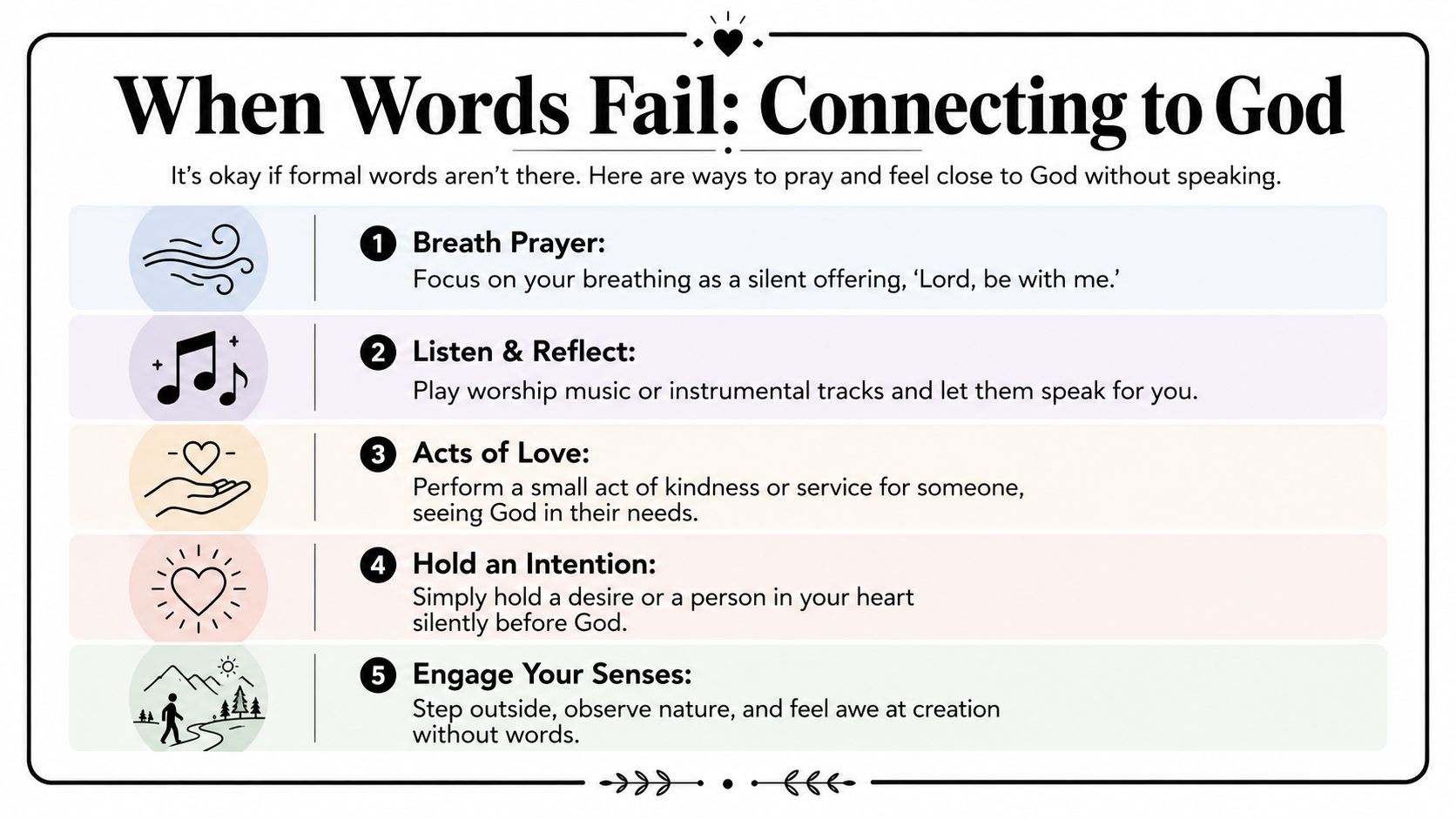
If your mind is foggy, stop insisting on spontaneous prayer. Borrow language. Written prayers are a gift, especially when exhaustion has flattened your inner life.
You can pray a psalm slowly. You can read a short liturgical prayer. You can use a simple guide from a trusted devotional. The point is connection, not originality.
Here's a low-pressure option:
-
Adoration
“God, You are good even when I feel thin.” -
Confession
“I've been short-tempered and distracted.” -
Thanksgiving
“Thank You for getting me through today.” -
Supplication
“Give me grace for the next hour.”
That structure keeps prayer from turning into rambling panic.
Try a breath prayer
A breath prayer is ideal for parents because it fits inside chaos. You pray one short line as you inhale and exhale.
Examples:
-
Inhale: “Lord Jesus”
Exhale: “give me peace” -
Inhale: “Be near to me”
Exhale: “in this moment” -
Inhale: “Father, have mercy”
Exhale: “I need Your help”
Say it while rocking a baby. Walking the hallway. Waiting outside a preschool class. Repeating the same line isn't failure. It's focus.
A short guide like these Chosen Portion insights for dry prayer can also help when prayer feels flat and you don't know how to restart without pressure.
To support that kind of low-energy prayer life, I also like practical encouragement on prayer when feeling overwhelmed, especially for parents carrying too much at once.
Here's a helpful reminder to sit with for a minute:
Let silence count too
Not every prayer needs words. Sometimes your most honest prayer is staying still long enough to stop running internally.
“God isn't grading your prayer language. He's meeting you in your weakness.”
Sit for one minute. Put both feet on the floor. Breathe. Offer your tired body to God. That is prayer too.
Finding God Together with Your Babies and Toddlers
A lot of parents assume their children are the reason their spiritual life has stalled. I think that's backwards. Your children may be the very place God is teaching you to notice Him again.
Babies and toddlers slow you down. They force repetition. They make you look at bugs, puddles, crackers, clouds, and moonlight. That can feel irritating when you're trying to get through the day. It can also become holy if you let it.

Stop separating family life from spiritual life
You do not need a “real” spiritual moment that happens after your kids are gone to bed for it to count. You can meet God with them and through them.
Try reframing the day like this:
| Daily moment | Faith practice with little ones |
|---|---|
| Morning wake-up | Say, “Thank You, God, for a new day” |
| Walk outside | Name things God made |
| Mealtime | One-sentence prayer before eating |
| Playtime | Sing a simple worship chorus |
| Bedtime | Bless your child out loud |
That isn't watered-down spirituality. That is family discipleship in its earliest form.
Tiny seeds are enough
You are not trying to create a miniature seminary in your living room. You are planting familiarity. Warmth. Repetition. Joy.
A few simple ideas work well:
- During walks say, “Look at the bird God made,” or “Thank You, God, for the rain.”
- At bedtime put your hand on your child's back and pray one line of blessing.
- At meals keep prayer short enough that a toddler can learn the rhythm.
- During play swap one nursery rhyme for a worship song you can repeat together.
- With books keep a board-book Bible nearby and read one page, not ten.
If you want more age-appropriate ideas, this guide on teaching children about God offers practical help without making it feel heavy.
A better measure: Don't ask, “Did I create a perfect spiritual environment today?” Ask, “Did my child hear or see something true about God in our home?”
Your child is not interrupting the sacred moment
Parents often believe spiritual life happens in private while kids are the interruption. But if God has given you these children, then loving them, blessing them, and welcoming them into simple habits of faith is part of the sacred work.
You're not behind because your Bible study has finger smudges on it. You're in a different classroom.
And toddlers are excellent teachers of dependence. They ask boldly. They cry honestly. They trust quickly. Adults spend years trying to relearn that.
Navigating Seasons of Spiritual Dryness
Some of you are doing the small habits. You're trying. And you still feel distant from God.
That matters, because the answer in that moment is not always more activity. Sometimes “pray more” lands like weight on an already bruised soul. When distance is tangled up with anxiety, guilt, or numbness, adding more effort can turn faith into performance.
When feeling distant because of anxiety or guilt, trying to increase religious activity can backfire. A more helpful approach is turning toward practices like silence, confession, and lament that deal directly with what's happening underneath, as explained in this teaching on spiritual dryness and receiving grace.

Name what is actually in the way
Sometimes the problem is not lack of discipline. It's unresolved guilt. Sometimes it's anxiety that never powers down. Sometimes it's exhaustion so deep that your heart feels emotionally unavailable.
Be honest about the blockage.
- If it's guilt, confess plainly. Don't spiral. Bring the specific thing into the light.
- If it's anxiety, stop pretending your racing mind is a spiritual problem only. Tell God what is scaring you.
- If it's numbness, don't fake feeling. Offer the numbness itself.
Lament is useful here. Lament means you tell the truth to God without cleaning it up first.
Examples:
- “God, I feel absent.”
- “I'm resentful and I don't want to be.”
- “I'm scared more often than I admit.”
- “I don't know why You feel far, but I want to keep turning toward You.”
Choose receiving over proving
Dry seasons expose a harsh habit many believers carry. We start treating spiritual closeness like something we earn by output.
You do not need to prove devotion to deserve God's presence. You need honesty and openness.
Try this simple reset:
-
Sit in silence for two minutes
No agenda. No fixing. -
Confess one thing without speeches
Keep it direct. -
Receive one truth
“God is merciful.”
“God is near.”
“God is patient with me.” -
Do one gentle act of return
Read one psalm. Take one quiet walk. Listen to one worship song.
When your soul feels dry, reduce pressure before you increase effort.
Watch out for spiritual self-accusation
There's conviction, and then there's the inner voice that says, “If you really loved God, this would be easy.” That voice is cruel, and it's not helping you.
Parenthood already reveals your limits every day. Dryness can become a place where God teaches you dependence instead of performance. Not glamorous. But very real.
If you've been asking, “How can I be closer to God?” while carrying shame, start here instead: “What would it look like to let God meet me as I am today?”
That question usually opens more doors than trying harder.
Your Next Small Step Toward God
Don't leave with a long list. Leave with one small step.
Not the step that sounds the most impressive. The one that feels doable in your real life. If one sentence of prayer while making coffee feels possible, start there. If one verse at bedtime feels possible, start there. If all you can manage is sitting still for one minute and whispering, “God, help,” start there.
That is not a lesser beginning. That is a wise one.
Pick one practice and keep it for a while
Choose just one:
- A morning sentence of thanks
- A short Scripture reading during breakfast
- A breath prayer during stressful moments
- A bedtime review of the day
- A simple blessing spoken over your child
Then keep it long enough to become familiar. Don't keep switching methods because you're chasing a feeling. Stability matters more than novelty.
Release the fantasy of doing everything
You do not need a perfect devotional life, a color-coded journal, family worship every night, and deep emotional prayer before sunrise. That picture crushes people.
You need a faithful, livable pattern. One that leaves room for grace. One that understands teething, tantrums, sleep regressions, and the fact that some days you'll forget entirely and begin again the next day.
The real goal is not to master spiritual habits. It's to keep turning your face toward God in the life you already have.
If your heart keeps asking how can I be closer to God, take comfort in this. The desire itself is already a kind of turning. God is not waiting for you to become less tired before He welcomes you. He is present in the hallway pacing, the dishwater, the car line, the bedtime song, and the silent minute after everyone is finally asleep.
He is closer than your feelings say.
And your next step can be very small.
If you want your home to reflect the same gentle, faith-filled care you're building in daily life, Little Venture Co. offers thoughtfully made pieces for babies and toddlers that fit a meaningful family rhythm. Their faith-inspired children's wear makes a lovely gift for little ones and a beautiful reminder that even everyday moments can point hearts toward what matters most.