

Dermatologist Approved: A Parent's Guide for Baby Skin
You're standing in the baby aisle, or scrolling late at night with one eye open, trying to pick pajamas, swaddles, bibs, detergent, maybe a body wash. Every label seems to promise the same thing. Gentle. Pure. Hypoallergenic. Dermatologist approved.
If you're a new parent, that wording can feel reassuring and confusing at the same time. You want something soft and safe. You also want to know what those words mean before they spend hours against your baby's skin.
That instinct is a good one. Parents aren't overthinking this. They're trying to make careful choices in a marketplace full of claims that sound medical, even when they aren't clearly defined. What helps is learning which labels are mostly marketing language and which ones point to something you can verify.
Navigating the World of Baby-Safe Claims
Baby products are packed with comfort words. “Clean.” “Natural.” “Sensitive.” “Dermatologist approved.” None of those phrases automatically tell you how a onesie, sleep sack, or crib sheet was evaluated.
That's where decision fatigue starts. A soft fabric can still be treated with substances you'd rather avoid. A brand can sound science-based without showing its work. And when your baby has dry patches, eczema-prone skin, or just seems fussy in certain fabrics, every label suddenly feels high stakes.
A helpful way to steady yourself is to separate marketing claims from verifiable standards.
Start with the contact question
Ask one simple question first: Will this touch my baby's skin for long periods of time?
For clothing and textiles, the answer is usually yes. Pajamas, bodysuits, hats, crib sheets, burp cloths, and blankets all spend hours in direct contact with delicate skin. That means the material matters, but so do dyes, finishes, and residues.
If you want a plain-English primer on a textile standard many parents look for, this overview of OEKO-TEX Standard 100 is a useful place to begin.
Why the phrase causes so much confusion
“Dermatologist approved” sounds precise. It sounds like a formal category. It isn't.
For many parents, the hidden confusion is this: the phrase sounds like a stamp of safety, but it often doesn't tell you whether a dermatologist reviewed a lotion formula, tested a finished fabric, or signed off on part of a product story. Those are very different things.
Practical rule: If a claim sounds medical, look for the details that make it real. Who reviewed it, what was evaluated, and can you verify anything beyond the phrase itself?
That's especially important with baby clothing. A lotion can be patch tested. A sleeper or swaddle needs a different kind of confidence. You're not just looking for “approved.” You're looking for clear safety signals tied to the actual textile.
What Does Dermatologist Approved Actually Mean
The phrase gets used like a seal. In reality, it works more like a loose description unless a brand explains it.
A dermatologist is a physician trained to diagnose and treat diseases of the skin, hair, nails, and mucous membranes. Board-level eligibility commonly requires completion of an accredited dermatology residency plus an unrestricted medical license, according to Cleveland Clinic's overview of dermatologists. That matters because “dermatologist approved” is not a regulated efficacy standard. The phrase has value only if a qualified clinician evaluated the product in a meaningful way.
The best-case meaning
In the strongest version of the claim, a qualified dermatologist reviews a product carefully. That might include:
- Ingredients or materials that are likely to touch skin directly
- Skin irritation concerns relevant to common conditions
- Use instructions for real-world wear
- Safety context for the intended user, such as babies, children, or adults
That kind of review can be helpful.
The weaker marketing version
Sometimes the phrase is much thinner than parents assume. A brand may not tell you:
| Question | Why it matters |
|---|---|
| Which dermatologist? | Credentials matter if the claim is medical-sounding. |
| What was reviewed? | A cream formula, a fabric, a dye process, and finished garment testing are not the same. |
| What standard was used? | Without a named method or certification, you can't tell how rigorous the review was. |
| Who was it for? | A product can be acceptable for many users without being ideal for babies with reactive skin. |
That's the gap. “Approved” can sound broad even when the actual review was narrow.
For baby textiles, ask a more concrete question
Instead of asking, “Is this dermatologist approved?” ask, “What can this brand prove about the fabric and finished product?”
That's a better filter because clothing and bedding need more than a reassuring phrase. They need evidence tied to the material itself.
A useful parent mindset is this: medical language can be part of the story, but it shouldn't be the whole story.
If a brand uses “dermatologist approved” and also shows a recognized textile safety certification, that's more meaningful. If it uses only the phrase, with no details, treat it as incomplete information.
Why This Seal of Approval Matters for Baby Skin
Baby skin doesn't need a complicated routine. It needs fewer irritants, softer contact, and consistency.
That matters because babies live in their clothes. A sleeper isn't something they wear for twenty minutes. It may be on for naps, nighttime sleep, tummy time, feeding, cuddles, and stroller rides. The same is true for swaddles, crib sheets, and loveys.
Why parents are right to be cautious
Adults often tolerate rough seams, heavily scented detergents, stiff finishes, or decorative fabrics without much thought. Babies don't always get that buffer. When skin is easily irritated, friction and prolonged contact can matter just as much as a skin product.
A dermatology expert discussion notes that children's routines should stay simple and that many cosmeceutical products are not created for young kids. It also highlights the more important question behind all these labels: approved for whom, at what age, and for what skin type. That point appears in this JDD discussion connected to skin of color and dermatology content.
Clothing choices can support comfort
For a baby with sensitive or eczema-prone skin, the goal is usually to reduce common triggers in everyday life. That can include scratchy textiles, retained heat, harsh washing products, and fragranced body care.
Parents looking for a simple fabric overview can compare options in this guide to the best fabric for sensitive skin.
And if your child already struggles with dry, itchy patches, a practical resource like Fillaree's guide for eczema relief can help you think through bathing and cleansing choices without overcomplicating things.
Why “safe for everyone” is the wrong shortcut
One of the biggest misunderstandings parents make is assuming that any expert-sounding label applies equally to all babies.
It doesn't.
A baby with very reactive skin, a baby who runs hot, and a baby with no current skin issues may all respond differently to the same sleeper or washcloth. That's why broad approval language should never replace the basics:
- Soft, low-irritation materials
- Simple care routines
- Careful laundering
- Fewer extras, not more
If a product touches your baby all day, “probably fine” isn't as helpful as “clearly tested and easy to verify.”
That's where label literacy becomes so useful.
Decoding the Lingo on Baby Product Labels
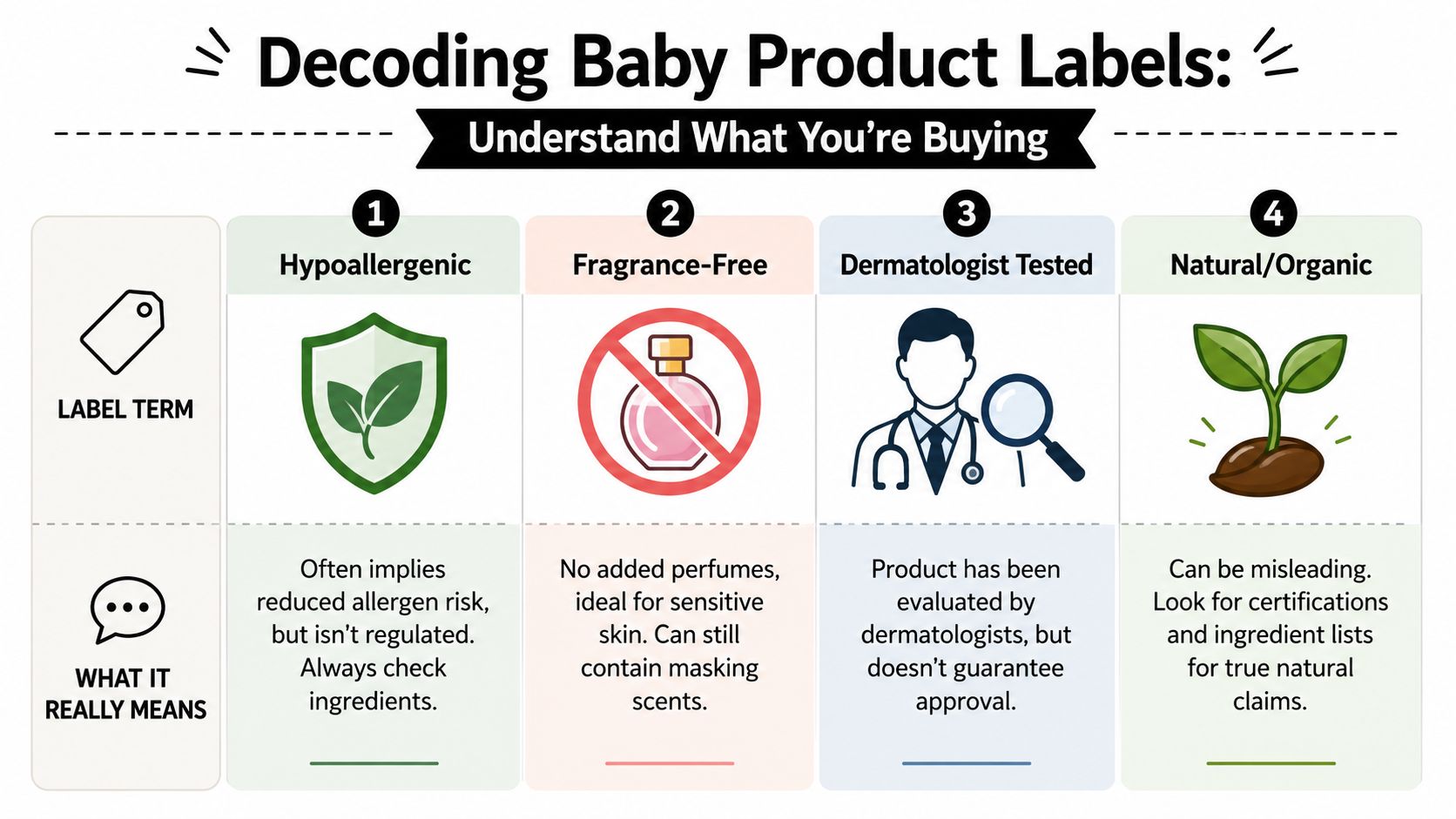
A lot of baby-safe language sounds official until you slow down and translate it. Once you do, the labels get easier to sort.
The words parents see most often
Here's a quick translation table for common terms:
| Label term | What it usually suggests | What it doesn't guarantee |
|---|---|---|
| Hypoallergenic | The product may be designed to lower the chance of irritation or allergy | A universal standard or a promise that no baby will react |
| Fragrance-free | No added fragrance in the usual sense | That the whole formula or textile process is irritation-free |
| Dermatologist tested | Some form of testing occurred under dermatologist supervision | That it's right for every skin type or every age group |
| Natural or organic | The brand wants to signal ingredient or fiber sourcing choices | That the finished product is automatically gentler on skin |
What dermatologist tested means, and what it doesn't
The phrase dermatologist tested has a technical meaning only when testing is performed under dermatologist supervision, often using repeated insult patch testing to measure irritation and sensitization potential. But it does not necessarily mean a product is safe for every skin type unless the test panel explicitly includes a sensitive-skin cohort. A clear explanation appears in Prequel's review of what dermatologist-tested means.
For parents, the simplest takeaway is this: it may suggest a reduced likelihood of topical skin reactions, but it is not a blanket safety promise.
That distinction matters even more for clothing. Patch testing is usually discussed with skin-applied products. A baby sleeper or blanket needs confidence in the finished textile, not just a comforting phrase.
Here's a quick video overview that helps make label-reading less intimidating:
Why verifiable certification is different
A standard like OEKO-TEX Standard 100 becomes much more useful than a vague claim. A certification gives you something outside the brand's own wording. It points to testing tied to the textile itself.
For parents trying to reduce everyday exposure to unnecessary irritants, that's a stronger signal than “dermatologist approved” standing alone.
You can also apply the same thinking elsewhere in the home. If you're trying to lower potential irritants around laundry rooms, changing tables, and nursery surfaces, this article on disinfectants with citric acid offers a practical example of how to compare safer-feeling claims against more concrete product details.
A simple label-reading routine
When you pick up a baby textile, walk through this short checklist:
-
Read past the front label.
“Gentle” and “approved” are starting points, not proof. -
Look for a named certification.
If there's no independent standard, the claim may be too vague to rely on by itself. -
Check the intended use.
A statement for adults or general skincare doesn't automatically translate to infant textiles. -
Keep your baby's skin history in mind.
A child with frequent redness or eczema may need a stricter filter.
If you want to build that filter from the ground up, this roundup of chemical-free baby products can help you think beyond buzzwords.
Red Flags to Watch For and How to Verify Claims
Parents usually don't need more labels. They need clearer ones.
A recent discussion of gaps in dermatology-adjacent products noted that consumers often want to know what a claim means and whether it's backed by transparent testing. It also points out that label information is often technical or non-standardized, which makes products harder to compare, especially for parents choosing sensitive-skin items. That concern is summarized in this LIVDERM article on transparency gaps.
Red flags that deserve a second look
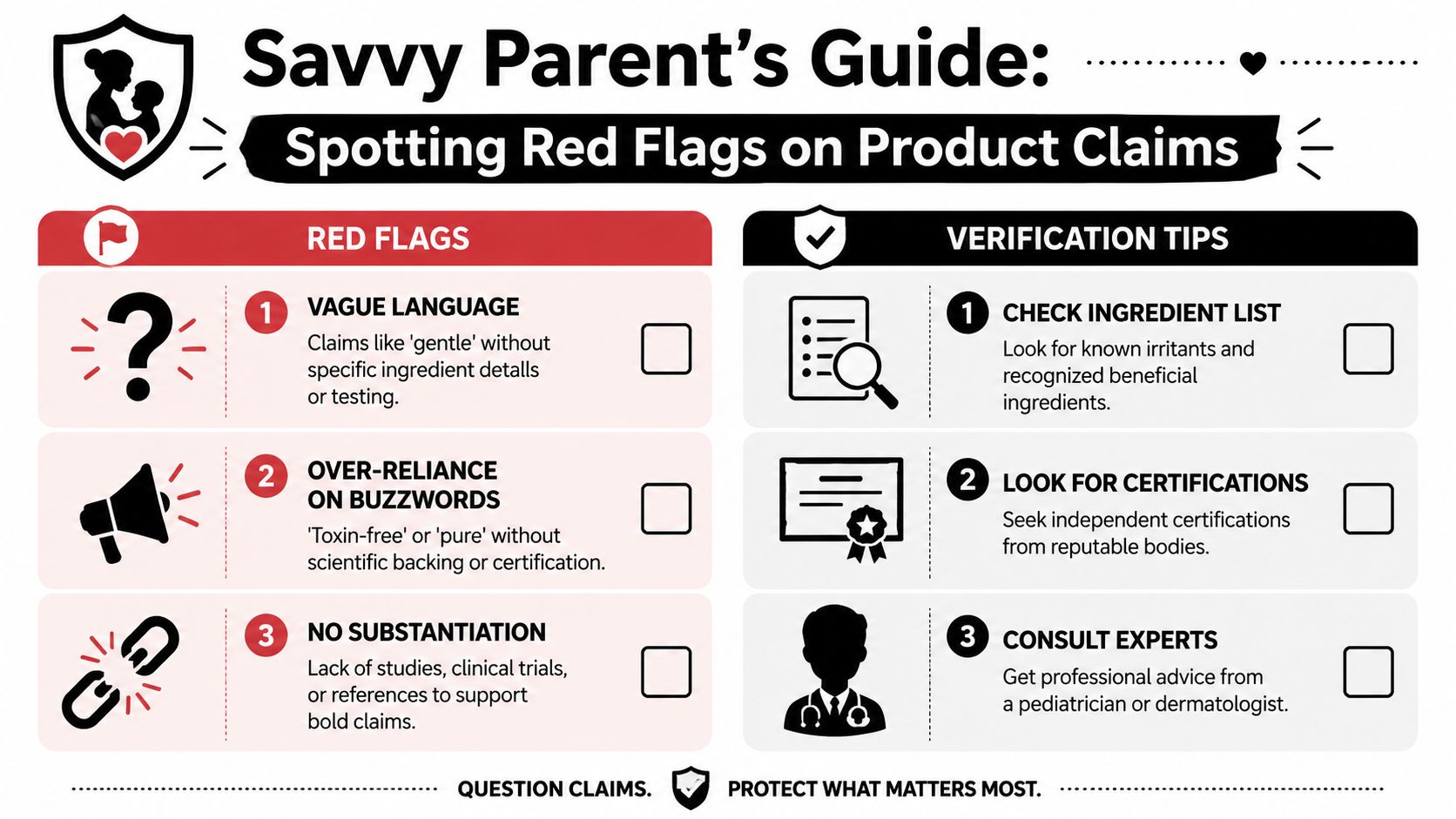
Some warning signs show up again and again:
-
A claim with no explanation
If a package says “dermatologist approved” but never names what was tested or reviewed, that's thin evidence. -
Too many comfort words at once
“Pure,” “clean,” “natural,” and “non-toxic” can sound persuasive in a cluster while still telling you very little. -
No independent certification
For textiles, a missing third-party standard leaves you dependent on the brand's own phrasing. -
No product-specific detail
A company may talk broadly about skin safety without tying that language to the exact pajamas, blanket, or sheet you're buying.
How to verify without becoming a full-time researcher
You don't need to investigate every product for an hour. A few practical checks go a long way.
| What to do | What you're looking for |
|---|---|
| Search for a certification label number | Proof that a claim is tied to a real, trackable standard |
| Read the care and fabric details | Clues about finishes, blends, and intended use |
| Check whether the brand explains the claim | Specifics are better than slogans |
| Ask your pediatrician or dermatologist when needed | Helpful when your baby has recurring irritation |
If a textile carries an OEKO-TEX label, look for the label number and use the brand's verification tools to confirm it. That's one of the simplest ways to move from trust-me language to something concrete.
Some claims are meant to reassure you. Certifications are meant to let you check.
That same approach helps with the nursery environment too. If you're rethinking scented products around your baby's room, this guide to air fresheners for home air is a helpful example of how to evaluate products that affect the air your child breathes, not just the fabrics they wear.
For laundering baby clothes, your detergent matters as much as the fabric label. This guide to baby laundry detergent for sensitive skin can help you choose a gentler wash routine so your baby's clothes stay comfortable after purchase too.
How Little Venture Co Earns the Dermatologist Safe Badge
Parents often use dermatologist language as a shortcut for trust because skin specialists deal with very common, high-volume conditions. The American Academy of Dermatology says acne affects up to 50 million Americans annually, and skin cancer is the most common cancer in the U.S. Those realities help explain why dermatologist guidance carries so much weight in everyday consumer decisions, as reflected in the CDC-linked reference on dermatology care and burden.
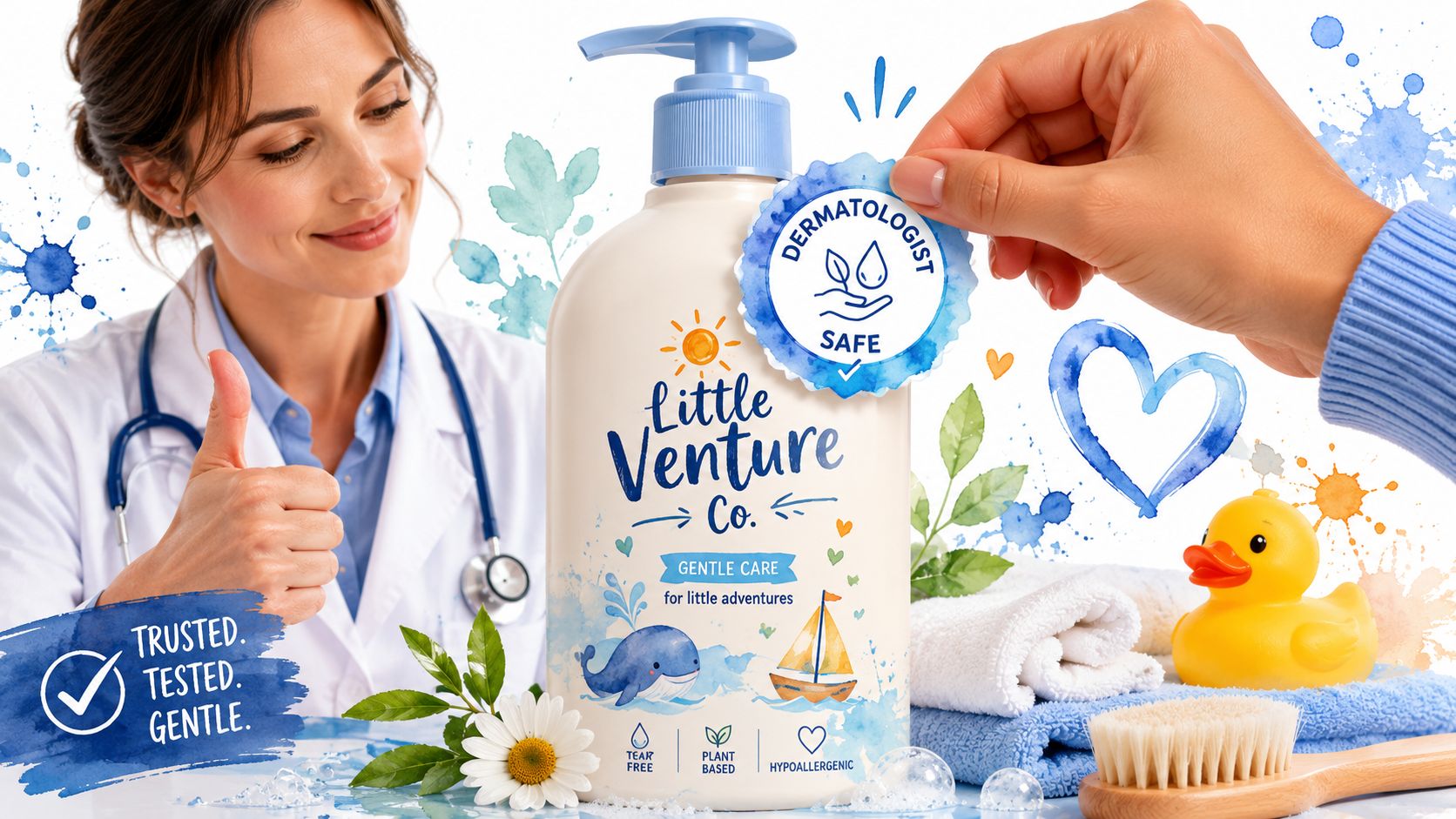
For baby clothing, though, trust gets stronger when specialist language is paired with textile-specific proof. That's the more grounded idea behind a “dermatologist safe” approach.
What that looks like in practice
A baby textile aligns better with skin-safe principles when it combines three things:
-
Softness for daily wear
Fabrics that feel smooth and breathable are easier on babies who spend long stretches in sleepers and sets. -
Simple, skin-conscious design choices
Parents usually benefit from fewer unnecessary extras and more focus on comfort. -
Verifiable testing
A recognized certification is more concrete than a loose approval phrase.
Why this matters for faith-minded families too
For many Christian parents, clothing choices aren't only practical. They're part of care. You're choosing what wraps your child during sleep, prayer, play, and ordinary family rhythms. Safety and gentleness aren't extras. They're part of stewardship.
That's why a textile brand earns confidence not by sounding medical, but by making its safety story easier to confirm. In this category, the strongest reassurance comes from the pairing of soft, baby-friendly materials with OEKO-TEX Standard 100 certification that parents can recognize and check.
The best baby-skin claim is the one that doesn't ask you to guess.
That's the standard parents should look for, whether they're shopping for their own child, a baby shower gift, or church nursery needs.
Frequently Asked Questions About Baby Skin Safety
Is dermatologist approved the same as hypoallergenic
No. They're different kinds of claims, and neither one automatically tells you everything you need to know. “Dermatologist approved” suggests some level of clinician involvement. “Hypoallergenic” usually suggests lower irritation risk. For baby textiles, neither replaces a verifiable certification.
Should I skip a product if it doesn't say dermatologist approved
Not necessarily. A product can be a strong choice without that phrase if it uses skin-friendly materials and carries a recognized textile certification such as OEKO-TEX Standard 100. For clothing, proof tied to the fabric is often more useful than a broad marketing label.
Why do parents like bamboo fabrics for sensitive skin
Many parents choose bamboo viscose because it feels soft, lightweight, and comfortable for all-day wear. For babies with easily irritated skin, feel and breathability can matter a lot. The most important step is pairing fabric preference with verifiable safety testing.
What should I check first on a baby clothing label
Start with the fabric details and any third-party certification. Then look for clear care instructions and avoid relying only on front-of-package comfort words.
If you want baby and toddler clothing that pairs softness with verifiable textile safety, explore Little Venture Co.. Their faith-inspired bamboo sleepwear and daywear are designed for comfort, made for everyday family life, and backed by OEKO-TEX Standard 100 certified materials so you can shop with more confidence and less guesswork.