

Bibles with Explanations: A Parent's Guide for 2026
You're probably here because you want to do something beautiful and simple. You want your baby or toddler to grow up hearing about God, Jesus, prayer, kindness, and the big story of Scripture. Then you open a bookstore page or walk into a church shop, and suddenly there are story Bibles, study Bibles, devotional Bibles, toddler board books, beginner readers, picture books, and full-text editions with notes everywhere.
That can make a loving decision feel strangely stressful.
I've watched a lot of parents carry this same worry. They're not asking for a seminary library. They're asking, “What can I use with my little one right now?” and “How do I avoid buying something too complicated, too watered down, or just not useful for our family?” Those are good questions. And the good news is that bibles with explanations can be a gentle help, not a confusing extra layer, when you know what you're looking at.
Starting Your Family's Faith Journey
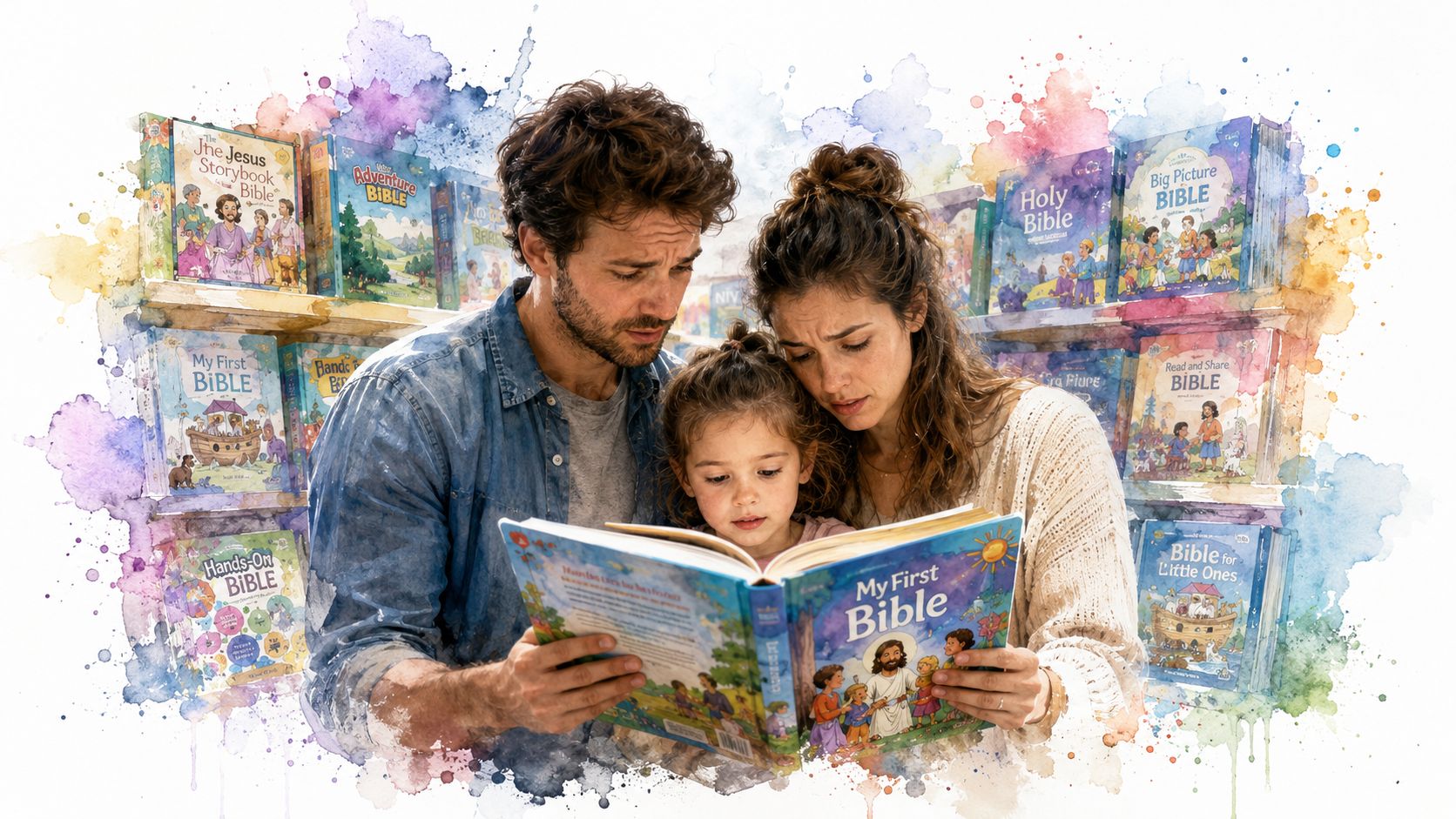
A young parent in my church once told me she stood in front of the children's Bible shelf for twenty minutes and left with nothing. Every book seemed to promise something different. One had bright pictures. Another had side notes. Another looked beautiful but felt too advanced. She finally said, “I just want to start somewhere without getting it wrong.”
That's where many families begin.
The Bible itself is a very large collection. It contains 66 books, 1,189 chapters, and over 31,000 verses, written by about 40 contributors, and the chapter and verse system we use today was added later to make it easier to reference and study, as summarized in these Bible structure facts. For a grown adult, that's already a lot to take in. For a baby or toddler, it helps to think in much smaller pieces.
What parents usually mean by explanation
Most parents don't mean, “I need academic commentary for my one-year-old.” They mean, “I need a way to make this understandable.” An explanation might be a picture that shows Noah's ark, a short sentence that says David trusted God, or a note for the parent that helps connect a story to daily life.
That's why it helps to treat explanatory Bibles like friendly guides. Some are written for the child. Some are written for the parent. Some do both a little.
Practical rule: Your first Bible choice doesn't need to be your forever Bible choice. It just needs to help you begin.
If you're trying to build faith into everyday family life, simple routines matter more than getting the “perfect” edition. A short story at bedtime, one picture and one sentence after breakfast, or a tiny conversation about God's care during playtime can carry a lot of weight. If you want more simple ideas for that early stage, teaching children about God in everyday moments is a helpful next read.
A first step is enough
For babies and toddlers, you're not trying to produce deep analysis. You're building familiarity, warmth, and trust. You're helping them connect God's Word with your voice, your lap, your home, and a sense of peace.
That's a solid beginning.
Understanding the Different Types of Explained Bibles
When parents hear “bibles with explanations,” they often lump everything together. That's where confusion starts. It helps to think of these books like kitchen tools. You wouldn't use a slow cooker recipe book the same way you use a measuring spoon. Both are useful. They just do different jobs.
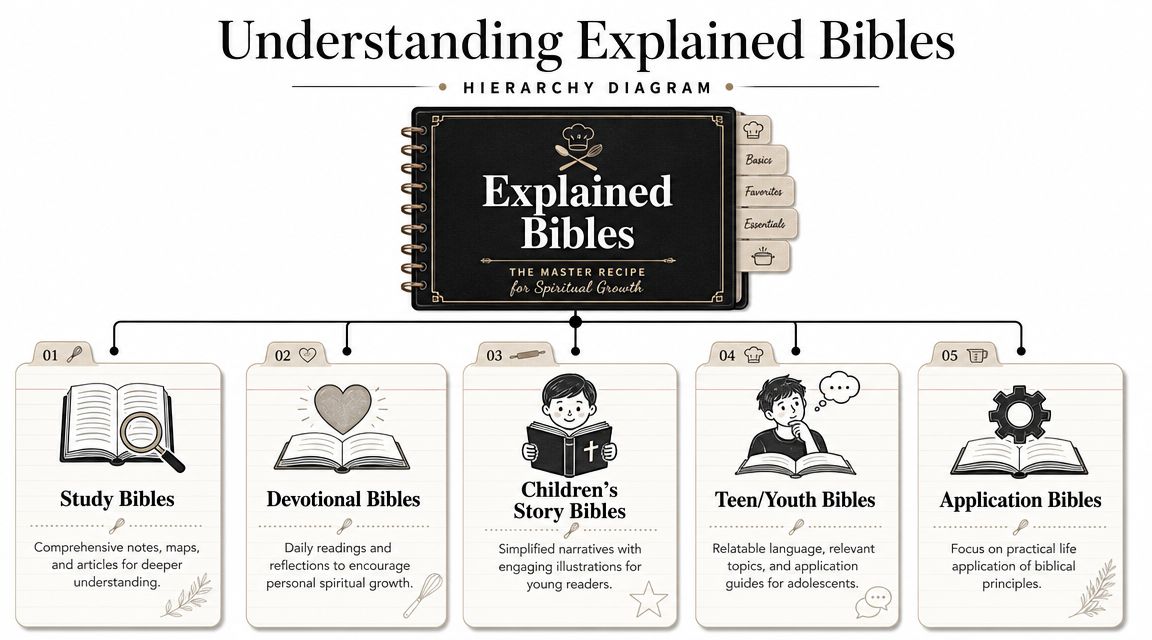
Study Bibles for parents
A study Bible is usually for the adult, not the toddler. It gives the full biblical text plus notes, cross-references, introductions, maps, and articles. Some editions include over 15,000 verse-by-verse notes, which changes the experience from simple reading to guided interpretation, as shown in this full-color study Bible example.
That can be wonderful for a parent who wants help understanding a passage before sharing a simpler version with a child. But it's usually too dense to put directly in a toddler's hands.
Imagine it as the parent cookbook with all the technique notes in the margin. Helpful for the cook. Not the first thing you hand the toddler on a stool beside you.
Children's story Bibles for direct use
A children's story Bible usually retells Bible stories in shorter, simpler language. It often uses pictures, fewer details, and one clear takeaway. For babies and toddlers, this is often the most natural starting point because the explanation is woven right into the storytelling.
These books aren't trying to cover every interpretive issue. They're trying to help a child grasp a real biblical truth in an age-appropriate way.
Devotional Bibles and application editions
A devotional Bible usually pairs Bible passages with short reflections, prayers, or prompts. An application Bible leans toward “What does this mean for life today?” These can be useful for parents and, later on, for older kids who can follow a brief thought after the text.
For little ones, though, devotional prompts work best when the parent does the adapting. A toddler doesn't need a paragraph of reflection. They need a sentence like, “Jesus loves children,” followed by a hug and maybe a song.
Translation and note style matter too
Even before you look at pictures and design, it helps to know that translations and note systems differ. If you're comparing editions and want a grounded overview, expert advice on Bible translations can help you sort through the choices without overcomplicating them.
Here's the simplest distinction to keep in mind:
- For your child's hands: look for clear storytelling, sturdy format, and simple truth.
- For your own study: look for trustworthy notes, readable layout, and the kind of help you find useful.
- For shared reading: choose something that won't interrupt the moment with too much text on the page.
If your goal is very early introduction, a board book can be a smart bridge between a classic story Bible and a baby-friendly format. For example, Christian board book options for little readers show how Bible ideas can be introduced in a format tiny hands can manage.
The right type depends less on what sounds impressive and more on who will actually be using the book today.
Key Features to Look For on the Page
Once you know the main categories, the next question is more practical. When you open the book, what should you look for?
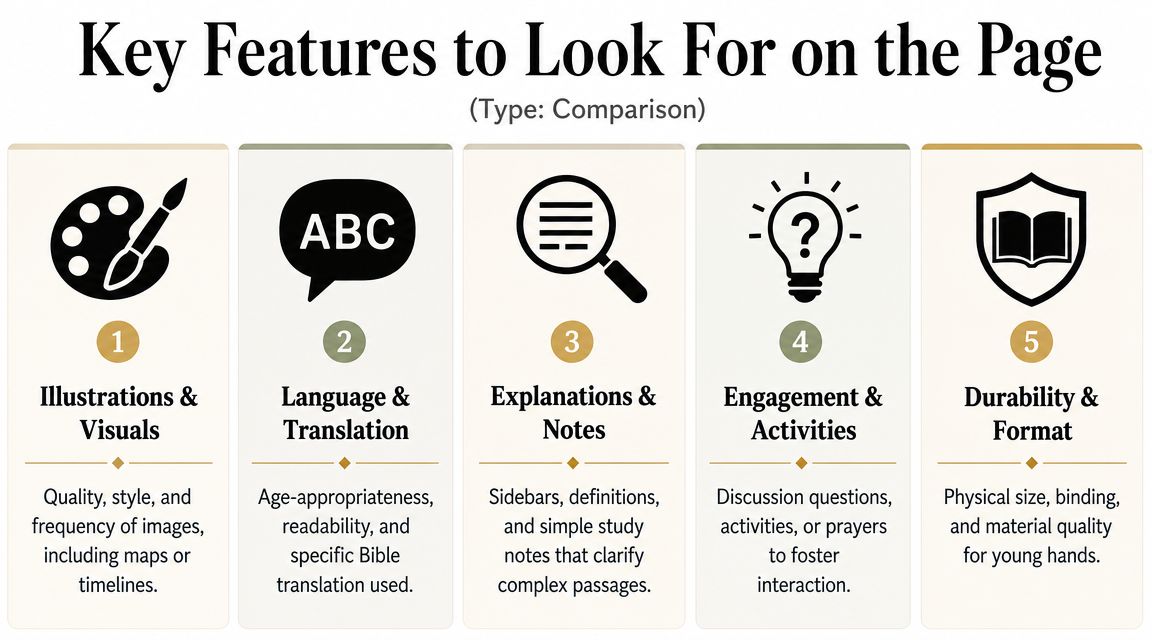
A page can tell you a lot in ten seconds. Is it calm or cluttered? Can your eye find the main point? Does the explanation help the text, or does it crowd it out?
The page elements that matter most
Guides on Bible usability often point to page-bottom commentary, book introductions, concordances, and wide margins for notes as meaningful features. More notes can help comprehension, while wider margins and paragraph formatting can improve readability and personal annotation, as explained in this overview of Bible features and usability.
For parents of babies and toddlers, I'd simplify that into a short checklist.
| Feature | What to notice | Why it matters for young families |
|---|---|---|
| Main text size | Is the story easy for you to read aloud? | You won't use a book often if reading it feels like work |
| Note placement | Are notes at the bottom, side, or inside the story? | Bottom notes are easier to ignore when you just want story time |
| Illustration style | Are the pictures gentle, clear, and easy to point to? | Toddlers learn through what they can see and name |
| Page density | Is the page crowded with extras? | Too much visual noise can make shared reading feel busy |
| Physical format | Board book, paperback, hardback, or study edition? | Format affects durability, comfort, and where you'll actually use it |
How much explanation is helpful on the page
For many parents, this becomes a sticking point. They assume more notes must mean a better book. Often it doesn't.
A good explanation for a little child is usually short, concrete, and close to the story. “God made the world.” “Jesus cared for people.” “David trusted God.” That kind of language gives you something to say out loud without turning reading time into a lecture.
A toddler doesn't need every detail. They need one faithful, understandable idea they can hold onto.
Translation and readability in plain language
You'll also notice translation labels and wording choices. Some are more formal. Some are more conversational. For parents who want a simple overview of how common English translations differ in tone and readability, Mr. Pen's Bible translation insights are a useful starting point.
When I'm helping families choose, I usually suggest this question: “Can I read this aloud without stopping to rephrase every other sentence?” If the answer is no, it may still be a fine Bible for your shelf, but not your daily family Bible right now.
A well-designed page should do one of two things. It should either help you understand the text better, or help your child engage the story more easily. If it does neither, keep looking.
Picking the Perfect Bible for Every Little Stage
Parents often worry about choosing something too advanced or too simple. That fear makes sense, but children don't grow in neat little boxes. You're not aiming for perfect precision. You're trying to match the book to what your child can enjoy and absorb today.
The most helpful principle is simple: more explanation isn't always better. For many beginners and children, lighter, text-focused notes are more usable than dense scholarship, as discussed in this reflection on how much explanation can overwhelm.
Babies from birth to about eighteen months
At this stage, the book is as much a sensory object as a teaching tool. Babies grab, pat, mouth, and stare. That's normal.
Choose books with:
- Board book construction so the pages can survive real handling
- Large, simple pictures with one main focal point
- Very short lines that you can read in a warm, rhythmic voice
- One idea per spread rather than lots of movement and detail
You're not trying to explain theology. You're building recognition. “God made animals.” “Jesus loves us.” “God cares for Noah.” Short and repeated is better than long and impressive.
Toddlers from about eighteen months to three years
Toddlers want interaction. They point, repeat words, ask for the same page again, and often latch onto one character or image. This is a great age for Bible stories with action and emotion.
Look for:
- Simple story arcs with a beginning, middle, and end
- Repeatable phrases your child can join in saying
- Questions you can answer in one sentence
- Durable pages that still feel inviting
This is also a good age for Bible-themed board books that focus on one truth at a time. One option in that category is Christian books for toddlers, including Bible-related board book formats designed for short, repeatable reading moments.
Preschoolers from about three to five years
Preschoolers start connecting stories. They can follow slightly longer readings and often enjoy “why” questions. For these reasons, a story Bible with brief explanations can become especially helpful.
What often works well:
- A storybook Bible with a clear narrative voice
- Short parent prompts such as a prayer or a one-line application
- Illustrations that show relationships and emotion
- A format that introduces how stories fit into God's bigger plan
At this stage, some children are ready for a little more detail. That doesn't mean they need packed footnotes. It means they can begin hearing how one story connects to another.
If a child stays engaged, asks for it again, and remembers one truth afterward, the book is doing its job.
The “right” Bible often changes as your child changes. That's not a sign you chose badly before. It means your family is growing.
Making the Bible a Joyful Part of Your Day
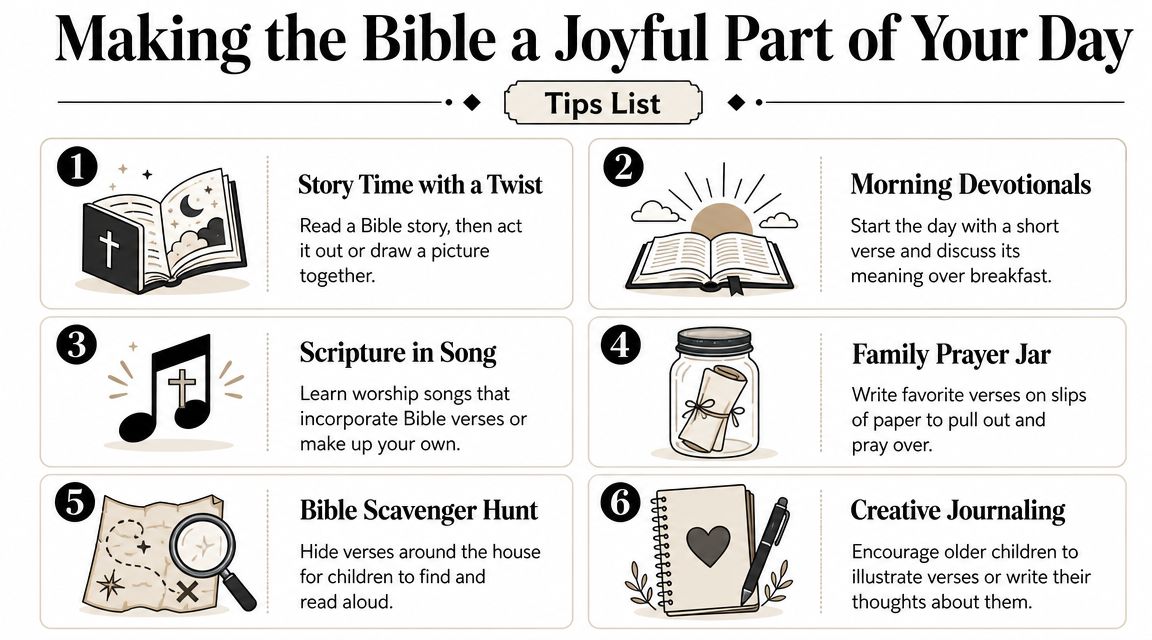
Once you've chosen a book, the key question becomes, “How do we practically use it?” This matters more than many parents realize. A good Bible can still sit untouched if it feels formal, rushed, or pressured.
Bible engagement remains strong in the United States. Barna's 2021 report says over 181 million Americans opened a Bible in the past year, and 34% of U.S. adults read the Bible at least once a week, according to Barna's State of the Bible findings. In family life, that kind of ongoing engagement usually grows through repeated habits, not occasional big moments.
Keep it short enough to end well
A happy three-minute Bible time beats a tense fifteen-minute one. Stop while your child is still interested. That leaves them wanting more next time.
Try rhythms like these:
- Bedtime reading with one short story and one prayer
- Breakfast Bible minute with a single page and one picture to name
- Car seat repetition where you retell the same Bible idea in plain words
- Sunday reset with one favorite story every week
Let the child do something
Little children learn through movement and repetition. Don't worry if reading time looks noisy.
You can:
- Point and name animals, people, boats, stars, bread, or water
- Act it out with hand motions
- Sing a line about God's love or Jesus' care
- Repeat one sentence together after the story
If you want a visual idea for family use, this short video can help spark some simple routines.
Focus on warmth, not performance
Some parents feel like they need to sound polished. You don't. Your child benefits more from warmth than from polish.
A simple pattern works well:
- Read one small section.
- Say one sentence about what it means.
- Pray one short prayer.
That's enough for many days.
“Thank You, God, for loving us” is a complete family prayer.
Build tiny habits around ordinary life
The best Bible routines usually attach to things you're already doing. Pajamas. Breakfast. Nap wind-down. Church mornings. Snuggle time on the couch.
If you'd like help turning those moments into a simple routine, family daily devotional book ideas for home rhythms can give you a practical starting point.
Children don't measure whether Bible time was impressive. They remember whether it felt safe, loving, and worth returning to.
Your Questions Answered by Parents Like You
Are storybook Bibles real Bibles
They're better understood as introductions to the Bible. A storybook Bible retells Scripture in simpler form, much like a child learns letters before reading long books alone. That doesn't make it fake. It means it serves a beginner's purpose.
The key is knowing what you're holding. If it's a retelling, use it as a doorway into the biblical story, not as the final step.
What if my toddler just chews the book or throws it
That's normal toddler behavior, not a spiritual problem. Young children explore with their whole body. This is one reason board books matter so much in the early years.
If a book gets bent, dropped, or gnawed on, it doesn't mean Bible time failed. It means your child is little. Keep going. Read one page. Put it away. Try again tomorrow.
When should we move to a full-text Bible
Move by readiness and interest, not pressure. Some children are ready to hear more direct Scripture passages earlier than others. Some still need picture-rich retellings for a while. Many families use both side by side.
A gradual shift often works best. Keep the child-friendly Bible for shared reading, and let your child also see you using a full-text Bible. This exposure demonstrates that the family storybook version points to something larger and lasting.
You're not taking a test here. You're raising a child. A faithful start counts for a lot.
If you're building a faith-filled home one small step at a time, Little Venture Co. offers thoughtful resources for young families, including Bible-themed children's books and faith-inspired items designed for babies and toddlers. It's one practical place to find tools that fit the early years without making them feel overwhelming.