

Are Sleep Sacks Safe for Newborns?
Of course. Here is the rewritten section with a more human, expert tone.
Yes, sleep sacks are definitely safe for newborns. In fact, they're what major health organizations and pediatricians recommend as a much safer alternative to old-school loose blankets. They keep your baby cozy and snug without the scary risks of suffocation or entanglement that come with regular bedding.
Why Experts Recommend Sleep Sacks
If you're a new parent, I know the feeling—that constant worry about your baby's safety, especially when they're sleeping. It’s completely normal. Your main goal is to create a sleep space that cuts down on risks, particularly the risk of Sudden Infant Death Syndrome (SIDS). This is where the simple genius of the sleep sack shines.
Think of a sleep sack not as a piece of clothing, but as a wearable blanket. It's a single, secure little garment that zips right over your baby's pajamas. Its design solves the single biggest problem with traditional blankets: they can move around. A loose blanket can accidentally cover a baby’s face and block their airway, but a sleep sack stays exactly where it’s supposed to, all night long.
The Science of Safe Sleep
The American Academy of Pediatrics (AAP) has really clear guidelines for safe infant sleep. You've probably heard the big ones: always place babies on their backs to sleep in an empty crib. "Empty" is the key word here—it means no pillows, no bumpers, and absolutely no loose blankets.
Sleep sacks fit perfectly into these guidelines because they get rid of the need for any of that extra bedding.
By keeping your baby warm without adding any loose items to the crib, a sleep sack directly supports the core principles of SIDS risk reduction. It’s a simple swap that makes a huge difference.
And their design is incredibly smart. Most sleep sacks are sleeveless, which is a crucial feature for preventing overheating—another known SIDS risk factor. This design allows for better airflow and helps your baby regulate their body temperature naturally.
A Proven Safety Record
The safety of wearable blankets isn't just a good idea in theory; it's backed by solid evidence. Research has shown time and again that sleep sacks are a demonstrably safer choice.
A 2019 analysis confirmed that these products keep an infant warm without the suffocation hazards posed by loose blankets, making them a far superior option for safe sleep. You can learn more about these sleep sack safety findings and see why they are so widely endorsed by health professionals. This foundation of safety is exactly why they've become a must-have for parents everywhere.
To make it even clearer, here’s a quick-glance table of the essential do's and don'ts.
Sleep Sack Safety Quick Reference
This table breaks down the most important safety guidelines to follow when using a sleep sack for your newborn.
| Safety Guideline | Why It Matters |
|---|---|
| Use the correct size | A sack that’s too big can ride up over the baby's face. One that’s too small can be restrictive. |
| Always lay baby on their back | This is the safest sleep position and drastically reduces the risk of SIDS. |
| Check the TOG rating | Choose a TOG appropriate for the room temperature to prevent overheating. |
| Keep the crib empty | The sleep sack is the only bedding needed. No extra blankets, pillows, or toys. |
| Ensure a snug fit around the chest | The neck and armholes should be secure enough that the baby can't wriggle down into the sack. |
| Stop using when baby can climb | Once your toddler can get out of the crib, a sleep sack can become a tripping hazard. |
Following these simple rules helps ensure your little one is getting the safest, most comfortable sleep possible.
How Sleep Sacks Create a Safer Sleep Space
So, what’s the big deal about a sleep sack? How can a simple wearable blanket be that much safer than a traditional one? It all boils down to removing the single biggest danger in a baby's crib: loose bedding. The link between things like blankets, pillows, and crib bumpers and the risk of Sudden Infant Death Syndrome (SIDS) is tragically clear.
A sleep sack is designed from the ground up to eliminate that hazard completely.
Think of it as a perfectly fitted, wearable sleeping bag for your baby. It gives them all the coziness of a blanket but stays securely in place all night long. This means it can't accidentally ride up to cover their face or get in the way of their breathing.
This simple but brilliant design delivers three huge safety wins, giving parents some much-needed peace of mind.
Preventing Suffocation and Entanglement
The most obvious win is preventing accidental suffocation. A newborn just doesn't have the strength or motor skills to push a heavy blanket off their face if they get tangled up. Even a light blanket can become a serious hazard if it covers their nose and mouth.
A sleep sack makes this scenario virtually impossible because of how it’s designed. Your baby wears it; it isn't just laid on top of them.
- A Secure Fit: A sleep sack that’s the right size will be snug (but not tight) around your baby's chest, with properly sized holes for their arms and neck. This smart design keeps them from wiggling down inside the sack.
- No Loose Fabric: Because the "blanket" is part of what they're wearing, there’s nothing loose in the crib to get tangled in or cover their head.
The whole idea is simple but incredibly powerful: a sleep sack keeps your baby warm without adding any loose items to their crib. This lines up perfectly with the safe sleep guidelines from the American Academy of Pediatrics.
This one feature takes the main risk of traditional bedding right off the table, making it a must-have for a safer nursery.
Regulating Body Temperature
Overheating is another major risk factor for SIDS. Babies, especially tiny newborns, are still figuring out how to regulate their own body temperature. Piling on too many layers or using thick, heavy blankets can make them dangerously warm while they sleep.
Sleep sacks are built to solve this problem. Most are sleeveless, and that’s a key feature, not a design flaw. This allows excess heat to escape from under their arms, preventing it from getting trapped and helping your baby stay at a stable, safe temperature all night.
Plus, sleep sacks come with a TOG (Thermal Overall Grade) rating. This is a standardized system that tells you exactly how warm the fabric is—no more guessing games. You can simply pick the right sleep sack for the temperature of your nursery. You can learn more about how to dress baby for sleep using TOG ratings to keep them perfectly comfortable and safe.
Promoting Safe Sleep Positions and Healthy Hips
We all know the safe sleep mantra: always place babies on their backs to sleep. While a sleep sack won't magically keep your baby in that position, it helps create the perfect setup for it. Since it keeps them warm, you won't be tempted to add pillows or positioning aids to hold a blanket in place—items that could actually increase the risk of them rolling into an unsafe position.
The roomy, sack-like bottom of a sleep sack offers another huge benefit: it promotes healthy hip development.
This design lets your baby’s legs rest in a natural "frog-like" position, with their hips and knees bent. This is critical for preventing developmental hip dysplasia, a condition where the hip joint doesn't form correctly. Unlike a tight swaddle that can pin their legs straight, a sleep sack gives them plenty of freedom to kick and wiggle while staying cozy.
Building a truly safe sleep environment means looking at all the pieces, from using a sleep sack to making sure you have one of the best crib mattresses for newborns. Each piece of the puzzle works together to reduce risk. By tackling suffocation, overheating, and proper positioning, a sleep sack is one of the most important foundational pieces you can have.
Choosing the Right Sleep Sack for Your Baby
Walking into the baby aisle can feel like stepping into another universe. With so many sleep sack options staring back at you, it's easy to get overwhelmed. But I promise, finding the perfect one isn't as complicated as it seems.
Once you know what to look for, you can pick a sleep sack that’s not just cozy, but more importantly, safe for your newborn. It all boils down to three things: the material, the TOG rating (that’s for warmth), and getting the fit just right. Nail these, and you'll have peace of mind while your little one snoozes safely.
Focus on Breathable Materials
A newborn's skin is incredibly delicate, and their internal thermostat is still a work in progress. That’s why the fabric of their sleep sack is a huge deal. You’ll want to stick with natural, breathable materials that are gentle on their skin and let air flow freely. This is one of the best ways to prevent dangerous overheating.
Fabrics like 100% cotton or bamboo viscose are fantastic choices. They're soft, lightweight, and do a great job of wicking moisture away from your baby's body, keeping them comfortable and dry. On the flip side, synthetic fabrics like polyester or fleece can sometimes trap heat, which could lead to an uncomfortable, sweaty baby. It's usually best to go with natural fibers.
Think of it like this: you're trying to create a tiny, perfect microclimate for your baby. The right material is your first line of defense, making sure they stay in that sweet spot—not too hot, not too cold.
Demystifying the TOG Rating
So, you've picked a great material. What's next? Figuring out how warm it is. This is where the TOG (Thermal Overall Grade) rating saves the day. It’s a simple, standardized number that tells you how much heat a sleep sack holds, taking all the guesswork out of dressing your baby for bed.
A low TOG means a lighter, cooler sack. A high TOG means a warmer, cozier one.
Matching the TOG rating to the temperature of your baby's room is probably the most important safety check you can do. It’s your best tool for preventing your baby from getting too cold or—even more dangerously—overheating while they sleep.
Choosing the right TOG can feel a bit technical at first, but this simple table breaks it down. Just check your nursery thermostat and match it with the right sleep sack and under-layer.
TOG Rating and Room Temperature Guide
| Room Temperature (°F / °C) | Recommended TOG Rating | What Baby Wears Underneath |
|---|---|---|
| 75-81°F / 24-27°C | 0.5 TOG | Short-sleeved bodysuit or just a diaper |
| 69-74°F / 21-23°C | 1.0 TOG | Long-sleeved bodysuit |
| 61-68°F / 16-20°C | 2.5 TOG | Long-sleeved pajamas or a bodysuit with pants |
| Below 61°F / 16°C | 3.5 TOG | Long-sleeved bodysuit and fleece pajamas |
Remember, this is just a guide! You should always check on your baby by feeling the back of their neck or their tummy to make sure they're not too hot or cold.
For parents who want to dive deeper, our guide on what is TOG has even more detail. It's also a great idea to read up on understanding TOG ratings for baby sleep bags from other experts to get a well-rounded view.
This infographic gives a great visual summary of why sleep sacks are such a game-changer for newborn safety.
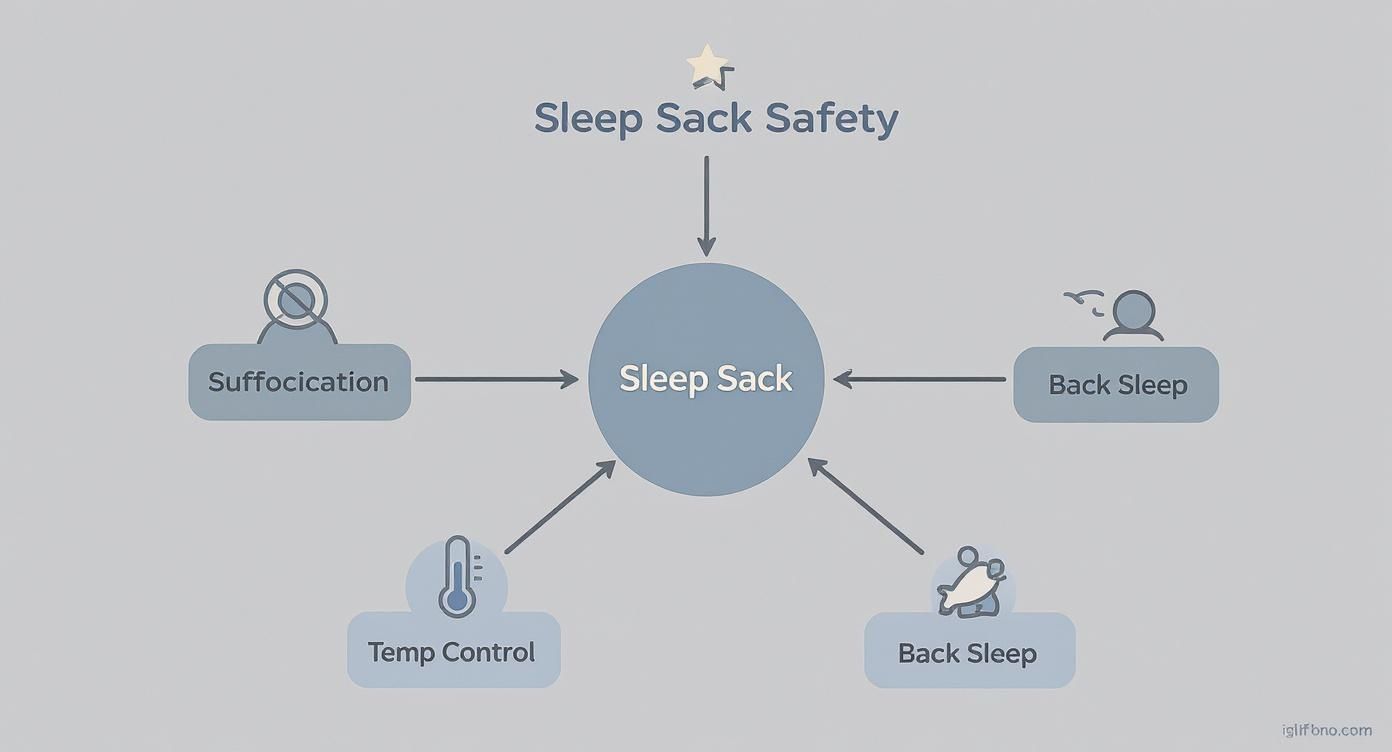
As you can see, the design tackles the biggest safety worries head-on. It eliminates the risk of loose blankets, helps you manage their temperature, and keeps them comfortably on their back.
Ensuring a Perfect and Safe Fit
Last but certainly not least is the fit. A poorly fitting sleep sack can be a real safety risk, undoing all the benefits. What you're looking for is a "Goldilocks" fit—snug where it needs to be and roomy where it counts.
Here's a quick checklist to get it right:
-
Check the Neck and Armholes: The fit around the neck and arms should be secure, but not uncomfortably tight. You should be able to slide one or two fingers between the fabric and your baby's skin. This is so important because it prevents the sack from riding up and covering their face.
-
Room for Hips and Legs: While the top is snug, the bottom should be wide and spacious. Your baby needs plenty of room to kick and bend their legs up into that natural "froggy" position. This freedom is essential for healthy hip development.
Always, always check the manufacturer's sizing guide. These are almost always based on weight and length, not age. It might be tempting to buy a bigger size for them to "grow into," but please don't. An oversized sleep sack is a serious safety hazard. A proper fit keeps the wearable blanket in place, ensuring your newborn is safe and sound all night long.
Common Mistakes and How to Avoid Them
A sleep sack is one of the best tools in your parenting toolkit for safer sleep, but its magic really depends on using it correctly. It's easy for well-meaning parents to make small mistakes that can undermine how effective it is. This isn't about making you anxious; it's about giving you the confidence to get it right.
Once you know the common pitfalls, you can use a sleep sack for every nap and every night, feeling totally secure that you're maximizing all of its safety benefits. Let's walk through the most frequent slip-ups and how to easily sidestep them.
Getting the Sizing Wrong
This is probably the biggest and most critical mistake: using the wrong size sleep sack. It’s so tempting to buy a size up so your baby can "grow into it," but this can be genuinely dangerous.
When a sleep sack is too big, the neck and armholes are also too large. This creates a gap big enough for your baby to slip down inside the sack, which could cause the fabric to cover their face and become a suffocation hazard. On the flip side, a sack that's too small is just plain uncomfortable, restricting their movement and putting pressure on their developing hips.
How to fix it:
- Trust the chart: Always go by the manufacturer's weight and height guidelines, not just the age range.
- Do the finger test: You should be able to comfortably slip two fingers between the neckline and your baby's chest.
- Never size up: Resist the urge to buy a bigger size to get more use out of it. When it comes to safety, a proper fit is a non-negotiable.
Improper Layering and Overheating
Overheating is a significant risk factor for SIDS, and it’s surprisingly easy to overdress a baby for sleep. We worry they'll get cold, so we pile on the layers underneath the sleep sack, but this can trap heat and raise their body temperature to unsafe levels.
Think of the sleep sack as the blanket. You have to factor in its warmth (its TOG rating) when deciding what your baby should wear underneath. Ignoring the TOG rating and the temperature of the room is a recipe for a sweaty, uncomfortable, and potentially unsafe baby.
Your goal is to keep your baby comfortably warm, not hot. A tell-tale sign of overheating is a sweaty neck or back. If you feel any dampness, it's time to remove a layer or switch to a lower TOG sleep sack.
Getting the nursery temperature right is a huge piece of this puzzle. You can read our complete guide on the best temperature for baby sleep to make sure their room is set up perfectly.
Using Modified or Unsafe Sleep Sacks
Another mistake is altering a sleep sack or using one that wasn't designed for sleep in the first place. This includes cutting holes, adding your own straps, or using products that haven't passed any kind of safety testing for infant sleep. A proper sleep product has gone through rigorous testing to meet very strict standards.
Tragically, there have been incidents where wearable blankets were used improperly in unsafe sleep environments. A 2014 review of these cases found that most deaths were linked to other major risk factors, like putting a baby to sleep on their stomach or having soft bedding in the crib, which compounded the danger. You can explore the findings of this infant safety study to see just how crucial a totally safe sleep setup is.
To make sure your sleep sack is always safe, stick to these simple rules:
- Never alter it: Don't cut, sew, or change the sleep sack in any way. If it doesn't work for you as-is, find a different one.
- Check for wear and tear: Every so often, give it a quick once-over. Look for broken zippers, loose threads, or holes that could become a hazard.
- Use it as intended: Sleep sacks are for sleep. They aren't meant for playtime or for use in car seats unless the manufacturer explicitly says it's safe to do so.
A Critical Warning on Weighted Sleep Sacks
In the world of baby gear, you’ll find a million and one products promising a miracle for your baby's sleep. But there’s one category you absolutely must steer clear of: weighted sleep sacks. This isn't just a matter of opinion—it's a serious safety warning that every parent needs to hear.
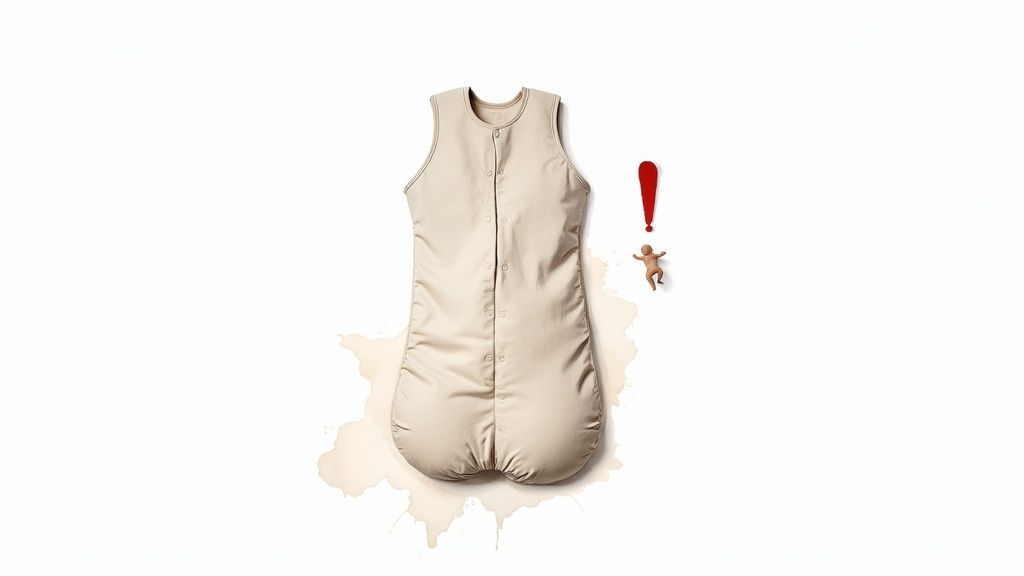
These products are basically wearable blankets with little weights, like beads or pellets, sewn into the fabric right over the baby's chest. The sales pitch is that this gentle pressure feels like a parent's touch, helping your baby settle down and sleep longer. The problem? This idea is fundamentally dangerous for an infant.
Why The Experts Say No
When it comes to baby safety, the advice from the people who know best is unanimous and loud. There's no gray area here.
Top authorities, including the American Academy of Pediatrics (AAP), have put out strong warnings telling parents to avoid these products completely. They're clear that putting any extra weight on a baby's chest or stomach is a bad idea.
Think about it: a newborn's breathing muscles are still getting stronger. Even a little bit of weight can make it physically harder for them to expand their chest and take a full breath. This can lower their oxygen levels and make it tough for them to breathe safely all night long. It's a huge risk for zero proven reward.
The Science Behind the Danger
The danger isn’t just about making breathing a bit harder. Babies have a crucial survival tool called the arousal reflex. It’s their built-in alarm that wakes them up if something is wrong with their breathing, like if they roll into a bad position or their airway gets covered.
Placing weight on their chest can actually dull this life-saving reflex. The constant pressure can push them into an artificially deep sleep, making it much harder for their internal alarm to go off when they’re in trouble. In effect, it dampens the very instinct that helps protect them from SIDS.
Official safety bodies have highlighted a direct link between these products and infant fatalities. The U.S. Consumer Product Safety Commission (CPSC) has issued urgent warnings, stressing that the pressure from weighted products can dangerously impair an infant’s breathing and heart function. You can read the official CPSC safety alert to understand the full scope of the risk.
Let's be blunt: the weight in a sleep sack isn't a feature; it's a hazard. When you're picking out a sleep sack, the decision is simple. Never buy one with added weights. The safest choice will always be a standard, non-weighted sleep sack that keeps your baby cozy without messing with their natural ability to breathe and stay safe.
Your Sleep Sack Questions Answered
https://www.youtube.com/embed/jsDDH-GA4go
So, you're on board with sleep sacks being a safe choice for your newborn. That's a great first step! But now the practical questions start popping up, and trust me, you're not alone in wondering about the little details that make a big difference.
Let's walk through some of the most common questions parents ask when they start using a wearable blanket. Getting these sorted out will give you the confidence to use your sleep sack correctly from night one.
This is your cheat sheet for navigating the day-to-day (and night-to-night) specifics, ensuring your little one is always sleeping soundly and safely.
When Can My Baby Start Using a Sleep Sack?
Here’s one of the best things about sleep sacks: they’re designed to be safe right from the very beginning. You can absolutely use a sleep sack for your newborn, even on their first night home.
The most important thing is simply getting the right size. You’ll find that many brands offer special preemie and newborn sizes just for the tiniest babies.
The key to newborn safety is making sure the sleep sack fits snugly around their chest. The neck and arm openings need to be properly sized so your baby can't wiggle down into the sack, which would be a suffocation risk.
It's also worth mentioning that most newborns have a pretty strong startle reflex (you might hear it called the Moro reflex) that can jolt them awake. Because of this, many parents choose to swaddle for the first few weeks to help calm that reflex and hopefully get longer stretches of sleep.
But the moment your baby shows any sign of trying to roll over, it's time to stop swaddling with their arms in. This is the perfect time to transition them into a sleep sack. If that switch feels a little daunting, our guide on when to stop swaddling can walk you through it. A sleep sack becomes the next safe step, keeping them warm without restricting their arms.
What Should My Baby Wear Underneath?
Figuring out what to dress your baby in under their sleep sack can feel like a confusing guessing game, but it doesn't have to be. The answer really just comes down to two things: the TOG rating of the sleep sack and the temperature of your nursery.
Think of the TOG rating as a simple guide to warmth. A low TOG (like 0.5) is for warm rooms, while a high TOG (like 2.5) is for cooler ones. Your goal is just to keep them comfortable—not too hot, not too cold.
Here are a few real-world examples to make it crystal clear:
- Warm Room (75°F / 24°C): A lightweight 0.5 TOG sleep sack is perfect. All they need underneath is a short-sleeved bodysuit or even just their diaper.
- Standard Room (70°F / 21°C): A versatile 1.0 TOG sleep sack paired with a long-sleeved bodysuit is often the perfect combo.
- Cool Room (64°F / 18°C): Go for a cozy 2.5 TOG sleep sack over a pair of full-length cotton pajamas.
The easiest way to check if your baby is comfortable is to feel the back of their neck or their tummy. If their skin feels sweaty or hot, they're probably too warm. If it feels a bit cool, they might need an extra layer. Don't go by their hands and feet—they often feel cool to the touch and aren't a reliable indicator of core body temperature.
How Many Sleep Sacks Do I Actually Need?
Babies are masters at creating laundry. Between spit-up, drool, and the inevitable diaper blowouts, having just one sleep sack is basically a recipe for a middle-of-the-night laundry emergency.
To save your sanity, it’s a great idea to have at least two or three sleep sacks on hand.
I call it the rule of three: one for the baby to wear, one in the wash, and one extra as a backup for those messes you didn't see coming. Having a spare also means you're not scrambling if one takes forever to dry.
You might also want to have sacks with different TOG ratings if your home’s temperature changes a lot between seasons. For example, you could have a couple of lightweight 1.0 TOG sacks for most of the year and a warmer 2.5 TOG sack for those chilly winter nights.
Are Sleep Sacks with Sleeves a Good Idea?
This is an excellent question, and it gets right to the heart of how babies regulate their temperature. While you might see some sleep sacks with long sleeves, the vast majority of safety experts and pediatricians recommend sleeveless designs.
The reason is simple: it’s all about airflow. A baby’s arms are one of the main places their body releases excess heat. Covering them with sleeves can trap that heat, which can increase the risk of overheating—a known risk factor for SIDS.
A sleeveless design lets your baby manage their own temperature much more effectively through the night.
If you live somewhere really cold and you're worried about your baby's arms getting chilly, it's much safer to add a long-sleeved layer underneath the sleeveless sleep sack. This gives you more control over their warmth without the added risk of trapping too much heat. When in doubt, always go with a sleeveless design for the safest sleep.
At Little Venture Co., we are dedicated to wrapping your little ones in comfort and safety. Explore our collection of beautifully designed, Oeko-Tex® certified bamboo sleep sacks that are as gentle on your baby's skin as they are on your peace of mind. Find the perfect wearable blanket for your child at https://littleventureco.com.