

10 in the Bed Book: A Parent's Guide to This Bedtime Classic
You're halfway through bedtime, one sock is missing, and your toddler is still bouncing under the covers. You start singing, “There were ten in the bed,” and suddenly the stuffed animals join the pile. One rolls out, everyone shuffles over, and your child waits for the next number with a grin.
That little routine is the lasting appeal of the 10 in the bed book. It turns a short counting rhyme into a story about movement, rhythm, surprise, and settling down. Used thoughtfully, it can support early maths, language, emotional vocabulary, sensory play, and a warm bedtime ritual without making reading feel like a lesson.
What the 10 in the Bed Book Is and Why It Endures
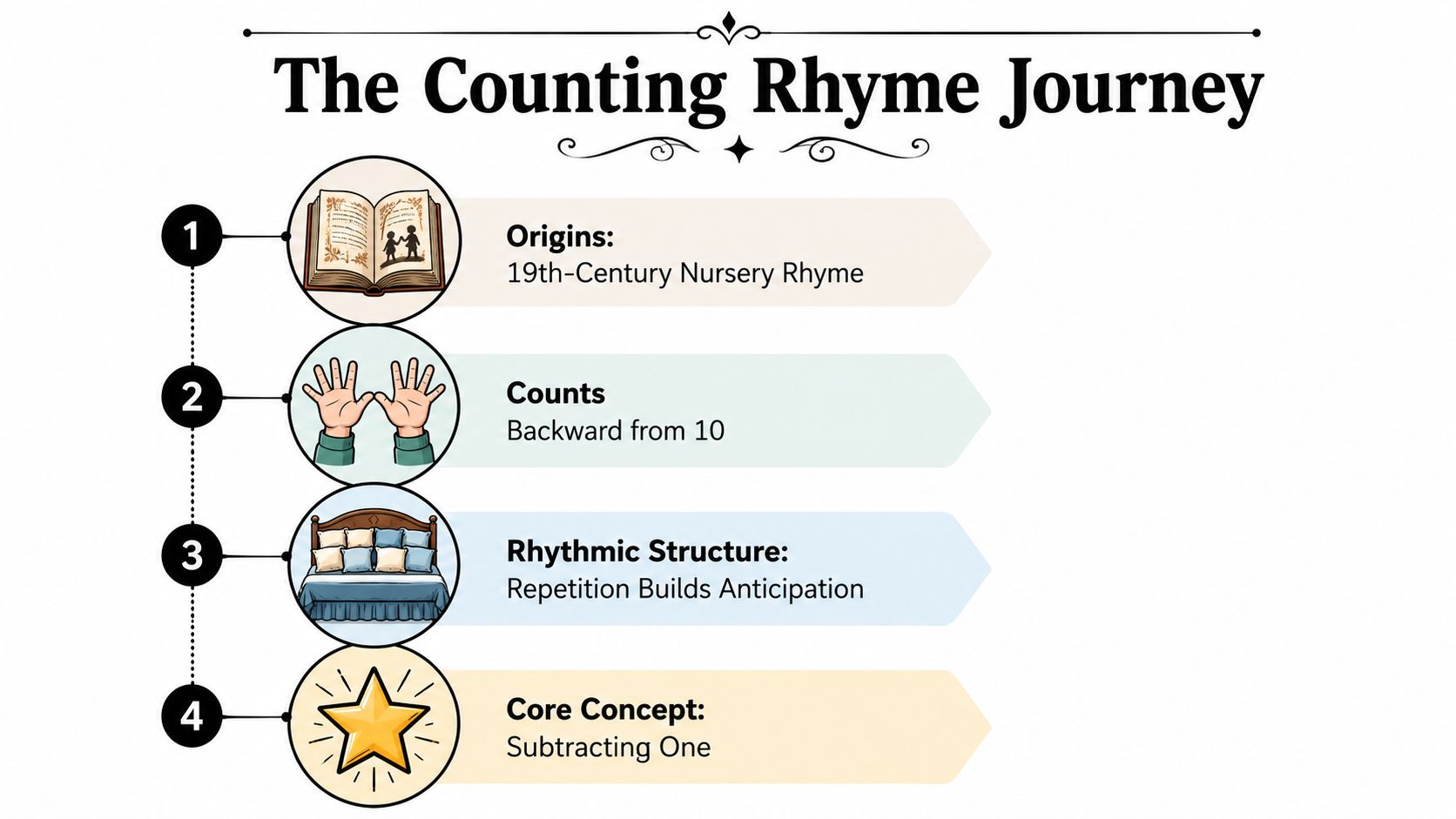
At its heart, Ten in the Bed is a backward-counting bedtime story. The familiar pattern begins with a crowded bed, then one character falls out after the instruction to roll over. The group becomes smaller, the verse repeats, and children quickly learn that the next part follows a dependable pattern.
Penny Dale's picture book was first published by Walker Books in 1988 and is described as an adaptation of the long-running English-language counting nursery rhyme. Dale made a memorable change to the cast. Instead of presenting ten children, the book centres on one child and nine soft toys, which gives the rhyme a cosy, picture-book quality for very young listeners. The book's history and publication details are documented here.

Why children return to it
Toddlers often enjoy knowing what comes next. They may not follow every word, but they recognise the musical shape, watch for the tumble, and join in with a number or action. The repetition gives them a secure place in the story, while the falling toys add just enough drama to hold attention.
The title has also proved commercially durable. A 25th anniversary edition was reported to have sold “almost 2 million copies,” and the book won the Oppenheim Toy Portfolio Award in 2002. Those milestones help explain why it has remained familiar across families, nurseries, and libraries rather than disappearing after a short publishing cycle.
Practical rule: If your child wants the same rhyme again, that repetition is useful practice, not a failure of imagination.
The book tends to work especially well for children who enjoy animals, soft toys, physical comedy, or songs with a clear beat. It doesn't need a perfect performance. A quiet voice, a few cuddly toys, and room for your child to answer are enough to make the story feel alive.
The Rhyme Behind the Book and Its Counting Logic
Before choosing activities, it helps to understand the simple engine that drives the rhyme. The sequence is built around one character leaving at each turn.
- Begin with 10 in the bed.
- One falls out.
- Count the remaining group, 9.
- Repeat the action and remove one more.
- Continue until 1 remains.
That is the mathematical idea children hear and see. The number changes because one has been taken away. The rhyme therefore gives a young child a concrete story for subtraction, rather than asking them to memorise an abstract equation.
The underlying song has a longer history than the picture book. Historical accounts describe earlier oral versions, a related printed form called “Men in a Boarding House Bed” in a 1941 party-games book, and a children's recording titled “Roll Over” from 1959. The rhyme's development from oral tradition through print and recording is outlined by Learn a Rhyme.
Why the pattern feels satisfying
The wording repeats, the beat stays familiar, and the number changes in an orderly direction. Children can predict the tumble before it happens, then check whether their prediction was right. That small pause between expectation and action is part of the fun.
Different families may remember different words, tunes, or characters. That doesn't mean one version is automatically wrong. Nursery rhymes travel by voice, so adults often adapt them to fit a child, a classroom, or a collection of toys.
For families who enjoy collecting traditional songs and stories, you can explore the Rhyme product line for related nursery-rhyme resources. The useful principle remains the same, keep the language predictable and let children participate rather than listening passively.
Developmental Benefits for Toddlers and Preschoolers
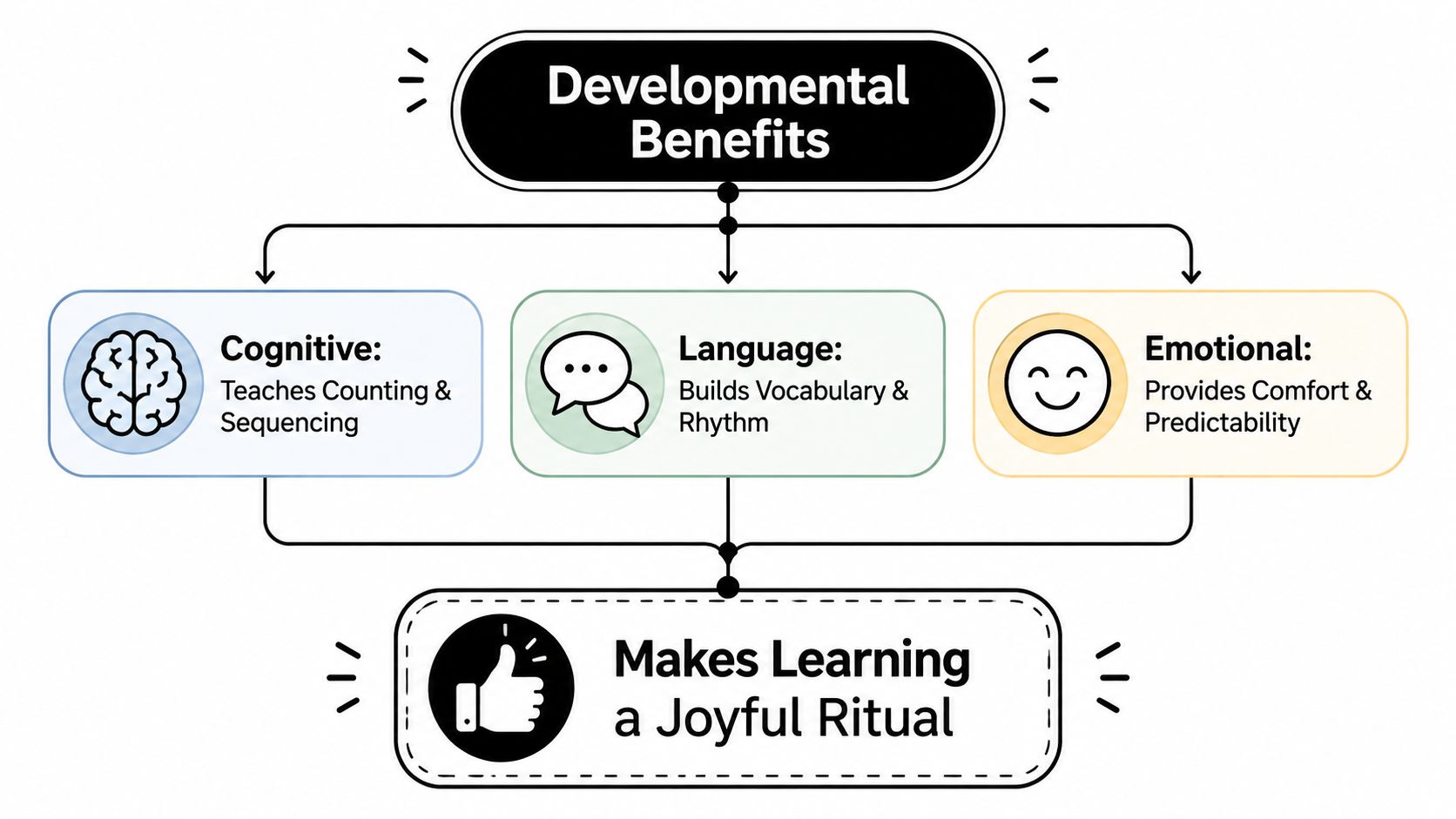
A child may look as if they're enjoying a funny bedtime tumble, but several kinds of learning can happen in the same few minutes. The book is commonly used as an early-years maths text because its action directly supports counting backward from 10 to 1 and the one-less principle. Each verse makes the numerical change visible.
Independent educational material also describes the story as useful for counting and sequencing forward and backward. A literacy resource lists a Flesch–Kincaid reading level of 0.6 and a word count of 248, details consistent with a low-decoding-load read-aloud for preschool and early KS1 children. The educational resource provides these reading and classroom details.
More than number recognition
Try asking, “How many are left?” before turning the page. Your child might answer with a spoken number, hold up fingers, point to the toys, or wait for you to say it. All of those responses show participation at an appropriate stage.
The repeated chant supports memory and oral language. Children hear the same sentence shape, practise joining in with a phrase, and learn that rhythm can carry meaning. The pause before “roll over” also creates a natural opportunity for prediction.
The emotional layer is quieter but important. A familiar sequence can help a child feel secure, especially when the activity takes place in a predictable evening routine. The characters tumble, but the story remains contained and playful. Children can experience excitement without losing the reassuring shape of the reading time.
Listen for participation, not perfection. A child who points, moves, fills in one word, or anticipates the next action is already working with the story.
Movement adds another route into the learning. Education guidance recommends combining the rhyme with actions, toy lines, a chosen “little one,” and simple comprehension questions. The Cumbria early-years guidance offers practical ideas for combining movement, repetition, and manipulation. For more themed reading ideas, you might also browse equestrian books for toddlers from Bridle Up or explore this selection of Christian books for toddlers.
Popular Editions and Formats Worth Knowing
The best edition depends less on the title and more on how your child handles books. A baby who chews board pages needs a different format from a preschooler who wants to study illustrations and act out every verse.
Penny Dale's illustrated version is the touchstone for many families. It presents the central child and soft toys in a storybook format, making the familiar rhyme feel like a proper bedtime adventure. Refreshed board-book versions can suit the 2–5 age range, especially when a family wants a compact book for little hands. A current listing shows the rhyme continuing to appear in updated board-book formats.
| Edition Type | Best Age Range | Why It Works |
|---|---|---|
| Chunky board book | Babies and younger toddlers | Sturdy pages support independent handling and repeated reading. |
| Illustrated picture book | Toddlers and preschoolers | Larger pictures leave room for pointing, searching, and conversation. |
| Sing-along or finger-play version | Children who love movement | Actions make the counting sequence physical and memorable. |
Look for rounded, sturdy pages if your child is still learning how to turn sheets gently. For shared reading, choose artwork with clear faces and easy-to-find characters. If your child loses interest quickly, a short format with a strong visual change on each page may work better than a more detailed edition.
Don't assume the newest cover is the best match. Check the recommended age, binding, page thickness, and whether the text leaves natural pauses for singing. The right book is the one your child can safely handle and wants to revisit.
Engaging Read-Aloud Tips and Sensory Adaptations
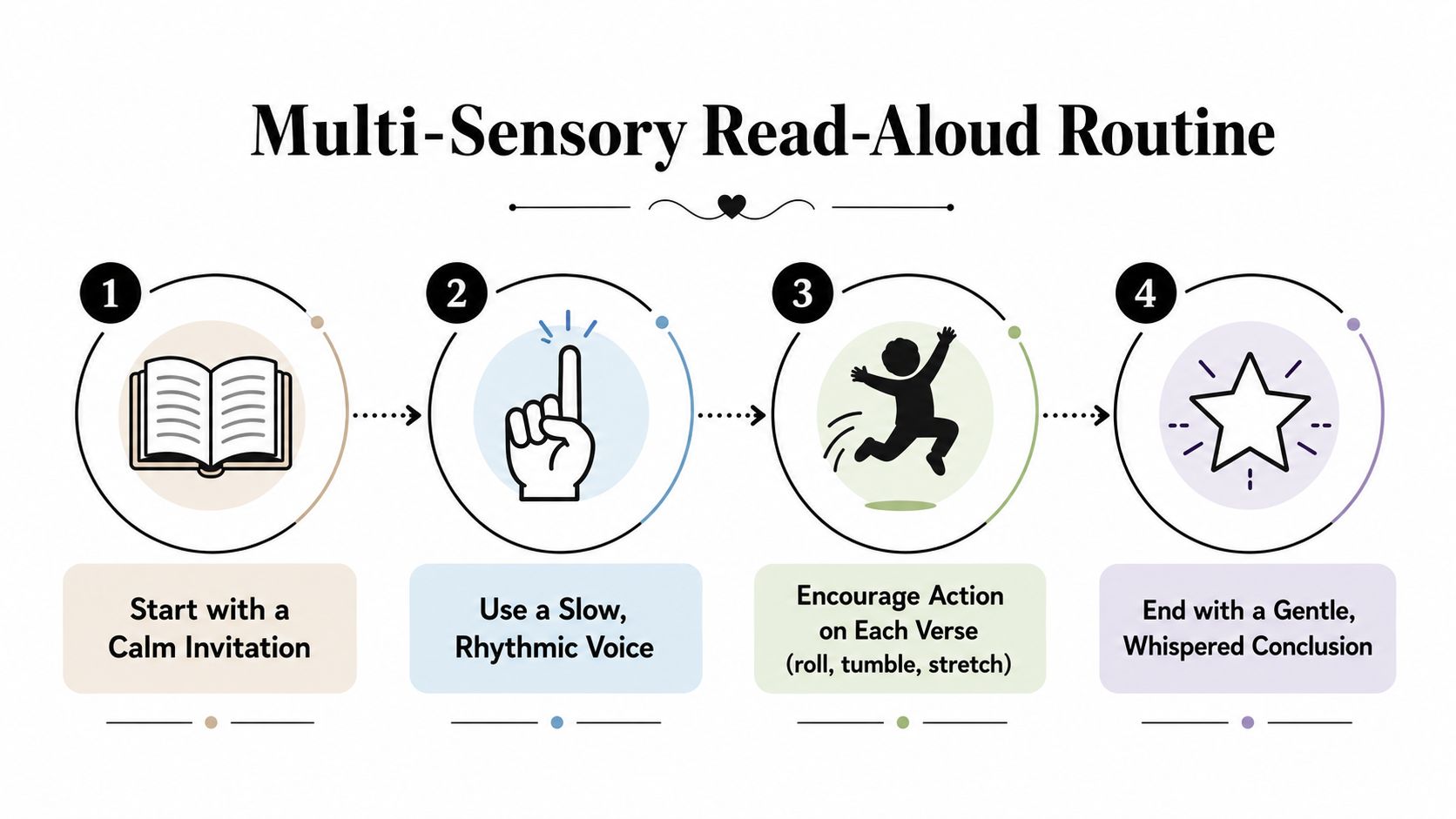
The rhyme works best when you treat it as a small performance, not a test of number knowledge. Start with the book open on your lap and invite your child to place a favourite toy beside you. Let the toy become part of the story, but keep the setup simple enough that bedtime doesn't turn into a second play session.
A repeatable bedtime routine
- Begin softly. Say, “Let's see who's in the bed tonight,” and give your child time to look.
- Count together. Touch each toy or picture as you count. If your child skips a number, continue without correcting sharply.
- Pause before the change. Ask, “What happens next?” A gesture or grin is a valid answer.
- Act out the movement. Roll a toy gently, wiggle your shoulders, or let your child point to the one who falls out.
- Lower the energy. As the group becomes smaller, quiet your voice and slow your movements.
- Finish with comfort. Put the toy beside the child, close the book, and use the same final phrase each evening.
Education guidance supports using physical actions and toy lines because children can manipulate the objects while practising the numerical sequence. That combination gives them something to hear, see, and touch.
For a quieter child, skip the dramatic tumble. Use a whisper, finger counting, and a single soft toy. Sensitive children may prefer dim lighting, fewer props, or a steady hand resting on the blanket. A weighted blanket should only be used if it is appropriate for your child and follows safe sleep guidance. For another calm bedtime idea, see 10 Minutes Till Bedtime.
Here's a gentle read-aloud performance you can borrow when your child wants the song but not the excitement:
Simple Activities and Crafts to Extend the Story
You don't need printed worksheets or specialist equipment to bring the rhyme into play. The strongest follow-up activities use the same objects and sequence your child already understands.
Choose an activity by the evening you have
| Activity | Preparation | Mess Level | Skill Practised |
|---|---|---|---|
| Stuffed-animal bed | Gather soft toys and a cushion | Low | Counting, one-less, positional language |
| Felt pillows | Cut or collect simple fabric shapes | Low | Matching, ordering, fine-motor control |
| Bed mural | Offer paper and crayons | Medium | Narrative recall, drawing, vocabulary |
| Hand-puppet rhyme | Use socks or paper bags | Low | Turn-taking, expression, sequencing |
For a quick version, line up soft toys on a cushion and remove one after each verse. Use words such as beside, under, behind, and on top as you move them. Your child hears mathematical language and positional language in the same game.
A simple craft can turn the story into a display. Draw a large bed, then let your child add ten toy faces, stickers, or fingerprints. You can count them together and cross out or cover one whenever a character rolls away. The finished picture becomes a prompt for retelling the rhyme later.
Keep the activity short if it happens near sleep. The purpose isn't to complete a perfect craft. It's to give the child another way to handle the sequence, remember the characters, and enjoy the story away from the page.
Gift and Pairing Ideas for a Cozy Bedtime Set
A book becomes a more useful gift when it connects to a routine the family can maintain. Ten in the Bed naturally suggests a cosy bundle because the story already belongs beside pyjamas, cuddly toys, and a quiet wind-down.
For a baby shower, pair the book with soft sleepwear and a small washable stuffed animal. For a birthday, add a personalised blanket or a simple playlist of familiar lullabies. For a holiday gift, include a sibling picture book so more than one child has a role in the bedtime ritual.
Build around comfort, not clutter
A thoughtful set might include:
- One durable book: Choose a board book for a child who still handles pages roughly.
- One bedtime garment: Pick something soft, easy to wash, and comfortable for movement.
- One familiar object: A teddy, cloth comforter, or small pillow can become the “little one” in the rhyme.
- One repeatable ritual: Add a handwritten note suggesting a short song, counting game, or cuddle after reading.
Bamboo sleepwear can be a useful pairing for families who prioritise a gentle feel against the skin. Little Venture Co.’s range uses ultra-soft bamboo viscose, carries OEKO-TEX Standard 100 certification, and contributes a portion of every sale to Heartbeat International. You can read more about choosing bamboo baby pajamas when building a comfort-first bedtime gift.
The book doesn't need an expensive collection around it. A favourite pair of pyjamas and one well-loved toy may create a stronger ritual than a crowded gift box. The meaningful part is the repeated invitation to slow down, sing together, and make space for the child to join in.
Buying Responsibly and Choosing a Quality Edition
Start with the child's age and handling habits. Choose sturdy board pages for babies and younger toddlers, and look for a well-made picture-book binding when you expect years of shared reading. Read the age recommendation, inspect the cover and corners, and buy from a library, independent bookseller, or trusted retailer where edition details are clear.
For sleepwear or fabric gifts, check the care instructions and look for recognised safety certification. OEKO-TEX Standard 100 certification can give families added confidence that tested materials meet its requirements for harmful substances, but it doesn't replace safe sleep practices or supervision.
A short checklist helps:
- Match the format: Board pages for early handling, picture-book pages for longer shared reading.
- Check the artwork: Clear characters make counting and retelling easier.
- Consider durability: Repeated bedtime reading can be demanding.
- Choose suitable extras: Avoid small loose parts for children who still mouth objects.
For broader gift inspiration, browse this list of gifts for preschoolers, then compare the practical features of board books before ordering.
Little Venture Co. offers faith-inspired bamboo sleepwear and daywear for babies and toddlers, made with soft, certified materials and a portion of every sale supporting Heartbeat International. Visit Little Venture Co. to choose a meaningful comfort-first gift that can become part of your family's next bedtime reading ritual.