

A Study in the Book of James: Your Practical Guide
Some days faith feels very real during morning Bible time, then completely out of reach by breakfast cleanup. A toddler is crying because the toast broke in half. Your phone lights up with bad news. You snap at your spouse, rush through the day, and by evening you wonder, “How does what I believe help with this?”
That's why a study in the book of james matters so much.
James doesn't spend his time in abstract debate. He writes like a pastor talking to people under pressure. He cares about what happens when life is loud, unfair, tiring, and emotionally messy. He cares about reactions, habits, speech, money, humility, and prayer. In other words, he cares about the exact places where modern parents often feel stretched thin.
If you've mostly heard James explained as a big argument about faith and works, that's only part of the picture. James also reads like a guide for people who need steadiness. When your family life feels scattered, your emotions are up and down, and your spiritual life feels less like peace and more like survival, James meets you there.
More Than Just Faith and Works
A lot of people come to James with one question: “Does faith need works?” That's an important question, but if that's all you look for, you'll miss the tone of the whole letter.
James sounds like someone helping a tired community get its footing back. He addresses believers living under pressure, and that changes how you hear his commands. They aren't random moral reminders. They're calls to become whole when life makes you fragmented.
James speaks to stressed people
Some Bible books feel like theological blueprints. James feels more like a wise small group leader who sees where your life is leaking and starts naming the spots. He talks about trials, wisdom, instability, speech, anger, favoritism, envy, planning, prayer, and patience.
That's why James lands so directly for modern families.
Parents today often live with a constant mix of pressure. There's money stress, school stress, social comparison, health concerns, work deadlines, church expectations, and the quiet fear that you're not doing enough. James doesn't give a productivity system for handling that. A more nuanced reading is that James is a stability-and-integrity letter for dispersed, pressured believers, a perspective highlighted in Sam Storms's reflection on James 1:5-8.
Practical rule: Read James less like a scorecard for high performers and more like a field guide for believers who need a steady heart.
If you want to read the text itself alongside a guide, it helps to keep a clean copy of the Book of James open so you can notice how often James connects inner belief with everyday behavior.
Integrity is the big issue
When James pushes on action, he isn't saying, “Earn God's love.”
He's asking a different question: “Does your life hold together under pressure?” That's the issue of integrity in the deepest sense. Not image management. Not acting polished at church while falling apart in private. Integrity means your beliefs, words, choices, and treatment of people line up.
For families, that can sound like this:
- When plans fall apart, do we panic or ask God for wisdom?
- When someone irritates us, do our words wound or heal?
- When we meet people who seem impressive, do we treat them better than others?
- When we say we trust God, does that shape how we respond to need?
James keeps bringing faith down to floor level.
Why this matters at home
A study in the book of james becomes powerful when you stop asking only, “What does this mean?” and start asking, “What does this expose in me?”
James is eminently practical because family life is eminently practical. No parent needs more vague inspiration. We need wisdom for the moment when we're tired, annoyed, insecure, and tempted to react fast.
James helps by doing two things at once:
- He tells the truth about spiritual inconsistency.
- He points toward a steadier way of living.
That's why this letter still feels so current. It doesn't flatter us. But it does help us grow up.
Meet James and His Original Audience
Before you can hear James well, it helps to meet the man behind the letter and the people receiving it. Their situation explains the urgency, the warmth, and the sharpness in his words.
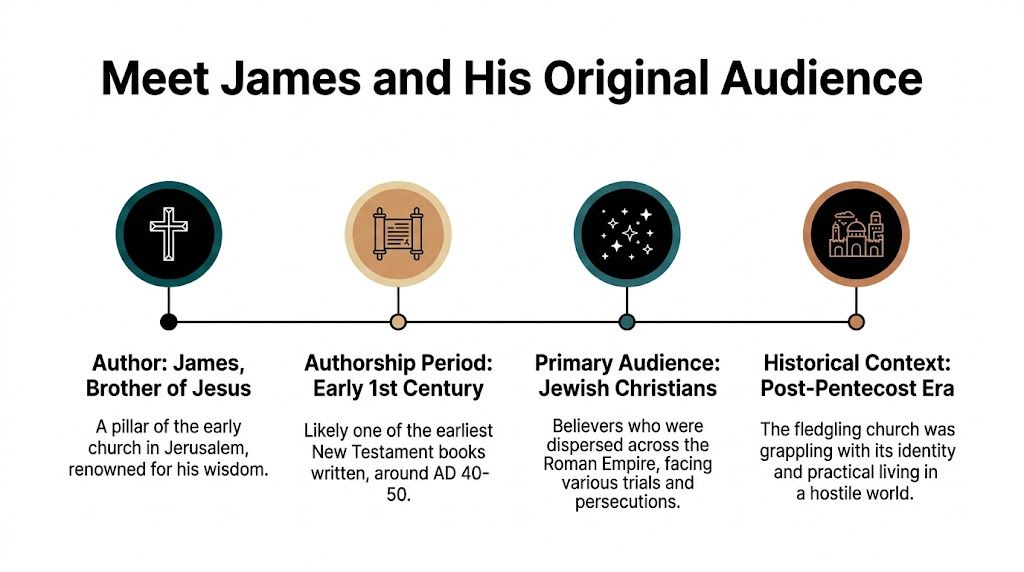
James was a real leader writing to real pressure
The Book of James is one of the shortest books in the New Testament, with 5 chapters and 108 verses, and many reference sources date it to about AD 45 to 50, which places it among the earliest New Testament letters, as summarized in this historical overview of James. The letter is traditionally attributed to Jesus' half-brother James, who became a leader in the Jerusalem church and led it for roughly 20 years before being murdered around AD 62, according to that same overview.
Those details matter because they place James close to the earliest Christian movement. This isn't a late reflection written far from the action. It comes from the early church world, where believers were still working out what faithful living looked like in daily community life.
The audience was scattered, not settled
James addresses the “twelve tribes dispersed.” That language carries a strong Jewish feel. It tells you these readers weren't living in comfort and control. They were scattered people, trying to follow Jesus while dealing with instability.
That helps explain why the letter feels so direct.
A parent today might say, “I'm not physically dispersed, but I feel scattered.” That's often the modern version. Your attention is spread across texts, bills, schedules, school forms, family needs, and private worries. James writes to people who knew what it felt like to live without much emotional margin.
James makes more sense when you picture a community under strain, not a classroom having a detached theological debate.
Why the Jewish tone matters
James is often described as the most Jewish in style among New Testament writings. You can hear that in how he teaches. He sounds like wisdom literature. He gives short, forceful instructions that stick in your mind. He uses vivid pictures. He moves quickly from one practical issue to another.
That means James often reads less like a carefully layered essay and more like a trusted elder saying, “Pay attention to this, and this, and this too.”
Here's a simple way to frame the setting:
| Piece of background | Why it matters for your reading |
|---|---|
| Early date | You're hearing one of the earliest Christian voices address practical living |
| James's leadership | The letter carries pastoral weight, not detached theory |
| Dispersed audience | The message is shaped for people under social and personal pressure |
| Jewish style | Expect wisdom, vivid images, and direct moral application |
Read it like a pastoral letter
If you read James like a cold rulebook, it can feel harsh. If you read it like a pastoral letter to pressured believers, it becomes more alive.
He's not piling guilt onto hurting people. He's calling a struggling community to maturity. He's saying, in effect, “Let your faith become visible where life is hardest.”
That's still the right setup for any good study in the book of james today.
The Four Big Ideas in the Book of James
James touches a lot of topics, but a few major ideas keep surfacing. If you can hold these four in your mind, the rest of the letter becomes easier to follow.
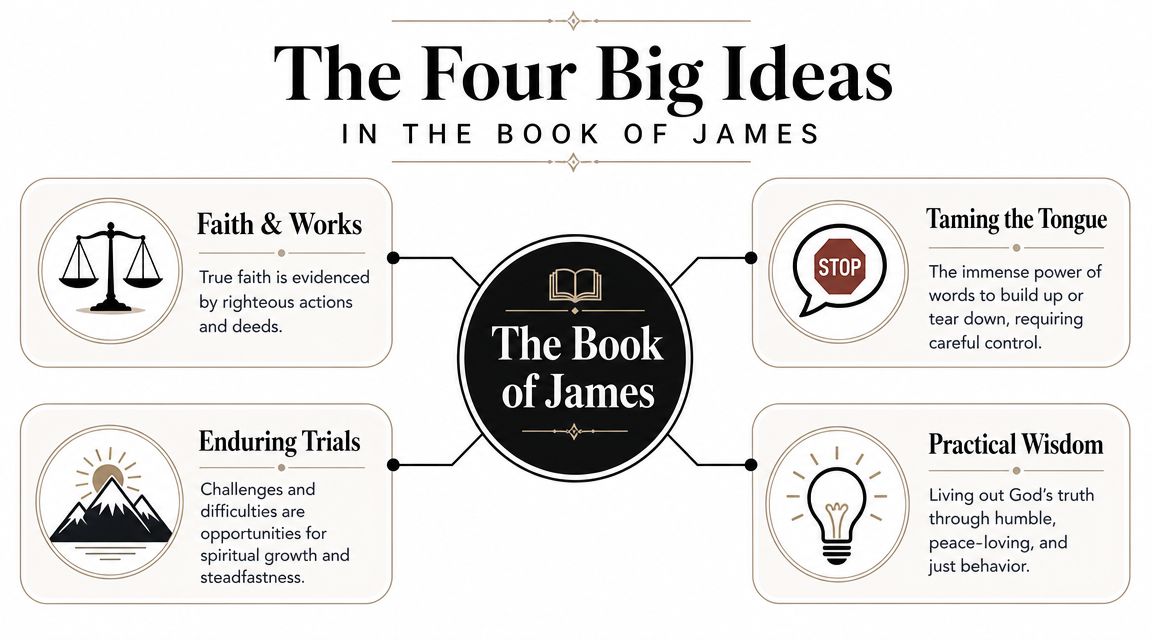
Enduring trials and asking for wisdom
James begins where many families live. Not with ideal conditions, but with struggle.
He treats trials as places where faith gets strengthened. That doesn't mean pain is pleasant. It means hard seasons can produce steadiness if you bring them to God rather than letting them pull you apart. James also links trials with wisdom. When life is confusing, he doesn't first say, “Try harder.” He says to ask God for wisdom.
A modern analogy helps here. Think of family stress like driving in heavy rain. You don't need more speed. You need visibility. Wisdom is that visibility.
One-sentence takeaway: Trials test your footing, and wisdom helps you stay upright.
Faith and works belong together
This is the theme people know best. James refuses the idea that faith can stay invisible forever.
If someone says they trust God, but their habits never bend toward mercy, obedience, or love, James says something is off. He isn't praising performative religion. He's exposing disconnected religion. Real trust in Jesus shows up in action the way healthy roots eventually produce fruit.
For parents, that may mean your theology of grace should affect your tone at home, your generosity, your patience, and how you respond to people who can't offer you anything in return. If you want a simple companion theme study, this reflection on the fruit of the Spirit pairs well with James because both push faith out of theory and into lived character.
Faith is not less than belief. But in James, it is never belief that stays alone.
Speech reveals the heart
James gives enormous attention to words. That alone makes the book worth studying in any home.
A family's emotional climate is shaped by speech. A rushed correction, a sarcastic comment, a cutting argument, or a thoughtless joke can linger far longer than the speaker intended. James treats the tongue as small but powerful. That feels ancient until you remember how one sentence can alter an entire evening in your house.
One-sentence takeaway: Your words steer more of your life than you think.
Favoritism, wealth, and practical wisdom
James also presses hard on how communities treat people. He warns against favoritism, especially the kind that honors the socially impressive while neglecting the vulnerable. He also speaks bluntly about wealth and self-centered ambition.
That doesn't mean every family Bible study has to turn into an economics seminar. It does mean James asks whether we instinctively value people by what they can do for us. That question reaches into churches, schools, neighborhoods, and friend groups.
Here's a quick map of the four themes:
- Trials and wisdom. Pressure can become a place of growth when you seek God.
- Faith and works. Genuine faith becomes visible.
- Speech. Words direct relationships and reveal maturity.
- Favoritism and wealth. God's people must not mirror status games.
When you keep those four ideas in view, James stops feeling scattered. You start hearing one consistent message: wholehearted devotion to Jesus should reshape ordinary life.
Chapter 1 A Guide to Enduring Trials
James opens with pressure, not comfort. That's one reason people connect with him so quickly. He starts where many believers live.

Joy in trials doesn't mean pretending
When James says to consider trials with joy, people often get confused. He is not asking you to call painful things pleasant. He isn't telling exhausted parents to smile their way through grief, uncertainty, or sleep deprivation.
He's talking about a deeper confidence. Joy here means knowing that God can produce maturity through hardship. Trials reveal what's shaky, but they also create endurance. James cares about what pressure forms in us.
That lands hard in family life. Delays, sickness, tantrums, stretched budgets, and strained relationships all uncover what's really going on in the heart. James says those moments can become places where God grows steadiness.
Wisdom is the next right request
One of the kindest things in James 1 is that he assumes people in trials will need help thinking clearly. He tells them to ask God for wisdom.
That matters because trouble often scrambles judgment. You don't know whether to act, wait, speak, stay quiet, spend, save, confront, or let go. James doesn't shame that confusion. He redirects it toward prayer.
If you're in a season where your mind feels crowded, it may help to slow down with a simple resource on prayer when feeling overwhelmed and use it alongside James 1.
Small group question: When stress hits your home, what do you ask God for first, relief or wisdom?
Double-mindedness is divided trust
James also warns about being double-minded. That doesn't mean you never feel emotion or ask honest questions. It means trying to lean on God while also refusing to trust him. It's inner division.
A simple household analogy works well here. If one parent is steering the stroller while the other keeps pulling it in another direction, progress gets awkward fast. Double-mindedness is spiritual tug-of-war. James wants a settled heart that brings needs to God without splitting loyalty between trust and self-rule.
James teaches in sharp, memorable strokes
One helpful lens for Chapter 1 is James's overall style. The book's structure is a sequence of short paraenetic teachings rather than one long linear argument. BibleProject notes that chapters 2 through 5 contain twelve concise teachings, beginning with favoritism, and moving through practical ethics that connect belief to behavior, which is why James is well read as a behavior-audit text in BibleProject's guide to James.
That same practical spirit already shows up in Chapter 1. James moves quickly from trials to wisdom to divided hearts to listening, anger, and doing the word.
Try reading Chapter 1 with these family discussion prompts:
- At dinner ask: Where did we need wisdom today?
- For parents ask: What pressure point reveals impatience in me most often?
- For older kids ask: What's the difference between hearing truth and doing it?
- For personal reflection ask: Where do I feel spiritually split right now?
Chapter 1 doesn't just comfort people in pain. It trains them to respond differently.
Chapters 2-3 Faith in Action and Taming the Tongue
If Chapter 1 opens the door, Chapters 2 and 3 walk straight into daily behavior. James's message grows especially concrete. He moves from inward stability to visible conduct.
Chapter 2 exposes a common church problem
James starts with favoritism. He describes the kind of community that treats a well-dressed, high-status person better than someone poor. That issue still lives with us, even if the outfits have changed.
Today favoritism often looks subtle. We may give more attention to confident people, successful people, polished families, or people who can increase our social comfort. James says that sort of sorting system has no place among believers.
This hits home for families because children learn honor by watching how adults treat others. They notice whether parents speak warmly to the influential but impatiently to the inconvenient. James pushes us to ask whether our welcome reflects God's heart or our own preferences.
Faith without works is dead means faith should be visible
Now to the question everyone asks.
James is not saying human effort purchases salvation. He is saying that a faith with no outward expression is not healthy, alive faith. If trust in Christ never leads to mercy, obedience, generosity, or changed priorities, then the claim of faith is hollow.
A simple comparison can help:
| Claim | James's concern |
|---|---|
| “I believe” | Good, but belief must move beyond words |
| “I know the right doctrine” | Knowledge alone does not prove living faith |
| “I care spiritually” | Care becomes visible in action |
| “I trust God” | Trust shows itself when costly obedience is required |
James is not obsessed with outward performance for appearance's sake. He is concerned with whether the inner life and outer life belong together.
A living faith breathes. It moves. It responds.
For parents, this can look ordinary. Do you say forgiveness matters, then hold grudges at home? Do you say God cares for the weak, then avoid inconvenient needs? James keeps pulling faith out of slogans and into choices.
Chapter 3 turns to the tongue
Then James shifts to speech, and his imagery is unforgettable. He treats the tongue like a tiny control point with oversized effect. Small words can steer large realities.
You already know this if you've ever watched one sentence redirect your entire evening. “Why are you always late?” lands differently than “Can we reset and try this conversation again?” Same conflict. Different fire.
James's point is not merely “be nice.” It is that speech reveals maturity. The mouth often exposes what the heart has been storing.
Try using these examples in a small group or family conversation:
- At home: A sarcastic comment can make a child withdraw for the rest of the night.
- In marriage: A defensive tone can turn a solvable issue into a larger conflict.
- At church: A careless remark can make a newcomer feel like an outsider.
- Online: A quick post can train your heart toward outrage rather than wisdom.
A useful reading key for both chapters
Read Chapter 2 and Chapter 3 together and a pattern appears. James keeps asking, “What does your faith produce when people are involved?”
Not in theory. In relationships.
That's why these chapters matter so much for homes. Families don't mainly struggle with abstract heresy. We struggle with partiality, tone, impatience, self-protection, and the gap between what we say and what we do. James brings all of that into the light.
Chapters 4-5 Warnings and Encouragement
James closes with some of his strongest language. He warns against quarrels, pride, self-sufficient planning, and oppressive use of wealth. Then he turns and offers patience, prayer, and hope. That combination is exactly what many readers need.
Pride is more practical than we think
When people hear “pride,” they often picture obvious arrogance. James shows a more familiar version. Pride is also the habit of centering your own desires, insisting on your own way, and making plans as if God were an accessory rather than Lord.
That's why James speaks about quarrels. Conflicts usually feel like they begin “out there,” with someone else's tone, someone else's mistake, someone else's selfishness. James asks what cravings and demands are driving the fight from inside us.
That is uncomfortably relevant.
At home, pride can sound like this: “My schedule matters most.” “My frustration is justified.” “My preferences should set the emotional weather.” James confronts that posture because it destroys peace from the inside out.
Submit to God is not passive language
James calls believers to submit to God and resist the devil. Some readers hear that and think of passive spirituality, as if James were saying, “Just wait and hope things improve.”
He isn't.
Submission is active reordering. It means placing yourself under God's authority in the places where ego wants control. Resisting evil means refusing the patterns that inflame envy, bitterness, rivalry, and self-exaltation. For modern families, that may include stepping back from comparison, refusing petty scorekeeping, or admitting wrong quickly.
Reality check: Prayer and humility are not retreat tactics. They are how believers stay sane and faithful in a world that rewards self-assertion.
James confronts arrogant planning and distorted wealth
James also criticizes the kind of planning that assumes total control over tomorrow. He's not against calendars, budgets, or wise preparation. He's against boasting in imagined control.
Parents know how quickly plans can change. A sick child, a job shift, an unexpected expense, or a hard conversation can rewrite the whole week. James teaches us to plan with open hands.
He also gives stern warnings to rich oppressors. The force of that warning should make all of us slow down and examine how we think about security, comfort, and power. Even if we aren't wealthy by every standard, we can still drift into the mindset James rebukes. We can start treating money like salvation, convenience like necessity, and people like obstacles.
A simple self-audit can help:
- When I feel anxious, do I run first to control or to God?
- When I make plans, do I leave room for humility?
- When I have resources, do I think mainly about comfort or stewardship?
- When conflict rises, do I defend myself first or repent first?
Patience and prayer are survival habits
James ends with encouragement that feels sturdy. He tells believers to be patient, like a farmer waiting for the harvest. That image matters because farmers work while they wait. Biblical patience is not laziness. It is steady faithfulness without panic.
Then James turns to prayer. He speaks about suffering, cheerfulness, sickness, confession, and restoration. Prayer is woven through all of it. Not as a last resort, but as a normal response to life with God.
That's one of James's great gifts. He doesn't leave pressured believers with warnings alone. He gives them a way to endure. Humble yourself. Stay patient. Pray sincerely. Keep going.
Those are not small instructions. For many families, they are daily survival strategies.
Bringing James Home A Practical Application Guide
Knowledge helps, but James keeps asking for practice. The most useful study in the book of james is the one that changes dinner-table conversations, conflict habits, prayer rhythms, and how your family treats people.
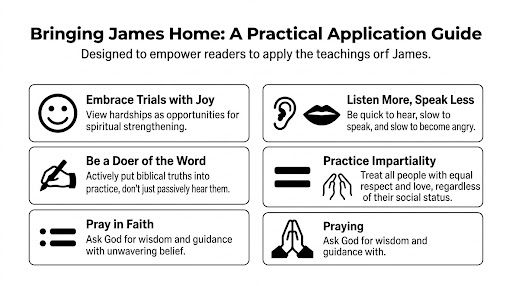
A simple 30-day James challenge
You don't need a complicated plan. You need repeated practice in small places.
Try this over a month:
- Week one, ask for wisdom daily. Keep a note on your phone or fridge. Write one situation each day where your family needs God's help thinking clearly.
- Week two, do a speech audit. Notice patterns like interrupting, sarcasm, complaining, or harsh correction.
- Week three, practice impartiality. Talk as a family about how you welcome people who are new, awkward, quiet, or easily overlooked.
- Week four, build a prayer habit. End the day with short, honest prayer about stress, conflict, gratitude, and need.
Discussion starters that work at home
Not every family discussion has to feel formal. James works well with short prompts.
- For young kids: What kind words help people feel safe?
- For older kids: What's the difference between saying sorry and changing?
- For couples: Where do we become double-minded under stress?
- For a small group: Who gets honored in our community, and who gets ignored?
If you want a structured companion tool, Little Venture Co. offers a devotional resource, and they also carry a James Bible study resource. That can be one option alongside your Bible, a notebook, and a simple reading plan.
Here's a helpful visual recap before you begin the challenge:
Keep the activities concrete
James is easiest to apply when the task is visible.
Try a few of these:
- Family taming-the-tongue challenge. Pick one speech habit to work on for a week, like no interrupting or no sharp responses from room to room.
- Welcome audit for your group. Ask who gets approached first on Sunday and who often stands alone.
- Mercy practice. Let each family member choose one quiet act of service during the week.
- Planning prayer. Before reviewing your calendar, ask God for humility about the week ahead.
Don't aim for dramatic change by tomorrow. Aim for repeated obedience in ordinary moments.
James grows roots in a household when people stop admiring the letter and start living it.
Frequently Asked Questions About James
Some questions keep coming up in almost every group study. That's normal. James is direct enough to stir honest confusion.
Does James contradict Paul on faith and works
Short answer, no.
James and Paul address different problems. Paul pushes back against the idea that people can establish righteousness before God through their own efforts. James pushes back against the idea that verbal faith claims are enough even when nothing changes. Paul confronts self-saving religion. James confronts empty profession.
So when James says faith without works is dead, he isn't undoing grace. He's describing the shape of living faith.
Is James legalistic
He can sound that way if you read him as a detached list of demands. But James is less interested in rule accumulation than in whole-person integrity.
He doesn't say, “Build a flawless religious image.” He says, in effect, “Let God's truth reshape what you do, say, value, and pursue.” That is demanding, but it isn't legalism. Legalism obsesses over earning. James obsesses over authenticity.
What does the perfect law of freedom mean
Many readers trip over that phrase because law and freedom seem opposite. James sees freedom differently.
Freedom in James is not the ability to do whatever your impulses want. It is liberation into the life God made you for. When God's word forms a person, that person becomes less trapped by selfish desire, double-mindedness, envy, and destructive speech. Obedience becomes freedom because sin is a worse master.
Why does James feel so intense
Because he is writing for real life, not religious theater.
Parents often appreciate James once they stop expecting soft, abstract encouragement. He speaks with urgency because relationships, communities, and witness are at stake. Words matter. Treatment of people matters. Humility matters. Prayer matters. James refuses to let faith remain vague.
If you're pairing James with a broader Bible memory or family discipleship plan, a collection like 100 Bible verses everyone should know can help anchor the bigger picture in your home.
The clearest way to read James is this: he wants a faith that holds together when life does not. That's why the book still speaks so directly to modern homes.
If you're building a faith-filled home one small habit at a time, Little Venture Co. offers resources and family-centered products designed for Christian households with little ones, including faith-inspired children's wear and Bible study materials that can support everyday discipleship.