

Quick Change Clothing for Babies and Toddlers Explained
A diaper blowout has happened at the park, the spare outfit is buried at the bottom of the bag, and your baby has decided that lying still is no longer part of the plan. Or bedtime is close, your toddler is overtired, and getting a shirt over their head feels like a small wrestling match. In moments like these, clothing design matters less as fashion and more as practical equipment.
Quick change clothing is made to reduce the time, movement, and fine-motor effort needed to dress, undress, or change a baby or toddler. It can use a full-length zipper, an accessible snap opening, a magnetic closure, a wide neckline, or a two-piece design that lets you replace only the dirty part. The best garments make the child more comfortable too, because fewer awkward pulls and repeated adjustments mean less frustration for everyone.
The useful question isn't just whether an outfit looks easy to open. You need to know whether the closure reaches the diaper area, whether the fabric stays comfortable during sleep, whether the fit allows movement, and whether the hardware meets children's apparel safety expectations. The following guide connects those choices to real routines, from midnight changes and nap transitions to sensitive skin, laundry days, and thoughtful gifts.
What Quick Change Clothing Really Means for Little Ones
A quick-change garment earns its name by solving a specific caregiving problem. During a diaper change, you might need access to the lower body without removing the entire outfit. Before a nap, you might need to change a damp shirt without disturbing a sleepy child. At the playground, you might need to replace muddy pants while keeping a clean top in place.
Traditional pullover onesies often require fabric to pass over a baby's head. That can be uncomfortable for a newborn with limited head control, and it can become especially difficult when a toddler arches, twists, or reaches for the nearest toy. A garment with a wide envelope neckline, side opening, or front zip changes the sequence. You open the clothing first, position the child, and close it once the body is settled.
The design is about fewer difficult movements
Common quick-change formats include:
- Full-length or two-way zippers, which can expose the diaper area while the upper body remains covered.
- Snap-crotch rompers, which open below the waist for a focused change.
- Wide envelope necklines, which can stretch over the shoulders or move down the body instead of being dragged over the head.
- Two-piece sets, which let you change a top or bottom separately.
- Side-snap or wrap-style garments, which open flat and reduce the need to maneuver a small child into narrow openings.
The important distinction is access. A decorative zipper that stops above the diaper may look modern but won't help much during a blowout. Likewise, a row of snaps can be useful only if the snaps align easily and don't require you to hold a squirming child in an awkward position.
Practical rule: Choose the opening that matches the change you perform most often, not the feature that looks most impressive on a product page.
Quick change clothing also supports a child's dignity and comfort. A baby doesn't have to be pulled, rolled, or turned more than necessary, while an older toddler can begin participating by pushing an arm through a sleeve or pulling up soft pants. Throughout this guide, the focus is simple: identify the feature that removes friction from your routine, then check whether the garment remains safe, breathable, washable, and comfortable after repeated use.
Where Quick Change Clothing Came From and Why It Stayed
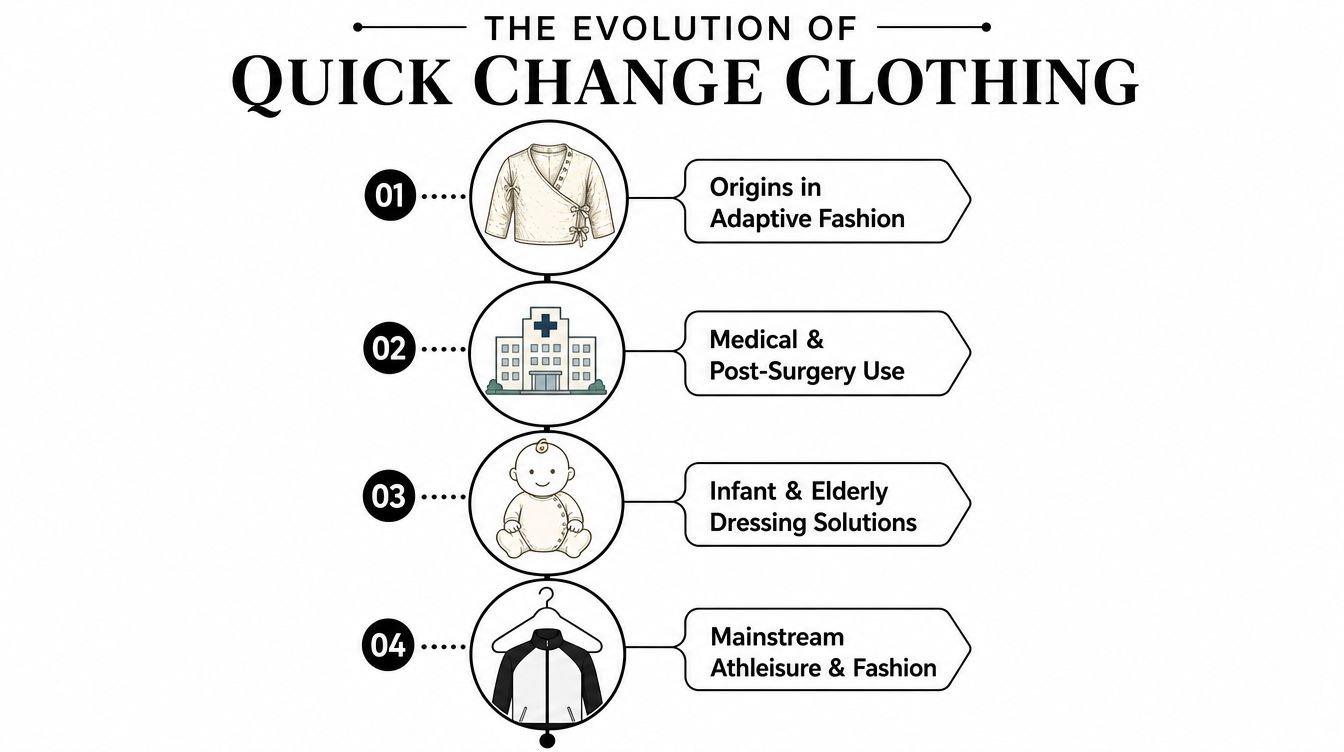
Quick-change design grew from a broader adaptive-fashion tradition. Adaptive clothing modifies ordinary garments so people with limited mobility, motor difficulties, medical needs, or other dressing challenges can get dressed with less strain. That same logic applies to babies, whose bodies are small, movements are unpredictable, and daily changes are frequent.
A notable early milestone came in 1948, when Gladys Reed was credited with creating a belt with hip pockets for carrying a body-worn hearing aid and batteries. The design mattered because it treated clothing as a functional solution rather than only a decorative layer. Later, between 1955 and 1976, Helen Cookman and Virginia Pope led a large collaborative effort to create functional fashions for disabled people. Independent fashion-history coverage records participation from nearly 30% of leading U.S. designers in the Functional Fashions Line during that period, evidence that adaptive design reached well beyond a small specialist circle. Learn more about the history of adaptive fashion.
Why baby clothing adopted the same thinking
Caregivers recognized that an adaptive feature doesn't need to be reserved for a medical setting. A two-way zipper can help with a nighttime diaper change. A wrap opening can make dressing a newborn gentler. A separate top and bottom can make a partial change easier after food spills. The child doesn't need a disability or diagnosis for the design to be useful.
The wider apparel system also helped functional clothing reach ordinary households. McKinsey's clothing-industry overview reports that global clothing production doubled between 2000 and 2014, while garments purchased per person increased by about 60% during that period. Adaptive fashion re-emerged in the 1980s as caregivers sought easier dressing, and the accessibility conversation gained momentum after the Americans with Disabilities Act of 1990. This history of adaptive fashion places quick-change clothing within that combined story of manufacturing, disability rights, and everyday convenience.
The lesson for parents is useful: a feature isn't a gimmick merely because it began in specialized apparel. Judge it by the problem it solves. If it reduces pulling, protects a sensitive area, or makes a partial change possible, it has a practical purpose.
The Features That Actually Make a Garment Quick Change
A quick-change outfit works as a system. The closure, fabric, cut, and safety details all need to cooperate. A smooth zipper is less helpful if the fabric overheats, and a soft knit loses its value if the opening forces you to pull it over a resisting head.
Start with the opening
A two-way zipper is often useful for sleepers because the lower slider can open toward the feet, exposing the diaper zone while leaving the chest covered. A magnetic placket can help an adult align the front quickly, but it must be securely constructed and appropriate for the child's age and use. A wide envelope neckline should stretch enough to pass over the shoulders without catching ears or rubbing the face.
Inspect the hardware with your fingers. Look for a covered zipper tape, a smooth pull, and no exposed sharp teeth against the skin. For detailed examples of baby zipper sleepers and their practical construction, see this guide to baby zipper sleepers.
Then examine the fabric and cut
Breathable bamboo, organic cotton, and stretch knits can make dressing easier because they move with the child. The label alone doesn't guarantee comfort. Rub the inside against your wrist, check whether seams feel raised, and look for enough stretch around the hips and shoulders.
A gusseted crotch gives the diaper area room without forcing the garment tight across the seat. Raglan sleeves can allow easier arm movement, while a snap-crotch romper should open flat enough for a clean change. A garment that looks generous in the torso but pulls across the diaper is not genuinely easy dressing.
Safety deserves its own check. Children's apparel guidance recommends permanent top and bottom stops on open-ended zippers, zip guards when hardware sits near the face, neck, or groin, and protection that prevents metal zippers from touching skin. The same guidance warns against three-dimensional zipper-pull trims that may create choking hazards. Review the children's apparel product-safety guidance before treating a cute detail as harmless.
| Feature | What to Look For | Red Flags to Avoid |
|---|---|---|
| Closure | Two-way access, secure snaps, covered zipper tape | Stiff sliders, exposed teeth, loose hardware |
| Fabric | Breathable, soft, flexible knit with moisture management | Scratchy seams, poor recovery, heavy trapped heat |
| Fit and cut | Room at the diaper, flexible shoulders, flat-opening lower section | Tight crotch, narrow neck, sleeves that restrict movement |
| Safety information | Clear children's apparel labeling and relevant testing information | Decorative pulls, detachable parts, unclear sleepwear instructions |
Thermal balance matters during sleep. Research on preschool sleep comfort found that fabric thickness had a stronger relationship with skin temperature than thermal conductivity, while related sleepwear research points to absorption, quick drying, and lower thermal conductivity as useful properties. Read the thermal-comfort research. In plain language, a warm garment still needs to release moisture and avoid overheating.
Sizing, Washing, and Caring for Easy-Dressing Outfits
A well-designed romper can become difficult to use if it shrinks, pills, or loses its stretch. Care starts before checkout. Measure the child's chest and body length, note their current weight if the brand uses it, and compare those measurements with the maker's chart rather than relying only on age labels. A practical baby clothing size chart can help you understand how those measurements relate to common clothing categories.
Use the fit test, not just the tag
Leave comfortable room through the torso and diaper area, but don't size so generously that sleeves cover the hands or the zipper bunches under a car-seat harness. You should be able to place a thumb comfortably near a waistband or shoulder area without creating pressure. Check that snaps close without pulling and that the neckline lies flat when the child turns their head.
Growth changes quickly, so a garment should allow movement without depending on excessive length. If you're buying ahead, confirm the brand's actual measurements and return policy. A slightly relaxed fit can be useful, but extra fabric shouldn't interfere with safe sleep or movement.
Protect the fabric during laundry
Use a fragrance-free detergent if your child has sensitive skin, and avoid fabric softener when the garment relies on moisture-wicking fibers. Softener can coat fibers and change how they absorb or release moisture. Washing inside out on a cold cycle can help protect prints, elastic, and the outside surface.
Follow the care label for drying. Low heat is generally gentler than high heat, particularly for bamboo-based fabric and elastane blends. Don't assume that a garment marketed as durable can tolerate every cycle.
Treat stains early and store knits thoughtfully
For a diaper stain, rinse promptly with cool water, apply a gentle stain treatment, and wash according to the care instructions. Aggressive scrubbing can roughen the knit and create a worn patch. If pilling appears, use a fabric shaver lightly rather than pulling at individual fibers.
Rotate frequently worn pieces so the knit can recover between uses. Fold stretchy sleepers instead of hanging them for long periods, and keep bamboo garments away from strong direct sunlight when storing them. These small habits protect the softness and shape that make the clothing valuable in the first place.
Matching Outfits to Real Daily Routines
The right garment depends on what you're trying to change. A sleepy baby in a dark bedroom needs a different solution from an active toddler returning from the park with muddy knees. Quick change clothing works best when the opening matches the task.
Choose the zip romper for concentrated access
A zip-front romper is a strong choice for naps, travel, car-seat transitions, and nighttime care. With a two-way zipper, you can open the lower section for a diaper change without exposing the whole upper body. The enclosed shape also layers neatly under a sleep sack, provided the fit remains comfortable and the sleepwear instructions are followed.
A two-piece set behaves differently. A snap-top with pull-on pants works well for tummy time, park visits, meals, and days when only one part of the outfit is likely to need changing. You can replace the pants after a spill while keeping the top clean, and you can combine each piece with other items. The tradeoff is that a full diaper change may require removing the bottoms completely.
| Factor | Zip Romper | Two-Piece Set (Snap Top + Pull-On Pants) |
|---|---|---|
| Closure | Usually one continuous opening, often with lower access | Separate top and bottom openings |
| Change speed | Fast for diaper-focused changes | Convenient for partial outfit changes |
| Skin coverage | Continuous coverage from torso through legs | Adjustable, with more exposed waist movement |
| Best routine | Sleep, travel, nap transitions, nighttime | Play, meals, outings, mixed wardrobe use |
For a longer day away from home, clothing is only part of the packing plan. A guide to versatile weekender bags explained can help you think through how spare clothes, wipes, snacks, and comfort items fit into a practical carry setup.
Let the child and setting decide
A toddler who dislikes shirts over the head may do better in a wrap-style top or a roomy snap opening. A child who overheats may need a lighter knit and fewer layers, even if a full romper seems faster. A child with sensitive skin may benefit more from flat seams and moisture control than from a clever closure.
For sleep-focused options, browse this sleep and play clothing guide, then compare each garment with your actual routine. The best choice isn't always the fastest garment in theory. It's the one you can open smoothly, clean easily, and put back on without starting another struggle.
How Little Venture Co. Puts These Ideas Into Practice
Little Venture Co.'s bamboo pieces illustrate how quick-change clothing can combine caregiver convenience with a gentle feel. The bamboo zip romper uses a two-way zipper, including an opening from the foot for lower-body access during diaper changes. That arrangement follows a simple principle, open only the part that needs attention.
The two-piece set applies the same idea through separate garments. A parent can change the lower half after a spill or diaper leak without automatically replacing the top. That flexibility matters during long days when a child moves between eating, playing, resting, and being carried.
Details that support repeated changes
The closure is only one part of the experience. Nickel-free shoulder snaps help avoid unnecessary contact with a common irritant, while tagless labels remove a source of scratching at the neck. Flatlock seams reduce bulky ridges, and gentle four-way stretch allows the fabric to move with a baby who kicks, rolls, or twists during dressing.
The fabric carries OEKO-TEX Standard 100 certification, which indicates that the material has been tested for harmful substances. That information doesn't replace checking the fit or care label, but it gives families a clearer starting point when they prioritize sensitive-skin comfort and material transparency.
The company's faith-inspired mission also shapes the meaning behind the garments. Little Venture Co. contributes a portion of each sale to Heartbeat International, an organization that supports pregnant women in need globally. That giving is separate from the mechanical usefulness of a zipper or snap, yet it can matter to families who want everyday purchases to reflect care for both the child wearing the garment and people beyond their household.
A useful garment should make the caregiver's hands calmer and the child's body more comfortable.
That is the strongest case for this approach. Quick-change clothing isn't valuable because it adds more features. It is valuable when the design removes a small daily burden without introducing rough seams, unsafe hardware, excess heat, or a poor fit.
Gifting Quick Change Clothing and a Simple Buying Checklist
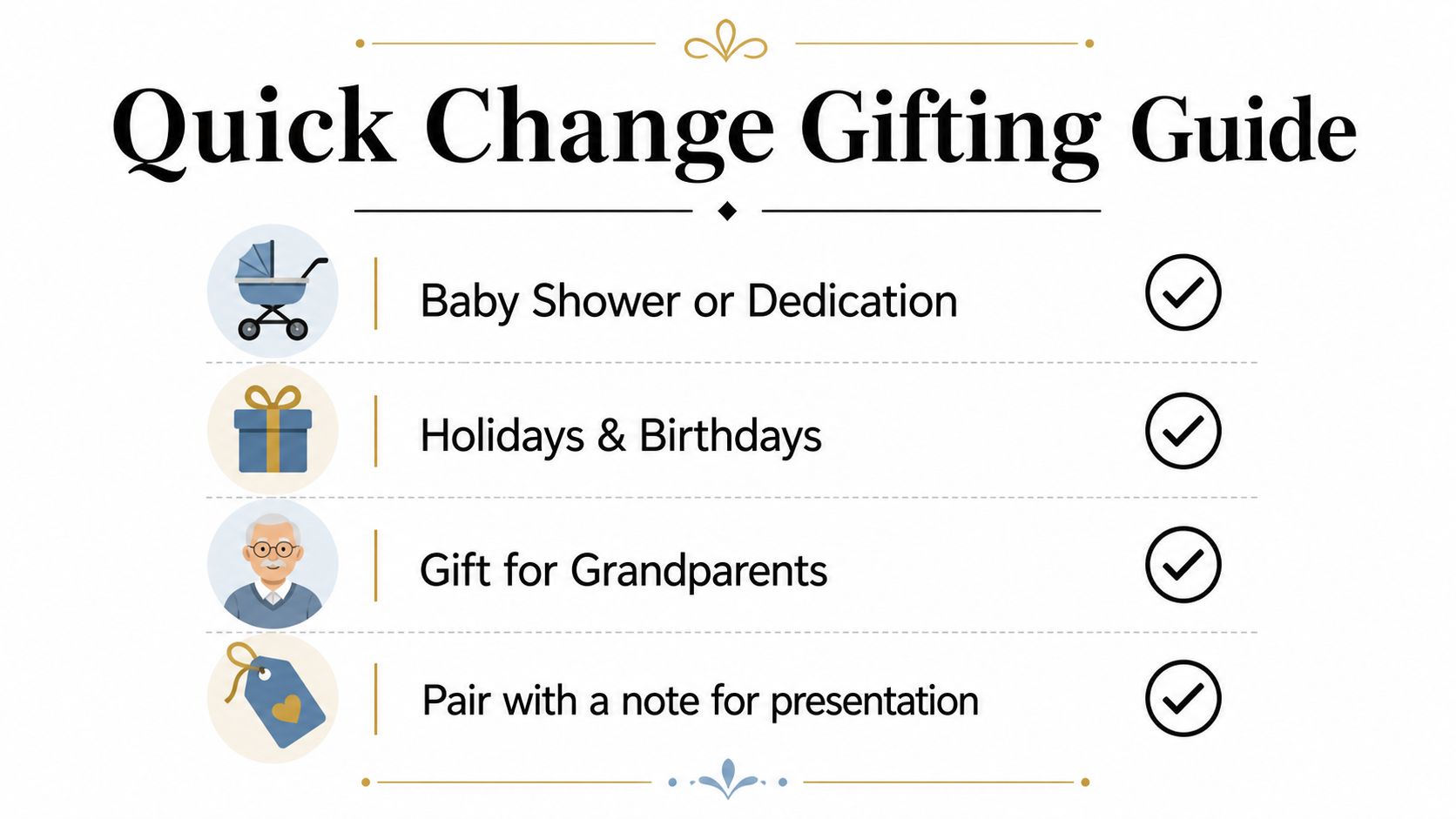
Clothing gifts can be beautiful, but practical clothing is often remembered because families use it repeatedly. A quick-change romper suits a baby shower, dedication, baptism, holiday, or welcome-home gift. Grandparents and relatives can choose something that feels special while still helping with the ordinary work of dressing a baby.
Presentation doesn't need to be elaborate. Pair a zip romper with a coordinated two-piece set, add a soft swaddle or teether, and include a short card explaining why the pieces are useful for naps, diaper changes, or messy meals. For a faith-centered occasion, a keepsake note can connect the gift to the child's dedication or baptism without turning the clothing into a one-time ceremonial outfit.
Match the gift to the buyer and household
A single romper may suit an individual giver, while a coordinated set can work for relatives contributing together. Monogramming can add sentiment, but check whether the customization affects softness or care. Bundle pricing can make group gifting easier when available, though the practical value still depends on choosing a usable size and season.
Bamboo-based clothing often communicates softness and quality at a glance, but gift buyers should still inspect the details. Confirm the opening style, fabric content, certification information, wash instructions, and whether the recipient family prefers close-fitting sleepwear, relaxed daywear, modest coverage, or materials selected for sensitive skin. A thoughtful gift respects those priorities instead of assuming every family wants the same design.
Families building a broader list can use this baby registry must-haves guide to place quick-change pieces alongside other daily essentials.
Save this buying checklist
- Closure: Choose a two-way zipper or secure snap opening that reaches the area you change most often.
- Fabric: Look for a breathable, soft material with comfortable stretch and sensible moisture management.
- Fit: Select a gently relaxed shape with room for movement and growth, without excess fabric that gets in the way.
- Certification: Check for OEKO-TEX Standard 100 or equivalent material-safety information.
- Care: Confirm that the garment can be machine washed according to your household routine, ideally with cold washing and low-temperature drying where the label permits.
- Gift presentation: Add a keepsake card, coordinated piece, swaddle, or teether that supports the recipient's daily life.
Quick-change clothing makes the most sense when it solves a real recurring problem. For some families, that means quicker diaper access. For others, it means fewer head-over-shirt battles, easier outfit swaps, or a softer option for sensitive skin. Choose the feature that serves the child in front of you, not the trend on the rack.
Little Venture Co. offers bamboo zip rompers, two-piece sets, and everyday accessories designed around soft comfort, easier changes, and faith-inspired family values. Visit Little Venture Co. to explore practical clothing for babies and toddlers, including OEKO-TEX certified pieces that can make daily dressing feel a little kinder.