

Proverbs 31 Bible Study for Women: Grace-Centered Living
You might be opening Proverbs 31 with a cold cup of coffee beside you, a laundry pile in the corner, and a quiet sense that you're already behind. Then you read about a woman who works with willing hands, plans ahead, speaks with wisdom, cares for her household, and fears the Lord, and instead of feeling inspired, you feel tired.
You're not alone in that.
Many women come to this chapter carrying pressure. Pressure from church culture. Pressure from social media. Pressure from their own hearts. A grace-centered proverbs 31 bible study for women starts by setting that pressure down. It helps you read slowly, in context, and with room to breathe. Proverbs 31 was never meant to crush you. It was meant to point you toward wisdom.
Beyond the Checklist Reframing Proverbs 31

A lot of women have been taught to read Proverbs 31 like a job description. Cook well. Work hard. Stay organized. Be kind. Be productive. Never drop a ball. That reading makes the chapter feel heavy fast.
But that common assumption doesn't fit the passage very well.
A better starting point is this: Proverbs 31 is the final chapter of Proverbs, and it belongs inside a whole book about wisdom, not inside a narrow category of "rules for women." A helpful overview from A Virtuous Woman's explanation of Proverbs 31 for modern women notes that the chapter combines guidance for leadership, wisdom, and household life rather than only domestic ideals. That changes the tone of the whole study.
Read the whole chapter, not just the famous part
Another place women get confused is by jumping straight to verses about the "wife of noble character" and ignoring the opening of the chapter. Proverbs 31 includes more than one kind of instruction.
That matters because it reminds us this chapter isn't a stand-alone personality test for wives and mothers. It's part of God's wisdom literature. It belongs to the larger biblical conversation about how people live wisely before Him.
Practical rule: If a passage starts making you score yourself, pause and ask whether you're reading poetry like a performance review.
There's also a literary detail that helps. Proverbs 31:10 to 31 is a 22-verse acrostic poem, a carefully shaped piece of wisdom writing tied to the Hebrew alphabet, as explained by Beloved Women's study on the virtues of the Proverbs 31 woman. That means this passage is artful and intentional. It's giving a full portrait of wisdom in action, not a frantic list to complete before bedtime.
Wisdom is the focus, not image management
Once you see the chapter as wisdom literature, the woman in Proverbs 31 starts to look less like an impossible standard and more like a picture of what godly wisdom can look like in real life. She makes decisions. She serves. She plans. She speaks. She fears the Lord. Her life has movement and purpose.
That doesn't mean every woman must express those things in the same way. A single woman, a new mom, a widow, a college student, and a grandmother won't all live this chapter identically. They shouldn't.
If you need a gentle reminder of your worth before your productivity enters the room, spend time with this reflection on being made in the image of God. That's the right heart posture for studying Proverbs 31. You are already seen by God before you ever "apply" a single verse.
Here are three reframes to keep in front of you:
- Not a checklist: This chapter isn't asking, "Can you do everything?"
- A wisdom portrait: It's asking, "What does reverence-shaped living look like?"
- A grace invitation: It's calling you to grow, not to pretend.
Proverbs 31 becomes warmer when you stop asking, "Why am I not her?" and start asking, "What kind of wisdom is God growing in me?"
Your Four-Week Proverbs 31 Study Plan
A simple plan helps a lot. If you try to tackle every phrase in one sitting, you'll either rush or spiral. A slower study lets the passage speak.
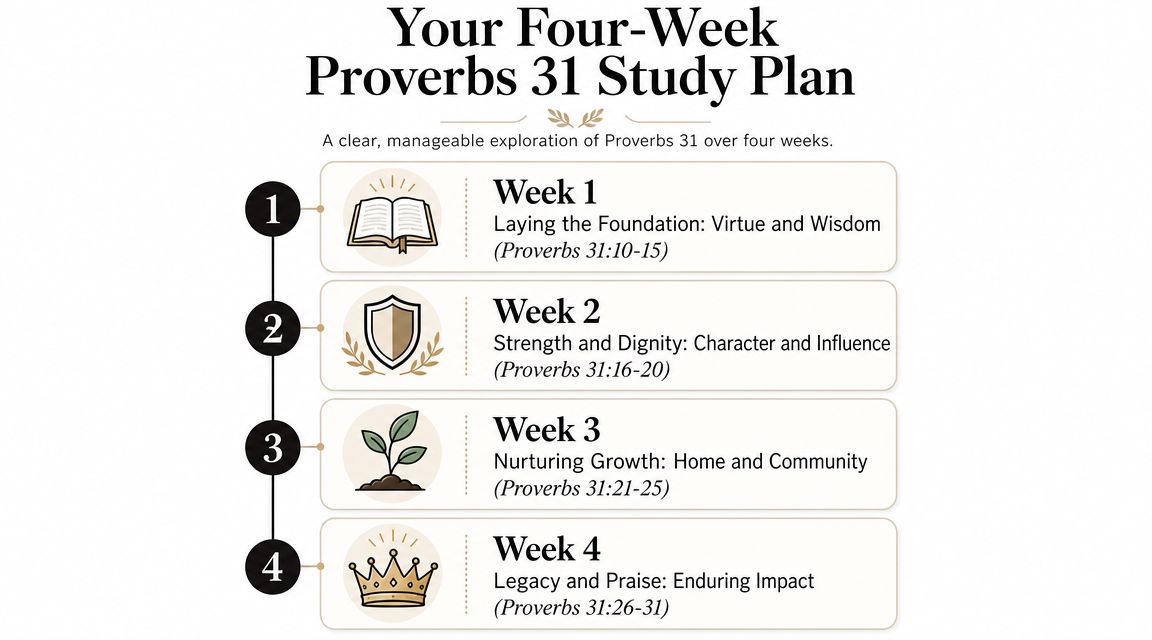
One of the most useful ways to study this chapter is the observation, interpretation, and application pattern. The Daily Grace Co.'s guide to studying the Proverbs 31 woman uses that kind of approach to draw out reverence for God, wise decision-making, and family stewardship without turning the passage into a productivity contest.
How to use the weekly rhythm
Keep each study session simple:
-
Observation
What words, actions, or repeated ideas stand out? -
Interpretation
What does this show about wisdom, character, and the fear of the Lord? -
Application
What would it look like to live this truth in your actual season of life?
If you're a busy mom or you're trying to create a steady devotional habit, something like Present Grace, a 52-week devotional for moms can pair well with a study plan like this by giving you a gentle rhythm for the rest of the week.
The four-week plan at a glance
| Week | Passage focus | Theme | Main question |
|---|---|---|---|
| Week 1 | Proverbs 31:10-15 | Virtue and wisdom | What kind of heart and habits does wisdom produce? |
| Week 2 | Proverbs 31:16-20 | Strength and influence | How does wisdom shape decisions, work, and generosity? |
| Week 3 | Proverbs 31:21-25 | Home and community | What does wise preparation look like without fear? |
| Week 4 | Proverbs 31:26-31 | Legacy and praise | What lasts when outward success fades? |
Week 1 with Proverbs 31 10 to 15
Start by noticing the overall tone. This woman is trustworthy, active, and attentive. Don't rush to compare. Just watch what the text highlights.
Ask questions like:
- What actions are named clearly? Look for verbs.
- What does the passage value? Trust, diligence, care, foresight.
- What is missing? There is no self-congratulation, no frantic image management.
A good application for this week is to look at your everyday responsibilities and ask where wisdom could bring steadiness. That might mean planning meals, answering people kindly, or showing up faithfully to ordinary work.
Week 2 with Proverbs 31 16 to 20
This section shows initiative, strength, and generosity. The woman makes decisions and extends care to others. That's important because Proverbs 31 doesn't present passivity. It presents active wisdom.
Write down what she does with resources, energy, and opportunity. Then ask where your own life needs wise courage. For one woman, that may mean handling finances carefully. For another, it may mean opening her hands to someone in need.
Study character traits, but anchor each one to a verse. That keeps the conversation rooted in Scripture instead of drifting into personal preference.
Week 3 with Proverbs 31 21 to 25
Now the passage turns toward preparedness, dignity, and confidence, which can discourage some readers, especially if life feels messy or uncertain.
Don't turn those verses into pressure to create a flawless home. Instead, look at the inner posture. The text points to wise preparation and freedom from fear, not a polished aesthetic.
Try this short exercise:
- Circle words about attitude: strength, dignity, confidence
- Underline practical actions: preparation, care, attentiveness
- Journal one area where fear has been louder than faith
Week 4 with Proverbs 31 26 to 31
These final verses move toward speech, reputation, and worship. The center of gravity lands on the fear of the Lord. That's where this chapter has been heading all along.
This week, focus on what lasts. Words matter. Character matters. Reverence matters more than charm or appearance. Let your application be small and clear. Maybe you pray before speaking in hard conversations. Maybe you choose one act of hidden faithfulness and offer it to God with joy.
Leading the Discussion With Questions and Icebreakers
If you're studying with a group, the best conversations usually begin when women realize they don't have to impress each other. They can tell the truth. They can say, "This verse encourages me," or "This part is hard for me right now."

A grace-centered group matters because many women still approach this chapter wondering how to study it without feeling crushed by an impossible standard. A Virtuous Woman's Proverbs 31 Bible study article speaks to that tension, and it's one reason discussion questions should invite honesty, not performance.
Questions for week 1
A simple icebreaker helps everyone exhale. Ask something easy first, like, "What's one ordinary task you do every week that nobody notices but still matters?" That immediately connects daily life with faithful service.
Then move deeper:
- What first reactions have you had to Proverbs 31 in the past?
- Which verse in this opening section feels comforting, and which feels challenging?
- What does trust look like in everyday relationships?
- Where do you see wisdom in small routines, not just big moments?
A leader might hear one woman mention packed lunches, another mention caring for aging parents, and another mention showing up for work on little sleep. That's a rich discussion, because women begin to see that wisdom often wears ordinary clothes.
Questions for week 2 and week 3
Week 2 works well with a scenario-based conversation. You might ask, "If a friend says she feels invisible because her work is repetitive and unseen, what in this passage would encourage her?" That invites women to interpret the text with compassion.
For those weeks, try these:
- Where do you see strength in this passage that isn't loud or showy?
- How can generosity look different in different seasons of life?
- What kind of preparation reflects wisdom, and what kind reflects anxiety?
- When you think about 'strength and dignity,' what comes to mind first?
If you want a verse-rich warm-up before discussion, this collection of Bible verses everyone should know can help your group build confidence handling Scripture together.
Here is a helpful teaching video to use later in your gathering, after you've already had some conversation and opened the passage together.
Questions for week 4
By the final week, women are often ready to talk more personally. This is a good time to ask slower, heart-level questions.
- What kind of praise are people tempted to chase today?
- Why does godly speech matter so much in a woman's home, work, and friendships?
- What does it mean to fear the Lord in this season of your life?
- What would a faithful legacy look like if nobody posted it online?
A strong discussion doesn't end with the "right answer." It helps women connect God's Word to what they're carrying right now.
A few icebreakers that work especially well in this final week:
- Share a phrase: One word that describes what God has been teaching you.
- Name a quiet win: Something small where you've seen growth lately.
- Offer encouragement: Tell the woman next to you one strength you've seen in her.
Making It Personal With Reflection and Prayer Points
Group study is wonderful, but personal reflection is where a lot of healing happens. Through personal reflection, Proverbs 31 stops being a topic and starts becoming prayer.
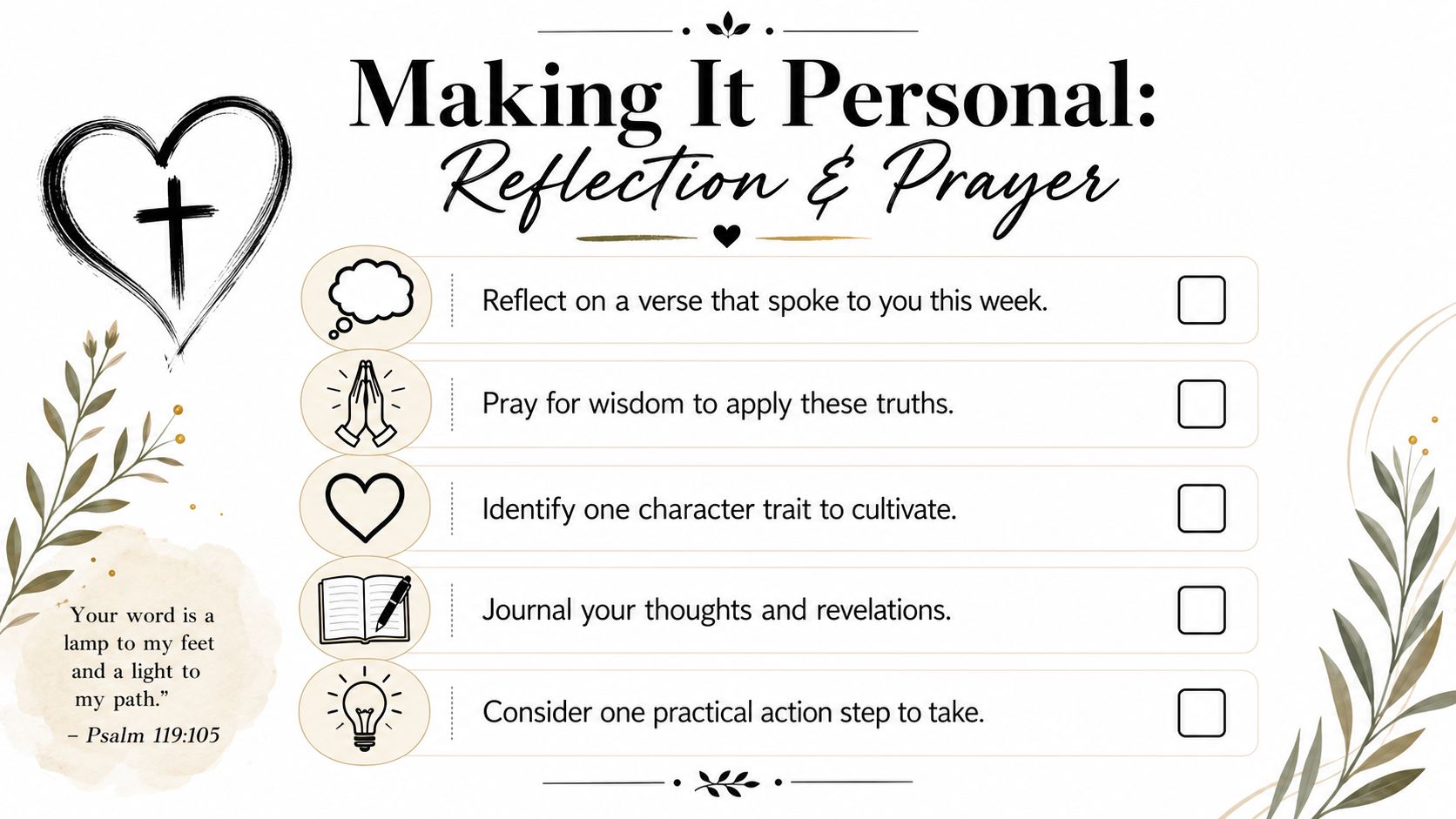
A sound way to study this chapter is to treat it as a literary-poetic passage, not a checklist. A teaching video on how to study Proverbs 31 in context emphasizes reading it in context, mapping repeated themes like wisdom and diligence, and turning observations into application themes rather than self-scoring. That matters because guilt grows quickly when women use this chapter to grade themselves.
Journal prompts that keep you grounded
When you sit down with your Bible, resist the urge to ask, "How am I failing?" Ask better questions.
Try prompts like these:
- Which verse drew my attention today, and why?
- What quality of wisdom do I see in this passage?
- What part of my life needs that wisdom most right now?
- What am I assuming God expects from me that this text may not explicitly state?
If you're in a weary season, pair your journaling with this gentle guide on prayer when feeling overwhelmed. Sometimes the most honest application is bringing your pressure to God.
Grace check: Conviction moves you toward God. Shame makes you hide from Him.
Prayer points for each week
You don't need polished prayers. Short and honest is enough.
| Week | Prayer focus | Sample prayer starter |
|---|---|---|
| Week 1 | Wisdom in ordinary work | Lord, help me serve faithfully in the tasks in front of me. |
| Week 2 | Strength and generosity | Give me courage to act wisely and an open hand toward others. |
| Week 3 | Peace instead of fear | Teach me to prepare with trust, not anxiety. |
| Week 4 | Speech and reverence | Let my words reflect wisdom, and shape my heart to fear You. |
Some women like to write these in a notebook. Others keep them on index cards, a phone note, or tucked into a Bible. The method doesn't matter much. Returning to prayer does.
Practical application for modern life
Application doesn't have to be dramatic. In fact, the strongest application is often specific and small.
Here are a few examples:
- At home: Choose one routine that feels chaotic and bring simple order to it.
- With money: Review one spending habit and ask whether it reflects wisdom.
- With speech: Before a hard conversation, pray for gentle words and self-control.
- In service: Look for one person you can help this week.
- In rest: Notice where you're trying to prove your worth through output.
A healthy proverbs 31 bible study for women leads to concrete change, but not frantic change. You are not trying to become a different person overnight. You are learning to notice how wisdom can shape the life you already have.
When you feel discouraged
There will be days when this passage still stings. That's okay. Stay with it.
Write a short response to God that begins with one of these lines:
- Father, I feel pressure when I read this because...
- Lord, I'm comparing myself to...
- Jesus, help me see wisdom here instead of condemnation...
That kind of honesty is not a failure of Bible study. It's part of it.
Tips for a Grace-Filled Study Leader
Leading Proverbs 31 well requires discernment. Women often bring old wounds into this chapter. Some feel they never measure up. Some carry grief around singleness, motherhood, work, health, or family life. Some have only heard this passage taught in a way that made them smaller.
A grace-filled leader doesn't ignore that. She makes room for it.
Set the tone early
Say out loud what your group needs to hear. Tell them this study is not about ranking women by domestic skill, energy level, marriage status, or personality. Tell them there's no gold star for sounding composed.
You can use simple phrases like these:
- "We're here to notice wisdom, not compare lives."
- "You don't need a polished answer to belong here."
- "Let's keep bringing the conversation back to what the text says."
That kind of framing keeps the room safe.
Redirect common problems gently
Most Proverbs 31 groups drift toward one of two ditches. One group turns the chapter into pressure. Another group reacts by dismissing the whole passage as unrealistic. Neither response helps.
When comparison starts, redirect with a text-based question. Ask, "What does this verse reveal about wisdom?" When guilt starts rising, ask, "Are we describing biblical truth, or are we adding expectations?" Keep bringing women back to Scripture and to grace.
Good leadership sounds less like correction from above and more like invitation beside them.
Protect women from performance
Not every woman will want to share intimately. Don't force vulnerability. Invite it, model it, and protect it when it appears.
A few practical habits help:
- Watch who speaks most: Draw quieter women in without pressure.
- Handle emotion calmly: Tears don't mean the study is off track.
- Affirm honest struggle: Women need to know they can tell the truth.
- End with hope: Don't leave the group sitting in self-evaluation.
Your job isn't to present yourself as the completed version of Proverbs 31. Your job is to lead women toward wisdom, humility, and the fear of the Lord with tenderness.
Putting Wisdom Into Action
A woman closes her Bible after studying Proverbs 31 and thinks, "This is beautiful, but what do I do with it on a Tuesday?" That is the right question. Wisdom becomes meaningful when it meets real life. School drop-offs, unfinished laundry, caregiving, meetings, tight budgets, hard conversations, and quiet acts of faith all count.
By the end of this study, many women do not need more pressure. They need a clear next step. Proverbs 31 gives that kind of direction. It invites you to pursue godly character within the life God has placed in your hands.
That changes how you apply the chapter.
Instead of asking, "How can I do everything this woman did?" ask, "What kind of woman is this passage forming?" The focus shifts from copying every detail to growing in the wisdom beneath the details. A healthy proverbs 31 bible study for women helps you notice patterns such as reverence for God, diligence, kindness, discernment, generosity, and faithful care.
Wisdom works like roots under a tree. You do not stare at the roots all day, but they shape everything that grows above ground. In the same way, the fear of the Lord feeds your words, your work, your relationships, your decisions, and your private life before God.
So read the passage again slowly. Mark the places where the Lord is inviting you to trust Him, repent, or grow. Write down one area to practice this week. Keep it small and honest. Maybe that means speaking more gently, planning your time with more care, serving someone discreetly, or praying before you react.
Leave comparison behind. Keep conviction. Let go of guilt that God is not placing on you.
Grace-filled application does not end with "try harder." It ends with faithful response. Fear the Lord. Walk in wisdom. Trust God to grow steady fruit in season.
If you're looking for meaningful faith-filled gifts for little ones, Little Venture Co. offers beautifully designed children's wear for babies and toddlers, including ultra-soft bamboo sleepwear and daywear created with comfort, quality, and Christian encouragement in mind. Their pieces make thoughtful baby shower gifts, nursery picks, and family favorites for parents who want everyday items to reflect faith and care.