

Your Men's Bible Study Guide: From Idea to Impact
A lot of men start in the same place. You feel a real nudge to gather a few guys, open Scripture, and lead something steady. Then your toddler wakes up early, work runs late, dinner turns chaotic, and the whole idea starts to feel unrealistic.
If you're a dad with young kids, that tension is familiar. You want to invest in other men, but you also don't want to become the guy who is “doing ministry” while neglecting his wife, his kids, or his own soul.
That's why a good men's Bible study guide matters. Not because it makes leadership flashy, but because it makes leadership sustainable. The right plan gives shape to your good intentions. It helps you lead with clarity, protect your time, and build something that serves the men in the room.
Getting Started The Right Way
Most men don't need more guilt. They need a path.
A dad from church once described it to me like this: he kept thinking he should lead a group, but every time he looked at his calendar, he backed off. Bedtime routines, sports drop-off, work deadlines, church responsibilities. He wasn't lazy. He was full. What he needed wasn't more passion. He needed a simpler starting point.
That's where many men get stuck with a men's Bible study guide. They think leading means building a polished ministry from scratch. It usually doesn't. It means gathering a few men consistently, choosing material that fits their real lives, and showing up prepared enough to help the conversation go somewhere useful.
Practical rule: Start smaller than your ambition. Consistency builds trust faster than intensity.
If you're feeling called to lead, pay attention to that. But don't turn that calling into pressure. A healthy men's group doesn't begin with big attendance or a perfect plan. It begins with a clear reason for meeting and a leader willing to keep it simple.
A few things help right away:
- Pick one lane: Decide whether this group is about fatherhood, spiritual basics, a book of the Bible, or a specific life season.
- Choose one night: Don't poll people forever. Pick the best workable time and invite men into it.
- Commit to a real rhythm: Men are more likely to engage when they know the group isn't random.
- Lead from honesty, not polish: You don't need to sound like a preacher. You need to guide the room.
Some of the best groups start because one man finally says, “I can host on Tuesday night, I can finish on time, and I can take this seriously.” That's enough to begin.
The biggest shift is this. Don't treat the group like one more demand on your life. Treat it like a life-giving rhythm that can steady your own walk with Christ while serving other men too. When it's shaped well, leading a group doesn't just drain you. It strengthens you.
Defining Your Group's Purpose and People
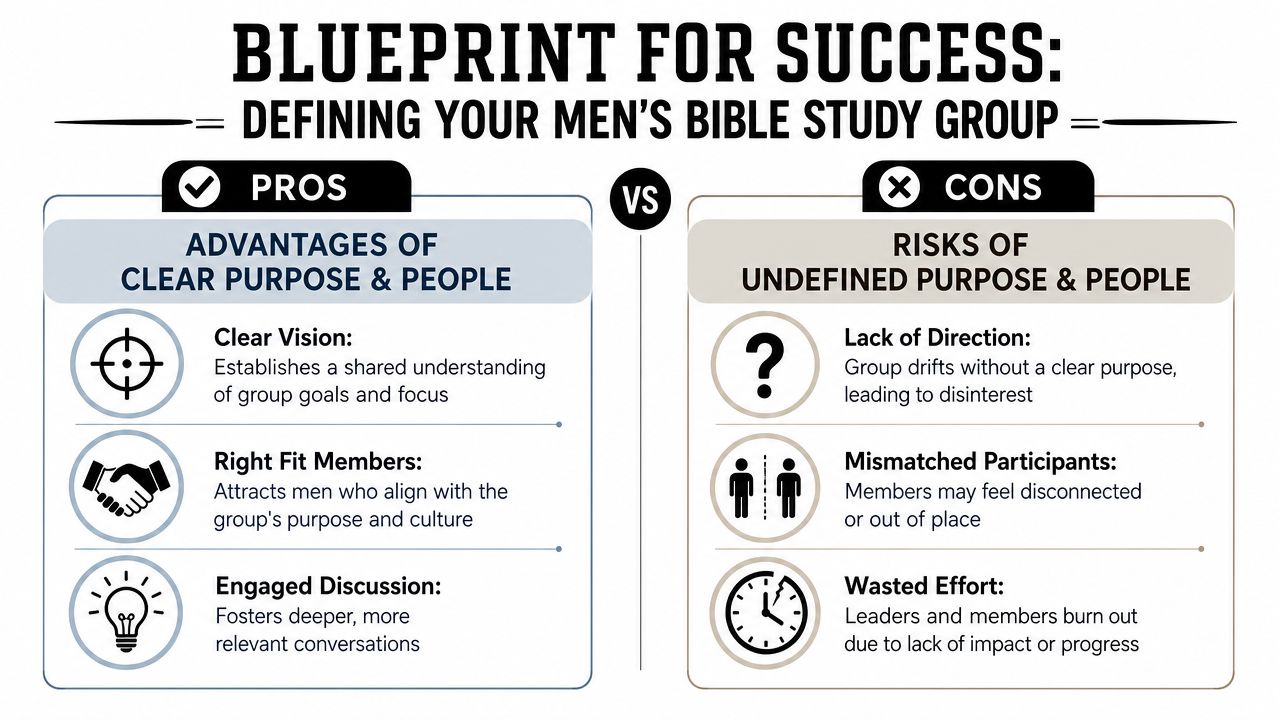
Before you choose a study, decide who the group is for. This is the part many leaders skip, and they usually pay for it later with weak discussions, awkward expectations, and spotty commitment.
A group without a defined purpose starts to drift fast. One man wants deep theology. Another wants practical help in marriage. Another just wants Christian friendship. None of those are bad desires. They just don't automatically fit together.
Start with a written sentence
Write down one sentence that answers two questions: Who is this for, and what are we trying to do together?
That sentence might be simple:
- a group for young dads who want to grow in Scripture and lead their families well
- a group for men returning to church who need a manageable re-entry point
- a group for seasoned believers who want focused accountability and discussion
That one sentence will help you choose the right men, the right content, and the right tone.
Closed usually works better than open
For many men's groups, a weekly, closed group works best. Guidance from Hill Cities on Bible study methods for men recommends keeping the group at no more than 12 men, notes that even 3 participants plus 1 leader is enough to start, and urges leaders to prepare extra questions, start and end on time, and make sure one or two men don't dominate.
That advice lines up with what happens in real rooms. Open groups sound easy because anyone can drop in. In practice, they often stay shallow. Men hesitate to be honest when the room changes every week. A closed group gives men time to trust each other.
A closed group is especially helpful if the topic touches real struggle. Men usually don't open up about marriage stress, anger, discouragement, or fatherhood fears in a room that feels unsettled.
Closed doesn't mean exclusive. It means the men know who they're walking with.
Size changes the quality of discussion
Bigger isn't always better. Many leaders assume more men means more momentum. Sometimes it means less participation.
Use this rule of thumb:
| Group size | What usually happens |
|---|---|
| 3 men plus 1 leader | Easy to start, room for honesty, every man has to engage |
| Mid-sized group | Good energy if the purpose is clear and the leader guides well |
| More than 12 men | Harder to hear everyone, easier for side conversations and passivity |
If you're a dad with little kids at home, smaller is often wiser. Smaller groups are easier to host, easier to prepare for, and easier to sustain.
Questions to settle before launch
- Who is this group for? Be narrow enough that men know whether they belong.
- Is it open or closed? If you want trust, choose closed for the first run.
- Where will you meet? Pick the location that creates the least friction.
- What is the expectation? Weekly attendance, real participation, and respect for time should all be stated up front.
A men's Bible study guide should help men grow, not force them to guess what kind of group they joined.
Finding a Study That Actually Connects
Some study guides look strong on a website and fall flat in a living room. Others seem simple and end up opening exactly the conversations your group needed. The difference usually isn't branding. It's fit.
Match format to the men in front of you
Men connect with different formats for different reasons. The best choice depends on attention span, biblical familiarity, and what kind of conversations you want.
A book of the Bible study is steady and grounding. It works well when your group wants to stay close to the text and avoid chasing whatever topic feels urgent that week.
A topical study works when the men need immediate traction in a specific area such as fatherhood, prayer, work, temptation, or friendship. This format often lowers the barrier for men who feel rusty around Scripture.
A video-based study can help if your group includes men who are nervous about speaking first. The video gives everyone a shared starting point. The downside is that weak discussion questions can leave the group hovering at the surface.
Why modular studies are so useful
Published men's studies have shifted in a practical direction. Subsplash's overview of men's Bible study resources notes that many guides are now free, modular, and downloadable, with some curricula developed for over 10 years. These resources often include videos, handouts, facilitator instructions, and studies that span 4 to 12 lessons.
That matters for busy leaders. A modular guide lets you lead without spending hours assembling material from scratch. It also gives you flexibility. If your group can handle a shorter run, you can choose a compact study. If the men want to keep going, you can extend from there.
Here's the trade-off in plain terms:
| Format | Works well when | Can go wrong when |
|---|---|---|
| Book study | Men want depth and steady habits | The group is too new and gets lost in the weeds |
| Topical guide | Men need immediate relevance | The content stays practical but shallow |
| Video curriculum | Men need a common launch point | The video does the work and the leader stops facilitating |
| Downloadable short study | Schedules are tight and commitment needs to feel realistic | The group treats it like casual content instead of discipleship |
Readiness level matters more than popularity
This is the step many leaders miss. Don't ask only, “Is this a good study?” Ask, “Is this the right study for these men right now?”
A guide that energizes mature believers may intimidate men who are just re-engaging church. A resource that feels too basic may frustrate men who are ready for more substance. The best men's Bible study guide meets the group where they are.
Use a simple filter:
- New or returning men: choose material with clear structure, short assignments, and practical application
- Mixed group: choose content with accessible entry points and enough depth for stronger contributors
- Established men: choose studies that require real preparation and personal response
For fathers, relevance matters even more. If your group includes dads in the thick of diapers, discipline, exhaustion, and spiritual responsibility, content around everyday obedience often lands better than abstract material. A resource like The Heart of a Father devotional for dads shows the kind of focused material that can connect more naturally with a specific season of life.
The best study isn't the one with the most pages. It's the one your men will actually engage, discuss, and apply.
If the guide creates shared relevance, you're already ahead.
Your Blueprint for a Great Weekly Meeting
A strong weekly meeting feels simple to the men in the room. It rarely feels simple to the leader before he gets there. Good groups run on quiet preparation.
Logos' guidance for leading a Bible study for men emphasizes a weekly rhythm, fixed start and end times, and leaders who are over-prepared so discussion stays focused. That advice is worth taking seriously. Men with jobs, wives, toddlers, school pickups, and long commutes respect leaders who honor the clock.
A repeatable meeting flow
You don't need a complicated agenda. You need a structure that is clear enough to repeat and flexible enough to feel human.
Simple weekly flow
10 minutes for arrival and conversation
5 minutes for opening prayer and framing the night
45 minutes for guided discussion
10 minutes for application and prayer
Finish on time
That kind of structure works because men know what to expect. Predictability lowers friction. It also protects family life, which matters a lot if your group meets on a weeknight.
A few practical choices make the difference:
- Open the room early: Let men settle in before the discussion starts.
- State the aim of the night: Give one clear sentence about what the passage or topic is driving toward.
- Keep one big idea in front of you: If the conversation drifts, bring it back there.
- End with a response: Ask what obedience looks like this week, not just what the text means.
Prepare more than you think you'll need
Men's groups often stall for one of two reasons. The leader under-prepared, or the leader over-talked. Preparation helps you avoid both.
Bring more than one kind of question:
- Observation questions help men see what the passage says.
- Interpretation questions help them wrestle with meaning.
- Application questions push the conversation into real life.
If one question falls flat, move on. If the room gets quiet, don't panic. A leader who stays calm gives men time to think.
For a weekly rhythm, many leaders also benefit from using a devotional habit outside the meeting. If you want a simple personal pattern to support your preparation, this daily devotional guide offers helpful ideas for keeping Scripture in front of you through the week.
Sample 6-Week Study Plan
Here's a practical model you can adapt right away.
| Week | Theme | Key Verses | Central Question |
|---|---|---|---|
| 1 | The fear of the Lord at home | Proverbs 1, Proverbs 9 | What does reverence for God change in a father's ordinary decisions? |
| 2 | Words that build or wound | Proverbs 12, Proverbs 15 | How do my words shape the emotional climate of my home? |
| 3 | Discipline and wisdom | Proverbs 3, Proverbs 13 | What's the difference between faithful correction and frustrated reaction? |
| 4 | Work, provision, and presence | Proverbs 6, Proverbs 10 | How do I balance providing for my family with being present to them? |
| 5 | Friendship and influence | Proverbs 13, Proverbs 27 | Which relationships are sharpening me, and which ones are weakening me? |
| 6 | Integrity in private and public | Proverbs 4, Proverbs 11 | Where does my character need to become more whole? |
What works and what doesn't
What works is a leader who comes in ready, keeps the pace moving, and refuses to waste the group's time.
What doesn't work is trying to impress men with commentary, rushing through too much material, or letting one rabbit trail take over the evening.
Men don't need a polished performance. They need a leader who can guide a meaningful hour and a half with purpose.
If you can do that each week, your group will have momentum.
How to Lead Engaging Bible Study Discussions
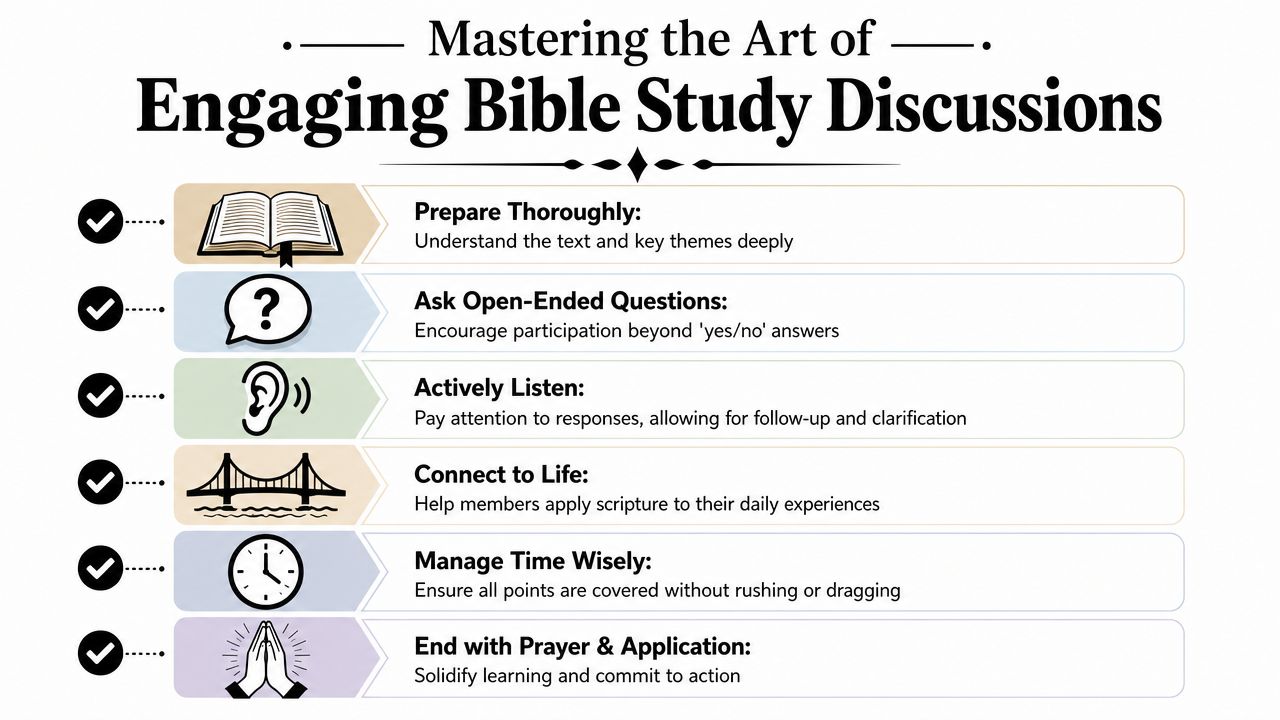
The leader's job isn't to give the best answers in the room. The leader's job is to help the room talk openly, stay grounded in Scripture, and move toward application.
That shift matters. A lot of men assume leading means teaching. Sometimes it does. But in a small group, the better role is usually facilitator. Men remember what they discover, confess, and apply more than what they merely hear.
Here's a helpful visual summary of the habits that make discussions stronger.
Ask questions that open men up
Bad discussion questions die fast. They invite a right answer, not a real conversation.
Better questions do at least one of these:
- They slow men down: “What stands out to you in this passage that you usually miss?”
- They surface tension: “Where does this text confront the way most men live?”
- They force application: “What would change this week if you obeyed this passage at home?”
A men's Bible study guide should give you a starting point, not a script you read word for word. If the printed questions are weak, rewrite them in plain language.
Create safety without lowering the standard
Not every man opens up at the same pace. Some speak too quickly. Some barely speak at all. Your job is to make the room safe enough for honesty and clear enough for challenge.
Study Gateway's discussion of Bible studies for men highlights a key issue many leaders overlook. One-size-fits-all guides can be a weak fit, and the best guide is often the one that creates psychological safety and relevance for men in distinct life situations such as divorce, addiction, or bereavement.
That principle goes beyond choosing content. It applies to how you lead the discussion.
Try these moves in real time:
- For the quiet man: Call on him gently with a specific question he can answer without pressure.
- For the talkative man: Thank him, then redirect. “That's helpful. I want to hear from a couple other guys too.”
- For the drifting conversation: Name it kindly and bring the group back to the central question.
- For surface-level answers: Ask one follow-up. “Can you say more about that?” or “What does that look like in real life?”
This short teaching may help if you want another voice on the craft of leading group discussion.
Use Scripture to move from talk to action
A discussion can feel lively and still accomplish very little. Men can trade opinions all night and leave unchanged. Good facilitators keep bringing the conversation back to the text and then into life.
Don't ask only, “What do you think?” Ask, “What does this passage call you to do?”
That one shift raises the level of the room.
If your group needs help engaging specific passages, a simple list of Bible verses every Christian should know can be useful for building shared familiarity with core texts.
The goal isn't a perfect conversation
Some nights the room clicks. Some nights it feels slow. Don't measure the health of the group by how emotionally dramatic each meeting feels.
Measure it by better markers:
| Healthy discussion looks like | Unhealthy discussion looks like |
|---|---|
| Men are participating, even imperfectly | One man is carrying the whole room |
| Scripture stays central | Opinions float free from the text |
| Application gets specific | Everyone leaves with vague inspiration |
| The tone is honest and respectful | Men posture, perform, or stay guarded |
A facilitator helps men engage truth together. That's far more valuable than delivering a monologue.
Leading Well Without Burning Out
The men in your group need your faithfulness. Your family needs it too. If those two callings start competing, something is off in the way the group is structured.

Build the group around your real life
A lot of burnout comes from pretending you have more margin than you do. If you have young kids, lead like a father of young kids. That means choosing a meeting time you can sustain, limiting side responsibilities, and setting prep windows that don't steal your whole week.
Some practical boundaries help:
- Protect family touchpoints: Don't schedule over the same evening every week if that night is important at home.
- Prep in one block: A focused session is usually better than dragging prep across multiple scattered nights.
- Use repeatable systems: Same format, same communication rhythm, same opening flow.
- Ask for help: Another man can host, handle reminders, or follow up with absent members.
This is also where broader church systems matter. If your group sits inside a larger ministry, healthy support makes a difference. Resources on effective church volunteer management can help leaders think more clearly about sustainability, communication, and shared responsibility.
Keep your own soul fed
Leading a men's Bible study guide every week can fool you into thinking you're spiritually healthy because you're always around spiritual content. Teaching and facilitating are not the same as abiding.
You still need unhurried time with the Lord that isn't for your notes, your questions, or your group. You need Scripture that addresses you before it passes through you. This reflection on what it means to abide in Christ is a useful reminder of that deeper source.
A sustainable leader doesn't just prepare lessons. He keeps receiving grace.
Aim for durable, not impressive
The healthiest groups aren't usually the flashiest ones. They are the ones still helping men walk with Jesus month after month because the leader chose a pace he could keep.
If you lead with humility, keep the structure clear, choose fitting material, and refuse to sacrifice your family on the altar of “doing more,” your group can become one of the most life-giving parts of your week.
That's the ultimate win. Not adding another ministry badge, but building a steady practice of discipleship that blesses other men and strengthens your own home.
If you're building a Christ-centered home in the middle of diapers, bedtime routines, and busy family life, Little Venture Co. is worth a look. Their faith-inspired pieces for little ones fit the season many young dads are in, and they make a meaningful gift for families who want everyday life to reflect what matters most.