

Hats with Bows for Babies: A Practical Buying Guide
You're probably standing in one of two places right now. Either you're looking at a baby hat online and wondering whether the bow is sweet or stupid, or you're holding a tiny hat in a store while running through a tired-parent checklist in your head: Is it soft? Will it leave marks? Is this safe for a newborn? Will it just end up in a drawer?
That's the right question set.
Most guides on hats with bows for babies spend too much time on cuteness and not enough on real-world use. I think that's backwards. A baby hat with a bow should earn its spot by doing three things well: it should feel gentle on sensitive skin, fit without fuss, and stay firmly in the supervised daytime category. If it can also work for photos, church, gifting, or a hospital going-home outfit, great. But safety and comfort come first.
The Hat Aisle Reality for New Parents
The wall of baby hats looks harmless until you need to choose one. Then suddenly every option feels loaded. A soft cream bonnet for the hospital discharge. A stretchy beanie for the first stroller walk. A dressier bow hat for newborn photos. They all look similar from a few feet away, but they're not built the same.
Some are soft until you touch the inside seam. Some look gentle until you notice the bow is attached with stiff stitching or glued trim. Some promise a “newborn fit” as if every baby has the same head shape, same amount of hair, and same tolerance for pressure.
What usually goes wrong
Parents don't regret the hat because it wasn't cute enough. They regret it because it created one of these problems:
- Scratchy bow construction that rubs at the forehead or temple
- Elastic that bites and leaves a red ring after short wear
- Fabric with a harsh hand feel that doesn't belong near sensitive skin
- Sizing that runs vague and slides over the eyes or squeezes too tightly
- Decoration that matters more than function, which is the opposite of what a baby accessory should do
Practical rule: If the bow is the first thing the brand wants you to notice, check the inside construction twice.
There's also a longer history behind the look. Baby hats and bonnets were common infant wear through the 1920s, mainly to keep babies warm and protected before modern baby outerwear was widespread. Historical clothing references also note that bows became a visible decorative element in children's hair and headwear in the late 19th century and early 20th century, especially for very young children, which helps explain why baby-sized hats with bows became a recognizable style rather than an adult one (historical clothing references on baby bonnets and bows).
What matters more than the bow
Start with the use case. A hat for a short outdoor walk is different from one for a dedication, and both are different from one meant for sleep. Then check fabric, seams, stretch, and attachment method.
That's the sorting system that helps when you're tired. Not “adorable.” Not “boutique.” Not “giftable.” Just: what is this hat made from, how does it fit, and when should my baby wear it?
Why Fabric Choice Matters Most
If you only get one thing right, get the fabric right. Babies feel fabric failures fast. A rough seam, trapped heat, or stiff finish can turn a cute hat into something they try to claw off within minutes.
I prefer bamboo or a bamboo-cotton blend with OEKO-TEX certification for baby hats with bows. That's the baseline I'd start from for sensitive skin.
Why soft isn't enough
Lots of brands call fabric “soft.” That word is almost useless on its own. What you want is fabric that stays comfortable once it's on a baby's head, especially under a decorative bow where heat can collect.
A good baby hat fabric should do four jobs:
- Feel smooth against skin
- Breathe well
- Handle moisture without getting clammy
- Hold some stretch without turning tight and rubbery
Bamboo blends often do that balance well for daywear. Regular cotton can still work, but some cotton knits feel dry or stiff after washing. Synthetics are where I get picky fast. They're more likely to feel warm and less forgiving if your baby already runs hot.
If you want a broader read on what tends to work for reactive skin beyond hats, ClothME has a useful guide on the best fabric for sensitive skin. Little Venture Co. also has a practical piece on sensitive skin fabric choices that's worth skimming before you buy.
What OEKO-TEX actually tells you
I like seeing OEKO-TEX Standard 100 on baby clothing because it gives parents a clearer checkpoint than vague “natural” language. In plain terms, it means the material has been tested for harmful substances. That doesn't replace common sense or good construction, but it's a useful filter when you're comparing similar hats.
For babies with touchy skin, that matters. The less mystery in the fabric and finish, the better.
Baby Hat Fabric Comparison
| Fabric | Softness | Breathability | Hypoallergenic | Care |
|---|---|---|---|---|
| Bamboo viscose | Very soft, smooth feel | Strong for lightweight knits | Often a good choice for sensitive skin when certified | Gentle washing works best |
| Bamboo-cotton blend | Soft with a bit more structure | Good balance | Often a solid middle ground | Usually easier for routine wear |
| Regular cotton | Varies a lot by knit and finish | Good | Can work well, but quality varies | Usually straightforward |
| Synthetic-heavy blend | Often smooth at first touch | Can trap warmth more easily | Less ideal for very sensitive skin | Easy care, but comfort trade-off |
The bow shouldn't be the hottest, stiffest part of the hat. If it is, pass.
Getting the Fit Right From Newborn to Toddler
Fit is where a lot of baby hats fail. Too tight, and the hat leaves marks or gets yanked off instantly. Too loose, and it slips over the eyes and becomes annoying at best.
You don't need a complicated system. You need a tape measure and one decent rule of thumb.
How to measure the head correctly
Wrap a soft measuring tape around your baby's head at the mid-forehead, just above the eyebrows, then bring it around the widest part of the back of the head. If you don't have a soft tape, use a strip of paper or ribbon and check it against a ruler.
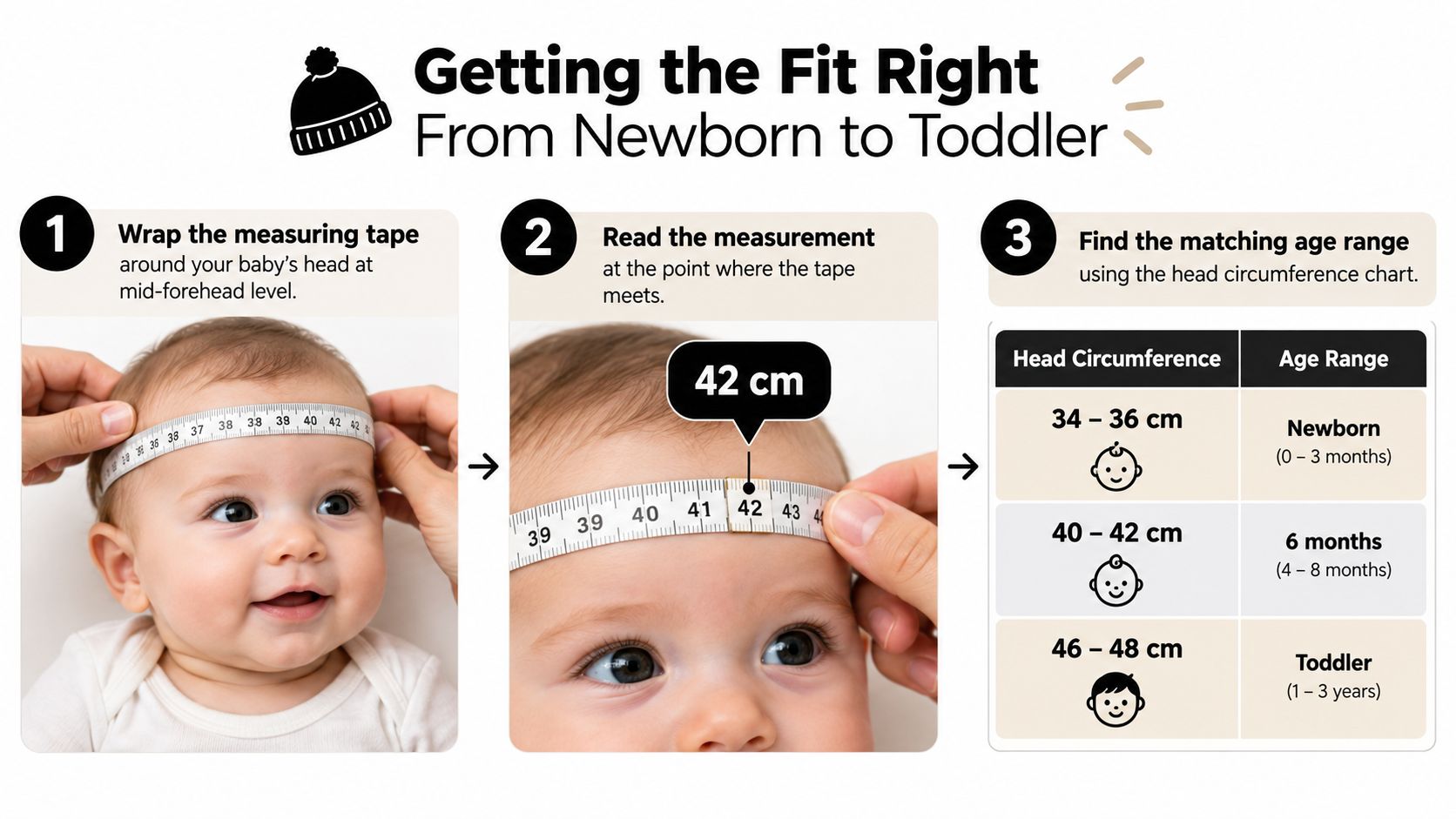
For quick age-range context, many parents use general baby size charts as a starting point, then adjust for the child in front of them. This baby clothing size chart is a helpful reference point when you're comparing brands.
My fit rule
Aim for about 1 cm of growth room. That's enough space to avoid pressure without turning the hat into a slippery mess.
Then watch how the fabric behaves:
- Bamboo viscose knits usually stretch more, so a loose-looking fit often gets looser
- Cotton knits can feel firmer at first, then relax with wear
- Structured hats don't forgive bad sizing, so they need a closer match from day one
One useful baby-proofing mindset carries over from other nursery gear too. If you're the kind of parent who checks edges and corners before guests arrive, simple products like Healtsy silicone ottoman caps probably already make sense to you. Hat shopping should have that same practical filter: remove avoidable friction before it becomes a problem.
Signs the fit is right
A well-fitting bow hat should:
- Sit above the eyebrows
- Cover the ears without folding them over
- Stay put during normal movement
- Leave no red ring after about 30 minutes of wear
If the hat creeps downward, twists easily, or pops off every time your baby turns their head, it's not the right fit. Don't talk yourself into it because the color works.
Bow Safety by Use Case
This is the part most baby hat guides blur. They say a bow hat is “safe if it fits.” That's too shallow to be useful. Safety depends on when the hat is worn, how the bow is attached, and whether you're supervising.
The design risk isn't really “bow versus no bow.” The bigger risks are detachable small parts, loose ties, and cords or strings near the head and neck. Children's apparel safety guidance treats small components on clothing for children under 3 as choking hazards, and safety manuals commonly require decorative attachments to withstand a 15 to 21 lb pull test so they don't detach under normal grabbing, tugging, or laundering stress (children's garment safety guidance).
Separate public safety guidance also advises avoiding hats with cords or strings, especially near the head and neck, because they can catch or tighten. For young children, clothing should have no cords or drawstrings in the hood or neck area, and Europe-linked guidance for children under 7 similarly prohibits those features there (children's apparel safety tips).
Bow Hat Safety by Use Case
| Use Case | Safe to Wear? | Key Caution |
|---|---|---|
| Stroller outing | Yes, for supervised wear | Choose breathable fabric and a fixed bow with no trailing ends |
| Photos | Yes, briefly | Remove right after the session and check for loose threads |
| Church or family gathering | Yes, for short supervised wear | Keep it comfortable and remove if baby gets warm or fussy |
| Gifting | Yes | Give one with sewn decoration, not glued pieces or clips |
| Car seat | Usually better skipped | Avoid bulk or structure that interferes with harness positioning |
| Naps or overnight sleep | No | Remove all headwear for sleep |
The hard no category
Sleep is simple. No bow hat for naps. No bow hat overnight. Don't negotiate with that rule.
Independent baby safety guidance is consistent that headwear and accessories should be removed for sleep because fabric, elastic, or strings can create suffocation or strangulation risk. That same guidance also points parents to a more useful middle ground for daytime: supervised wear, secure attachment, proper fit, and removal if the baby gets warm (baby bow and sleep safety guidance).
If the baby is going into a crib, bassinet, or any sleep space, the hat comes off.
What I'd buy and what I'd skip
I'd buy a hat with:
- A fully sewn bow
- No beads, clips, or glued add-ons
- No neck ties
- No adjustable cords
- Short, neat ends instead of floppy ribbon tails
I'd skip anything with chin straps, drawstrings, or decorative pieces that look like they could peel, crack, or pull free. For babies, a “secure enough” bow isn't secure enough.
Styling Bow Hats With Daywear and Sleepwear
Most parents over-style baby accessories. A bow hat works best when the rest of the outfit calms down.
Daywear that actually looks good
Match the bow color to the largest neutral in the outfit. That gives the look some order. If the romper is cream, oat, sage, blush, dusty blue, or soft floral, let the hat echo one of those tones instead of fighting them.
A few combinations almost always work:
- Cream bow hat + simple footed romper
- Soft white or ivory bow hat + cardigan for church
- Muted pastel bow hat + solid bamboo onesie
- Sage or blush bow hat + neutral knit set for photos
Keep the bow proportional to the baby's head. A huge bow on a tiny newborn can look more costume than clothing.
Church and family photos
For dedications, baptisms, or Sunday wear, I'd stick with ivory, soft white, or washed pastels. Subtle smocking, light lace, or gentle texture reads thoughtful without looking fussy.
Family photos work better when the baby's hat ties into someone else's outfit instead of matching everyone exactly. A bow that picks up a sibling's dress tone or a parent's scarf color looks intentional. Matching every person perfectly usually looks forced.
Sleepwear gets a different rule
Don't style bows into sleep. Keep bow hats for awake time only.
If you want a head covering for a very specific reason while baby is awake, choose something plain, light, and breathable. Once it's nap time, remove the accessory and keep the sleepwear simple. That line should stay clean.
A bow hat is an outfit finisher, not a sleep essential.
One relevant note on popularity and shopping behavior. The broader baby apparel category is projected to keep growing, with one market estimate placing the global baby apparel market at about USD 70.86 billion in 2025, USD 74.78 billion in 2026, and USD 122.43 billion by 2034, while another forecast estimates USD 44.14 billion in 2026 and USD 52.65 billion by 2031. The estimates differ, but both point to continued demand for babywear, including niche accessories, even if parents still prioritize comfort, sensitive-skin materials, and practical use over decoration alone (baby apparel market discussion and forecasts).
Choosing Bow Hats as Meaningful Gifts
Most baby gifts have a short shelf life. The outfit is adorable, then the baby outgrows it almost immediately. The blanket is nice, but the family already has several. The novelty piece gets one photo and disappears.
A good bow hat can do more than that. It can be wearable, photogenic, and sentimental without becoming clutter.
Why this works better than trendy gift sets
A well-made bow hat has a narrow job, but it does that job well. It works for a hospital going-home moment, a dedication outfit, family photos, or short daytime visits. If the fabric is soft and the bow is sewn securely, parents usually notice the quality right away.
I'd rather give one excellent baby accessory than a basket of average ones.
What to look for in a giftable hat
Choose a hat with:
- Bamboo or bamboo-blend fabric
- OEKO-TEX certified material
- A sewn bow, not glued trim
- A color that works across seasons
- Simple care instructions
Ivory, blush, sage, soft white, and muted floral-adjacent neutrals tend to photograph well and pair easily. If the family is faith-oriented, these shades also fit naturally with church outfits and dedication clothing.
If you're building out a more thoughtful bundle, Little Venture Co.’s guide to thoughtful baby shower gifts gives a good sense of what parents keep and use.
The keepsake factor matters
There's a difference between a hat that survives the wash and one that survives the year. Sewn construction matters here. A bow that stays attached, keeps its shape, and still looks gentle after repeated wear has a decent chance of becoming a keepsake.
That's what makes it feel meaningful. Not the trendiness. Not the packaging. The fact that it was comfortable enough to wear and well made enough to save.
Caring for Bamboo and Delicate Embellishments
Bamboo hats with bows aren't hard to care for, but they do punish lazy laundry habits. Heat, rough washing, and heavy detergents can ruin the softness and distort the bow.
The wash routine I'd stick to
Use cold or lukewarm water, up to 30C, plus a mild liquid detergent. Put the hat in a mesh laundry bag if you're machine washing it. That protects the bow stitching and reduces snagging.
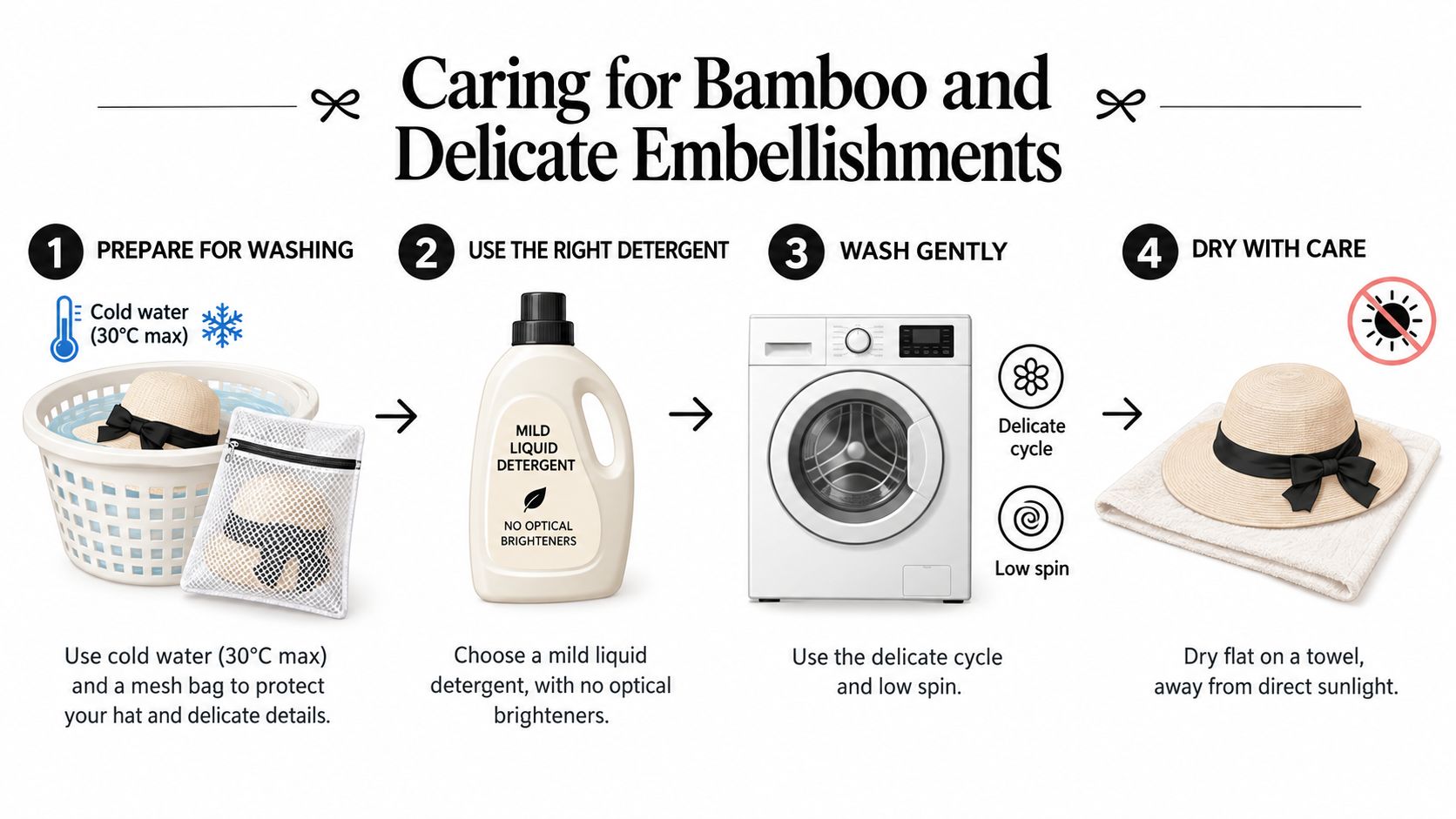
Skip fabric softener. It can coat the fibers and change the feel of the fabric, which defeats the point of buying bamboo in the first place.
For a more detailed care routine, this guide on how to wash bamboo clothing is a practical reference.
Drying and stain care
Lay the hat flat on a clean towel and keep it out of direct sun. Don't hang it by the bow or band. Don't toss it in a hot dryer and hope for the best.
For minor milk spots, a gentle baking soda and water paste can help. For yellowing on white hats, a short oxygen-bleach soak is usually a better move than harsher treatments.
Storage matters too
Fold the hat flat. If the bow is delicate, wrap it lightly in tissue so it keeps its shape between wears.
One product example that fits this category is the Little Venture Co. Fruit of the Spirit Bow, which is a hair bow accessory designed to coordinate with baby outfits. Even with accessories like that, I'd apply the same care standard: clean gently, inspect attachment points, and reserve them for supervised wear.
A Simple Checklist Before You Buy
When you're staring at product photos or standing in a store aisle, you don't need more inspiration. You need a quick filter.
Use this.
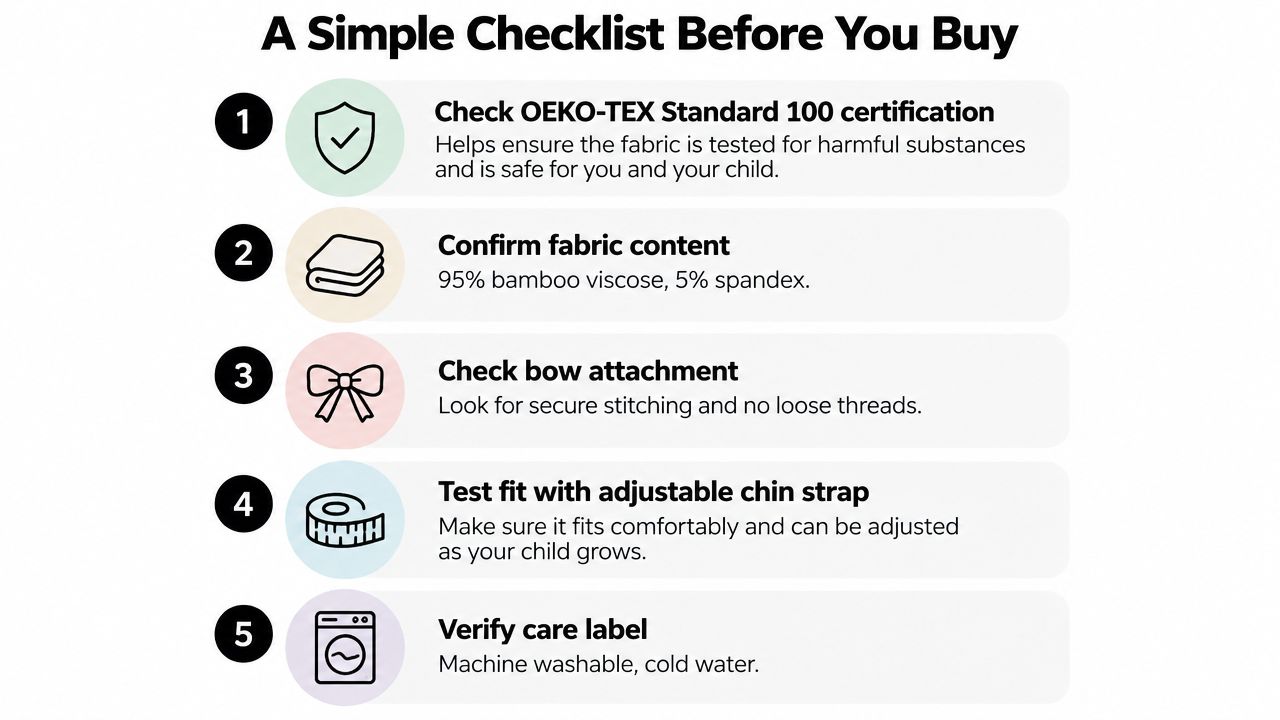
My checkout checklist
- Check the fabric first. Look for OEKO-TEX Standard 100 and favor bamboo viscose or a bamboo blend for sensitive skin.
- Measure before guessing. Confirm the head size and leave about 1 cm of growth room.
- Inspect the bow attachment. It should be stitched down securely, not glued on or built with loose add-ons.
- Match the hat to the use case. Photos, stroller outings, gifting, and church wear can make sense. Sleep and unsupervised wear do not.
- Read the care label. If the washing routine is too fussy for your household, you probably won't use it much.
- For faith-centered wardrobes, check the palette. Ivory, soft white, and muted pastels usually work best with dedication and Sunday pieces already in the drawer.
The shortest version
Buy the hat if it is soft, securely made, easy to care for, and clearly meant for supervised daytime wear.
Skip it if the brand leans on cuteness to distract from fabric, fit, or construction. That usually tells you everything you need to know.
If you want baby clothing and accessories built around the standards that matter, Little Venture Co. offers faith-inspired bamboo daywear and sleepwear made with Oeko-Tex® Standard 100 certified materials for sensitive skin. It's a good place to look if you want pieces that feel gentle, photograph beautifully, and make sense for real family life instead of just a product page.