

Come and See Bible Meaning for Families and Faith
My youngest once tugged my sleeve toward the window and said, “Come look.” It wasn't a big speech, just a tiny invitation, but it changed what I saw because I got up and went. That's a good doorway into the Bible phrase “come and see,” because it starts with ordinary curiosity and ends with a person standing close enough to know for themselves.
The Invitation Behind Come and See in the Bible
A toddler who pulls your hand toward the dog, the rain, or the cookie tray is already teaching the shape of this phrase. Come and see is not mainly a slogan, it's movement, attention, and relationship. Someone notices, someone responds, and the one who was invited gets close enough for the moment to matter.
A phrase that moves people
In John 1, the invitation isn't delivered like a lecture. It comes from a real scene, with real people, in the middle of an ordinary day. John the Baptist points two followers toward Jesus, they begin following, and Jesus turns and asks what they're looking for before inviting them to stay with him. That's not abstract theology, it's a lived encounter, the kind that can happen before dinner, after work, or while a child is still chewing a snack.
The phrase works because it respects the other person's agency. It doesn't force belief through pressure or win someone by volume. It says, go see for yourself.
Practical rule: if a message is worth trusting, it can survive a person getting close to it.
That matters in families because kids learn by presence long before they can explain ideas. They don't just need words about Jesus, they need moments where faith feels warm, safe, and visible. The Bible's invitation language gives parents a simple pattern, bring a child near, let them notice, and trust that understanding often grows after nearness.
A lot of adults hear come and see and think only of outreach. The Bible scene is gentler than that. It's also a discipleship invitation, a way of saying that following Jesus begins with shared time, not a polished argument.
Where the Phrase Appears in Scripture
John places the first come and see scene at the opening of Jesus' public ministry. John 1:35-39 says John the Baptist pointed two of his followers to Jesus, they followed, Jesus asked what they were seeking, and then he invited them to come and see where he was staying. The passage even keeps a time marker, “about the tenth hour,” which John's timekeeping places at roughly 4:00 p.m. according to the text's historical setting in John 1:39. That detail gives the scene weight. This happened in a specific place, at a specific hour, with named people, not in a vague religious fog.
The chain of witnesses matters too. The passage names John the Baptist, Andrew, Simon Peter, Philip, and Nathanael, which helps readers see how testimony moved from person to person. John points, Andrew tells, Philip invites, and Jesus meets each person directly. The Gospel is showing how faith spread through witness and encounter rather than through detached theory.
The second invitation in John
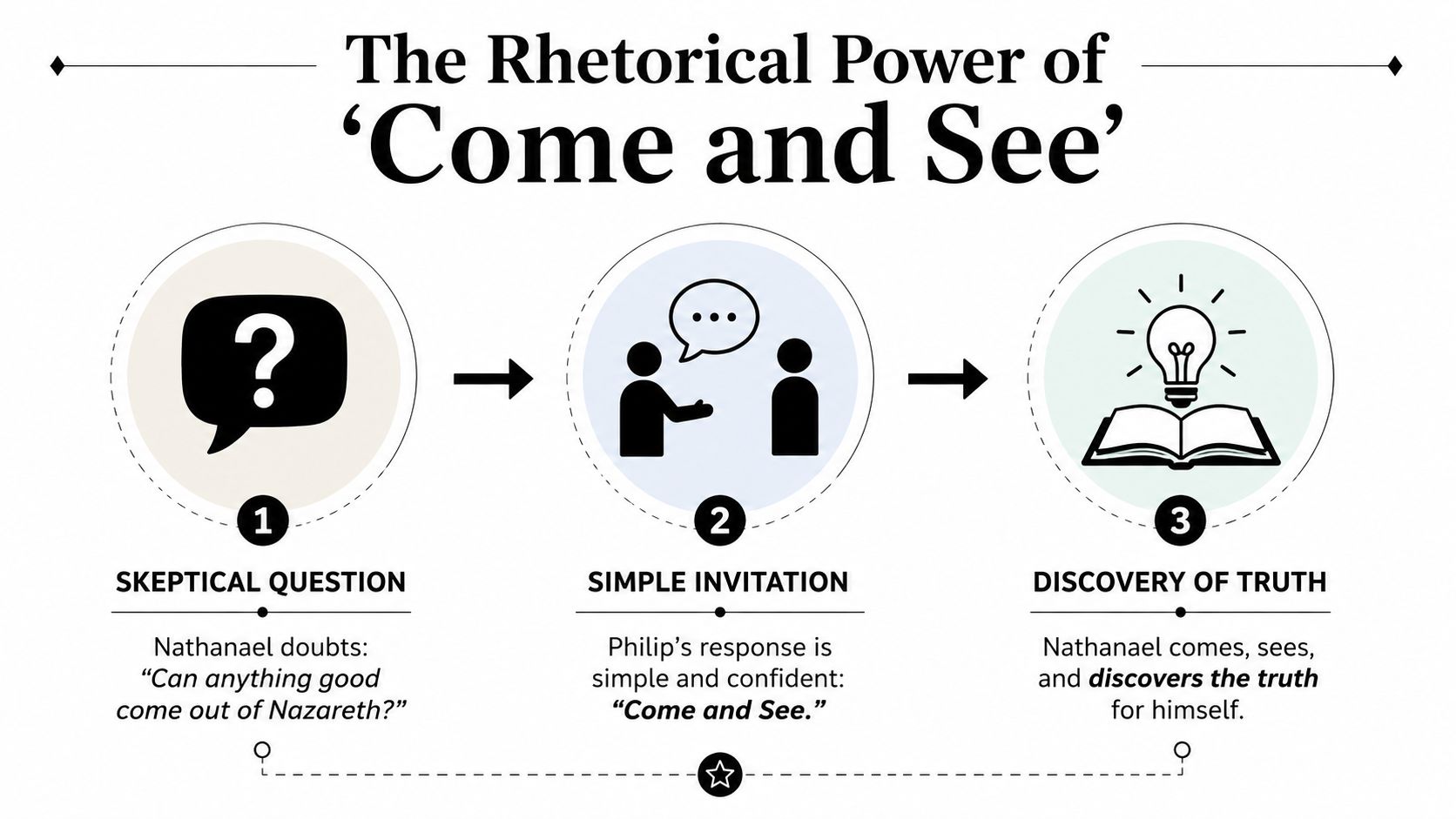
John repeats the phrase in John 1:46, when Philip speaks to Nathanael after Nathanael's skepticism about Nazareth. Philip doesn't stall out trying to win the argument with a debate. He says, “Come and see.” The repetition is deliberate. John wants readers to notice that the same invitation appears when curiosity is open and when doubt is loud.
The first scene shows Jesus inviting seekers into his presence. The second scene shows a disciple echoing that same posture toward someone who's unconvinced. That pattern is one reason the phrase stays so memorable. It doesn't just describe one nice moment, it becomes a model for how Christian witness works.
Simple takeaway: the Bible uses come and see as a bridge from hearing about Jesus to meeting Jesus.
That's why the passage is so helpful for parents. You can retell it in a few short beats. A follower hears. He walks. He stays. Then he tells someone else to do the same. Kids can understand that sequence even if they can't yet explain doctrine, and adults can use that sequence to guide bedtime conversations without turning them into mini sermons.
Why John Repeats the Phrase Twice
Nathanael gives the phrase its hardest test. When Philip says Jesus is from Nazareth, Nathanael answers, “Can anything good come out of Nazareth?” Philip doesn't punish the question or shame the skeptic. He keeps the invitation simple, come and see. That's a smart rhetorical move because it lowers the emotional temperature and shifts the burden from hearsay to firsthand observation, as noted in this commentary on John 1:46.
The logic is easy to follow. Nathanael starts with a prejudice. Philip doesn't try to bulldoze it with more noise. He invites Nathanael into contact with Jesus, and once Nathanael encounters him, the confidence grows into the stronger confession in John 1:50-51. The point isn't that questions are bad. The point is that the Bible doesn't treat skepticism as something solved only by argument.
What the repetition teaches readers
The second use of the phrase turns come and see into a pattern. It says, if someone is unsure, let them observe. If they're wary, let them experience. If they've only heard a report, give them a chance to meet the person at the center of it. That's why the phrase works so well for families, because children do not usually move from curiosity to trust by pressure. They move by familiarity, repetition, and a sense that they're safe to look.
This also explains why the line feels so useful in everyday faith conversations. You can invite a child to come and see a Bible story, a prayer moment, a nativity display, or a kind act from a neighbor. You're not forcing certainty. You're making room for recognition.
A parent can borrow Philip's tone without sounding preachy. “Come and see” can mean, sit beside me, hold this page, look at this picture, or stay for one more verse. The phrase keeps its power because it respects the child's pace while still pointing somewhere real.
Come and See Across the New Testament
The Bible doesn't use this kind of language only once. In Matthew 28:6, the angel at the empty tomb says, “Come, see the place where he lay.” That line has the same feel as John 1. It's an invitation to verify, to look, and to move from report to witness. The Christian tradition keeps returning to this shape because it treats truth as something you can encounter, not just hear about.
That matters when you read John's Gospel in its historical setting. Many scholars and reference works place John's writing in the late first century, commonly around AD 90-100, which means the Gospel preserves a memory tradition from roughly 6-7 decades after Jesus' life, according to this overview of the phrase's historical setting. That doesn't make the text distant in the way a medieval legend would be. It places the invitation close enough to the events to feel like living memory, not late invention.
Why the empty tomb scene fits the pattern
Matthew's angelic invitation and John's disciple scenes work together. In both cases, the reader is told to look for evidence. In both cases, the result is not mere data collection, it's worship and belief. The phrase carries the weight of an eyewitness culture, one that says Christian hope can be announced in a way that invites inspection.
That's one reason the Bible can speak so naturally to skeptical people. It doesn't pretend that seeing is unnecessary. It repeatedly says, come close enough to notice. A family can use that same instinct at home by making faith visible in ordinary ways, like reading a story with the child on your lap or naming what God has done in the day.
For a broader devotional reading rhythm, you can also pair this idea with a family plan from Daily Devotional ideas that keeps the focus short and steady. The point isn't to overwhelm a child with information. It's to make room for encounter.
A Kid-Friendly Devotion for Little Ones
A bedtime version of come and see can stay very short. Sit on the floor with a Bible, two stuffed animals, or hand puppets. One toy can “hear” that Jesus is near, and the other can invite, “Come and see.” Then tell the story in simple words, Jesus welcomed people, and he still welcomes us to know him.
Try this tonight: keep the devotion under ten minutes, and stop while your child is still engaged.
A simple kitchen-table flow
- Tell the story. “John's friends wanted to know Jesus. Jesus said, ‘Come and see.’”
- Let your child respond. Ask, “What do you want to see about Jesus?” If they're too little, offer choices like “his love,” “his kindness,” or “his care.”
- Make a tiny visual. Cut out paper eyes, or draw a little jar and fill it with picture cards of things your child loves.
- Pray one short prayer. “Jesus, thank you for showing us who you are. Help us come close to you.”
- End with a touchpoint. Put the paper eyes on the fridge or keep the jar on a shelf where bedtime can return to it tomorrow.
This works because toddlers learn through objects, repetition, and physical closeness. The activity doesn't need to feel polished. A crooked paper eye is fine. A few picture scraps are fine. The goal is to let the invitation feel warm and real, not staged.
If you want a simple companion habit, a short family reading plan like this devotional guide can help you keep the rhythm going without turning it into homework. Kids remember repeated calm far better than one big dramatic lesson.
Using Come and See in Nursery and Church Ministry
Churches sometimes overcomplicate welcome. A family walks in, and the room is full of language, forms, and expectations before anyone has made eye contact. The phrase come and see offers a better rhythm. It suggests that hospitality should be visible, calm, and easy to step into.
A nursery, classroom, or family ministry space can carry that message without turning it into a slogan. A welcome card at the door tells parents they belong before they've mastered the routine. A wall verse at child eye level gives the room a script that sounds gentle rather than corporate. A class banner with two open hands says the same thing in shape, not just words.
Small choices that make the phrase believable
Use the same greeting every week so new families don't have to guess the culture. “We're glad you're here” is better when it's paired with a helpful next step, like where to hang coats or how to label a bottle. Volunteers don't have to sound polished. They do need to sound calm.
A few practical ideas work well across settings:
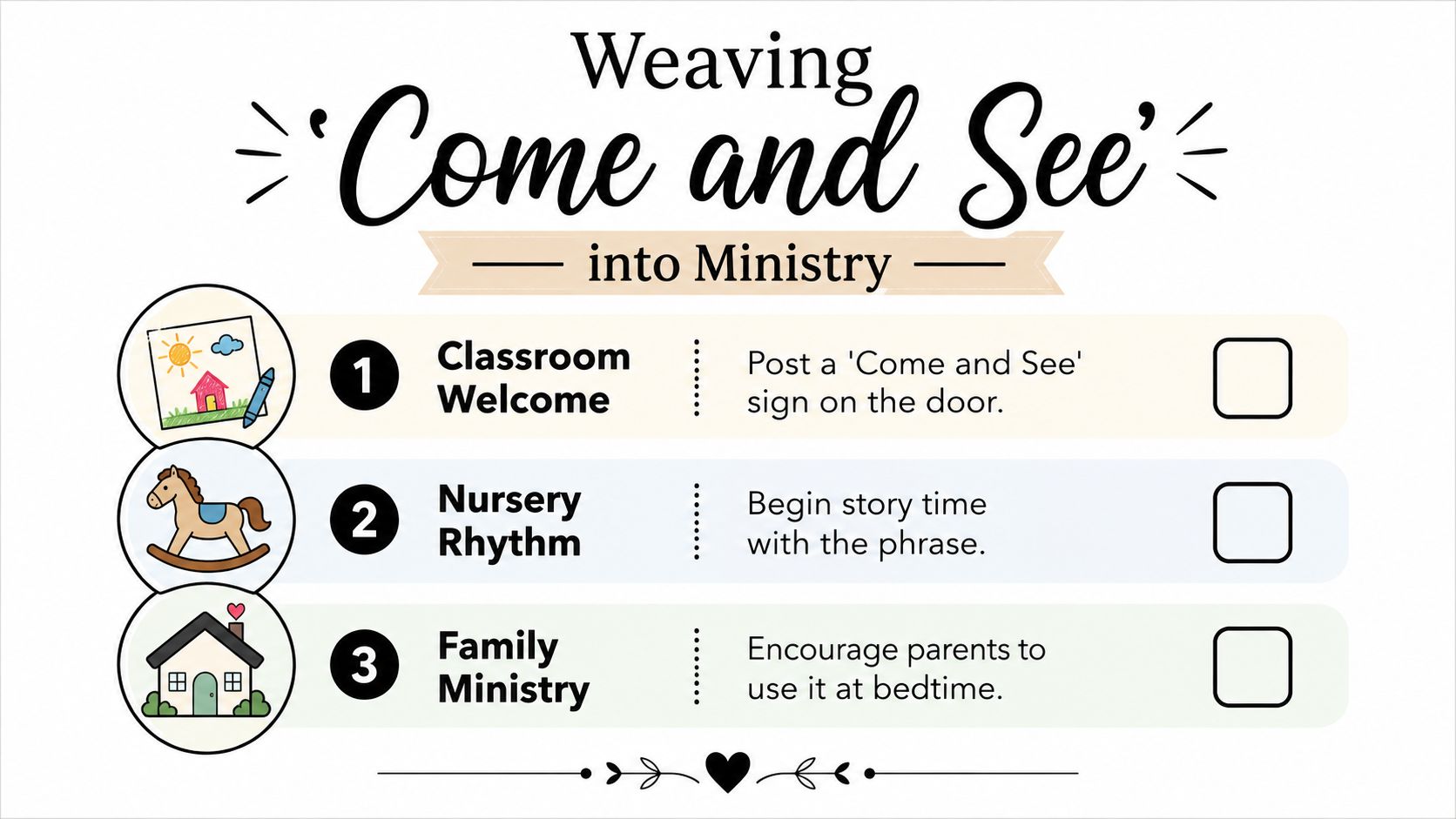
- Classroom Welcome: Post a “Come and See” sign on the door so the room feels invitational before the lesson starts.
- Nursery Rhythm: Begin story time with the phrase and a short picture cue so little ones can connect the words to the routine.
- Family Ministry: Encourage parents to use the words at bedtime, when a child is already still and listening.
A helpful partner resource for this kind of space is Bible verses for nursery wall, since the room itself can preach what your volunteers are trying to say. The best ministry environments don't just announce welcome, they make welcome easy to feel.
If your church has cautious parents, this matters even more. People who are unsure about institutions often trust what they can observe. A room that is tidy, kind, and age-appropriate lets the phrase land as something real, not performative. That's the difference between an invitation and a pitch.
Gentle Gift and Clothing Ideas for Families
A keepsake only works if it feels like something a parent would use. For baby gifts, that usually means softness, easy changes, and a message that doesn't shout over the child's comfort. A fabric like bamboo viscose is often chosen for its soft feel on sensitive skin, and Oeko-Tex Standard 100 certification gives parents a clearer safety signal because the material has been tested for harmful substances. Those two details matter more than a flashy print ever will.
A good faith-inspired sleeper or gift set should feel calm in the hand. Snaps or zippers that cooperate during a 2 a.m. change matter because tired parents don't have the energy to wrestle with fussy closures. A timeless verse or quiet embroidery can make the piece feel like a blessing rather than a trend.
What parents are really carrying home
A baby shower gift can say, “Your child is loved before they can understand a word.” A Christmas sleeper can hold a first holiday memory without trying too hard. A baptism keepsake can mark a sacred day while still being soft enough for everyday wear. The message doesn't need to be loud to be meaningful.
That's where clothing becomes more than clothing. It turns into a small, lived-in reminder that faith belongs in ordinary routines, not just on a special shelf. A parent may never read the verse on the sleeper every time it's worn, but the feeling of the piece still becomes part of the family's memory.
For families looking for more ideas in this direction, Christian baby gifts can spark thoughtful choices that feel personal without being showy. The right gift usually honors both the child's comfort and the parents' values. That balance is what makes it last.
A Simple Way to Carry This Home
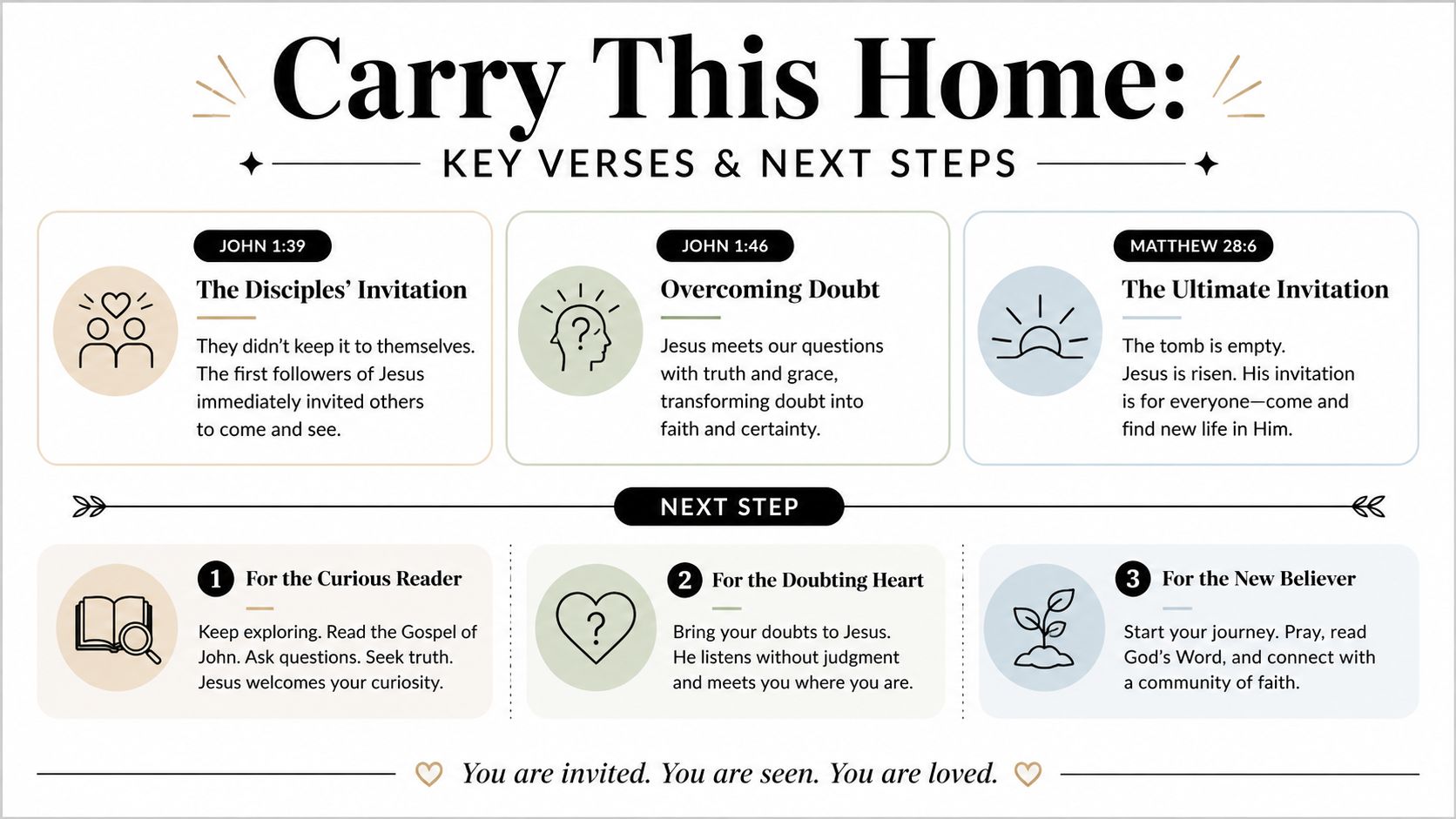
Here's a small set of verses to keep nearby, whether on your phone, a note card, or the back of a nursery door: John 1:39, John 1:46, and Matthew 28:6. One shows the first disciples being invited, one shows doubt met with a simple invitation, and one shows the empty tomb framed as something to look at with your own eyes. You can also revisit this devotional resource when you want a short family rhythm to build around them.
Three gentle next steps
- For the Curious Reader: Read John 1:39 tonight and say, “Jesus invites people close.”
- For the Doubting Heart: Read John 1:46 and let the phrase stay simple. You don't have to solve everything before you look.
- For the New Believer: Read Matthew 28:6 and thank God that faith includes real evidence and real hope.
The nicest next move tonight may be the smallest one. Prayers can be brief, children can be sleepy, and the invitation can still be true.
Little Venture Co. makes faith-inspired bamboo sleepwear and daywear that feels gentle enough for real family life, not just photo day. If you want a soft, meaningful way to keep come and see close at bedtime, nursery time, or gift-giving, visit Little Venture Co. and look for pieces that carry the message with comfort and care.