

Bible Verse Journals: A Guide for Christian Parents
Some days you're just trying to drink your coffee before it goes cold, settle a fussy baby, and remember whether anyone has eaten something green. In that season, “build meaningful family faith habits” can sound lovely and impossible at the same time.
That's why Bible verse journals can be such a gift. They don't ask you to create a perfect quiet time or turn your home into a picture-ready devotional space. They give you one small place to write down a verse, a prayer, a memory, or a moment with your child. Over time, that little book becomes both a devotional practice and a family keepsake.
For parents of babies and toddlers, that matters. Your child may not remember the lullaby you sang during a midnight rocking session, or the prayer you whispered over their crib. But you can remember it for them. You can write it down. You can hand it back to them one day.
A Simple Way to Grow Your Family's Faith
A lot of Christian parents start with a simple hope. You want your home to feel grounded in Scripture. You want your children to grow up knowing that God's Word belonged in ordinary life, not only on Sundays.

A Bible verse journal fits that hope because it's small and concrete. You don't need a full hour. You need a verse, a pen, and a few honest lines. If you'd like another gentle way to keep Scripture in the rhythm of daily life, this family devotional resource can pair beautifully with journaling.
Why this feels timely for young families
This practice isn't only for retirees, seminary students, or naturally organized people. Younger adults are engaging Scripture in deeper ways too. The American Bible Society's 2025 State of the Bible report found that Scripture Engaged adults rose from 11% to 15% among Gen Z and from 12% to 17% among Millennials in one year, showing that younger adult generations are driving growth in deeper Bible engagement, according to the American Bible Society's 2025 State of the Bible release.
If you're a tired parent in those generations, that should feel encouraging. You're not trying to recover an old-fashioned habit that no one else uses. You're joining a living practice.
A gentle reminder: Family faith often grows through repeatable little things, not dramatic big ones.
What it can look like at home
One mom might write a verse from the Psalms and add a note about her toddler's bedtime prayer. Another parent might copy a single line from the Gospels during nap time and write, “Read this while rocking you today.” A dad might keep a journal near the high chair and jot down a prayer after breakfast.
That's enough. Bible verse journals work best when they feel like an open door, not another item on your list.
What Exactly Is a Bible Verse Journal
A Bible verse journal is a place where Scripture and your response to Scripture live side by side. Think of it as a written conversation. God's Word is on the page, and your prayer, questions, gratitude, worries, and observations answer back.

It's different from a diary. A diary usually starts with your day. A Bible verse journal starts with a passage, even if it's only one line. It's also different from formal Bible study notes. You don't need long outlines, language tools, or a stack of commentaries to begin.
Why verses work so well
Bible verse journals make sense because the Bible's chapter-and-verse structure makes short passages easy to find and revisit. The chapter-and-verse system commonly used for journaling was added in the 1200s CE, roughly a millennium after the last biblical book was written, and that change made precise reference to small passages much easier, as explained in these Bible facts from OverviewBible.
That's why many journals center on single verses or short passages. Parents especially need that kind of manageable format. You may not have the margin for a long study session, but you can stay with one verse while folding laundry or sitting beside a crib.
If you want a starting list, this collection of Bible verses everyone should know can help you choose passages that are familiar, comforting, and easy to return to.
What goes inside one
A Bible verse journal can include many kinds of entries:
- A copied verse you want to remember.
- A short prayer for your child, your marriage, or your own heart.
- A note about the day such as “You clapped during worship.”
- A question like “What does trust look like in this season?”
- A memory marker tied to a spiritual moment.
You don't need to write something profound. You only need to tell the truth before God.
For families with little ones, that simplicity is what makes the practice stick. You're not producing polished pages. You're building a record of faithfulness, one verse at a time.
Finding the Perfect Journal for Your Family
When people shop for Bible verse journals, they often focus on the cover first. That's understandable. But with babies and toddlers in the house, the better question is, “Will this journal work in real life?”
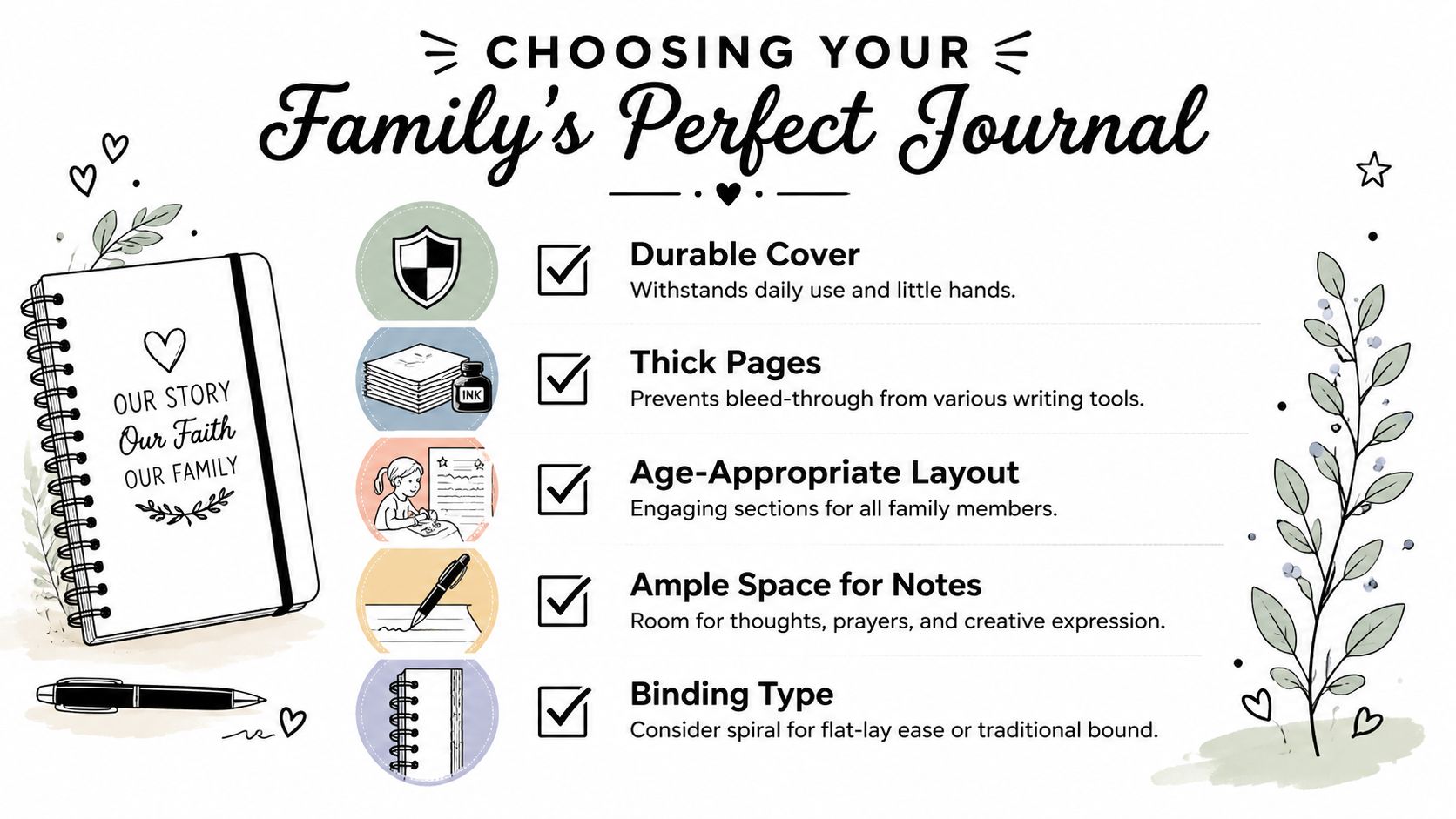
Some families want a keepsake they'll save for years. Others want a sturdy notebook they can keep on the kitchen counter without worrying about bent pages and cracker crumbs. Both are good choices. The right fit depends on how you'll use it.
A helpful layout for busy parents
One of the clearest journal formats comes from Crossway's ESV Scripture Journals. Many popular journals, like those, use a split-layout format that places the biblical text on one page and a lightly lined blank page opposite it. That design reduces the friction of cross-referencing and allows for immediate annotation beside the passage, as shown in Crossway's overview of ESV Scripture Journals.
That matters more than it might seem. If you're holding a baby with one arm, flipping between a separate Bible and notebook gets old fast. A side-by-side format keeps the reading and writing together.
Features worth comparing
Here's a simple way to think through your options.
| Feature | Best for | Possible downside |
|---|---|---|
| Guided prompts | Parents who freeze at a blank page | Can feel restrictive later |
| Blank pages | Creative memory keeping and flexible use | May feel intimidating at first |
| Spiral binding | Lays flat during journaling | Less formal as a keepsake |
| Bound journal | Feels special and giftable | Harder to write in one-handed |
| Compact size | Diaper bag or travel use | Less room for photos and notes |
| Larger format | Handprints, letters, keepsake pages | Not as portable |
A few practical buying tips
- Choose thicker pages if you like markers: Thin paper can make the page feel crowded, especially if you're adding color, stickers, or little art pieces.
- Think about storage: If this will become part of your child's memory box, choose something durable enough to hold up over time.
- Leave room for family life: You may want space for hospital bracelets, printed photos, or birthday notes.
- Consider starting simple: A plain notebook can become a beautiful Bible verse journal if the format helps you use it.
Practical rule: Pick the journal that makes you most likely to open it on an ordinary Tuesday.
The prettiest journal isn't always the most useful one. The best one is the one that fits beside the rocking chair, survives the toddler years, and welcomes you back without pressure.
Journaling with Babies and Toddlers A Keepsake Guide
Bible verse journals take on a uniquely tender quality. With babies and toddlers, journaling isn't about teaching them to take notes. It's about preserving the early years through the lens of faith.
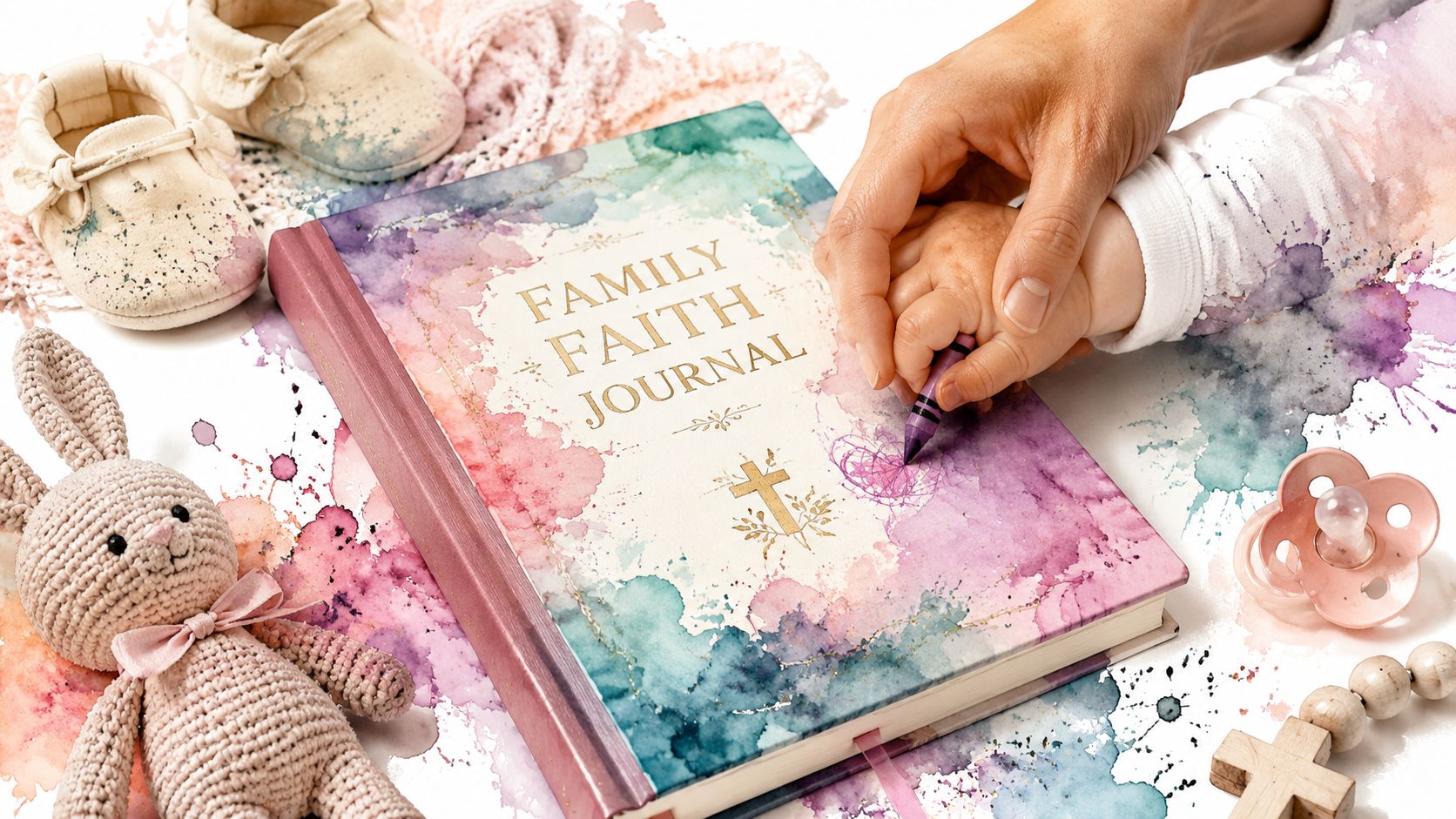
A page might hold a verse, but it can also hold the story around that verse. What you prayed during a hard feeding season. What your toddler said after hearing about Jesus calming the storm. What you hoped God would grow in your child long before they could read your handwriting.
Ways to turn a journal into a family keepsake
You don't need elaborate craft skills. A few simple practices can make the journal feel rich and personal.
- Trace tiny hands or feet: Add them beside a verse that reminds you of God's care and design.
- Write letters to your child: A short note that begins with “Today you are...” becomes precious later.
- Tape in a small photo: Pair it with a verse and a sentence about what was happening that week.
- Record answered prayers: Keep the language plain. Years from now, those pages will preach God's faithfulness back to your family.
- Note spiritual firsts: First church service, first time folding hands to pray, first favorite Bible song.
What to write when you're not sure where to begin
Some parents get stuck because they think every page should sound deep. It doesn't have to. Try writing what happened, what verse you chose, and why it mattered that day.
For example:
“You fell asleep on my shoulder after a long afternoon, and I read this verse over you. I was tired and a little frayed, but God felt kind and near.”
That kind of entry does two jobs at once. It remembers your child's early life, and it remembers your walk with God during it.
If you ever want to preserve journals in a more lasting family format later on, this guide to family legacy books offers thoughtful ideas for turning handwritten memories into something you can pass down.
A rhythm that fits little ones
A family journal can live in small pockets of the day:
- after breakfast prayer
- during nap time
- on Sunday afternoon
- before bed, after the house finally goes quiet
For extra support in keeping Scripture close during those everyday moments, this daily devotional reading guide can help you keep the habit gentle and steady.
The beauty of this practice is that your child doesn't need to understand it yet. They're still being formed by it. They're growing up in a home where God's Word is loved enough to be written down and remembered.
Simple Prompts and Creative Activities
Blank pages can make even eager parents shut the journal and walk away. A few prompts solve that problem quickly.
Bible journaling supports multimodal encoding, which means reading, writing, and drawing work together to improve recall. Lifeway describes Bible journaling as a process that helps turn a verse into linked cues such as text, notes, color, and sketches, making it easier to revisit context and build durable memory over time in this Bible journaling for beginners guide.
Prompts for your own reflection
Try these when you want to keep things short and meaningful:
- What do I need from God today: Not the polished answer. The honest one.
- Where did I notice grace in my child today: A laugh, a quiet moment, a small kindness.
- What verse do I want spoken over this season: Write the verse, then add one sentence about why.
- What am I carrying that I need to hand to God: Fear, exhaustion, impatience, uncertainty.
- What do I hope my child will know about God: Pick one truth and pray it plainly.
Easy activities to do with babies and toddlers
These work best when you keep supplies basic and expectations low.
- Sticker page: Let your toddler place a few stickers near the verse while you read it aloud.
- Color wash background: Add a light watercolor background, then write the verse after it dries.
- Crayon scribble corner: Give your child a small area of the page to “help.”
- Nature add-ins: Tape in a leaf from a walk and pair it with a verse about creation.
- Finger tracing: Guide your toddler's finger under a short verse as you say the words slowly.
Creative work can make Scripture feel more memorable, especially when little hands help make the page.
If you're looking for a few uplifting passages before you start, this collection of House of Saint's spiritual inspiration can spark ideas for verses that are comforting and easy to revisit with young children.
The point isn't making pages look impressive. The point is giving your mind and heart more than one way to hold onto Scripture.
Giving the Gift of a Lifelong Faith Habit
A Bible verse journal makes a lovely gift because it's personal without being complicated. It works for a baby shower, baptism, dedication, or first birthday. More than that, it tells parents, “You can begin a family faith tradition right where you are.”
That matters because many journaling ideas online lean heavily toward decoration, while parents with little ones need something more sustainable. A common gap in journaling content is guidance on making the practice workable for busy people. Framing it as a low-friction system rather than an aesthetic project is what makes it accessible, especially for new parents, as discussed in this article on making Bible journaling practical and inspiring.
How to make it giftable
A simple gift bundle can feel thoughtful without being overdone.
- Pair the journal with pens: Choose a few comfortable pens or colored pencils.
- Add a short note: Include one sentence explaining why you chose this gift.
- Tuck in a starter verse list: A handful of meaningful verses removes first-page hesitation.
- Include something for the season of life: If you're building a fuller care package, this Kudosz expecting parents guide has helpful ideas for practical and heartfelt gifting.
Why this gift lasts
Some baby gifts are used for a few months and forgotten. A journal can grow with a family. It starts as a place for sleepy prayers and baby milestones. Later it becomes a record of first questions, first memorized verses, and first glimpses of personal faith.
If you're choosing a faith-centered present, these Christian baby gift ideas can help you think beyond the usual options and build a gift that feels meaningful from the start.
A Bible verse journal doesn't need to be elaborate to become treasured. It only needs to be opened, used, and kept.
If you're building a faith-filled gift or looking for gentle, meaningful ways to surround little ones with truth, Little Venture Co. offers faith-inspired essentials for babies and toddlers that fit beautifully into those everyday family rhythms.