

Baby Girl Coming Home Outfit Summer: Essential Style Guide
You're folding tiny outfits into a hospital bag while July heat presses against the windows. The air conditioner is humming, the car may be hot when you leave, and somewhere between the hospital room and your front door, your newborn will need to stay comfortable without being buried under layers. You want her first outfit to look sweet in photos, but you also want it to work in real life.
The right baby girl coming home outfit for summer is less about a complicated look and more about a smart little system. Choose breathable fabric, leave room for an uncertain newborn size, plan for the car seat, and pack one simple backup. That's enough to make the moment feel special without turning discharge day into a clothing emergency.
Why the Summer Coming-Home Outfit Deserves Extra Thought
A coming-home outfit carries more responsibility than its size suggests. It's the first layer against your baby's skin after birth, the outfit she'll wear through discharge paperwork and the car ride, and probably the clothing item that appears in every photo sent to grandparents. In summer, it also has to move through several different environments without making her too warm or too cold.
A typical July trip might begin in a cool hospital room, continue through a sunny parking lot, and end in a strongly air-conditioned car. Once you arrive home, the temperature may feel different again. Newborns can't regulate heat as effectively as older children, so an outfit that seems harmless indoors can become uncomfortable during a warm transfer.
The summer newborn dressing guide from Little Venture Co. is a useful starting point, but the car-seat portion deserves special attention. Your baby isn't just going from one room to another. She's moving between climate-controlled air, outdoor heat, a harnessed seat, and your home.
Think in terms of the whole journey
Summer clothing research supports keeping seasonal infant outfits substantially lighter than winter clothing. One 2021 study found a mean clothing area factor of 1.22 for summer outfits, compared with 1.42 in mid-season and 1.90 in winter. A common summer combination of short sleeves, a T-shirt, and short trousers ranged from 1.15 to 1.46, with a mean of 1.24. The study's clothing-area measurements help explain why a light romper or bodysuit makes more sense than a thick layered ensemble.
That doesn't mean your baby should be uncovered. It means the base outfit should do the main work, while removable pieces handle brief changes in temperature. A thin swaddle or blanket can come off quickly. A bulky outfit can't be safely compressed under car-seat straps.
Practical rule: Dress your baby for the warmest part of the transfer, then use removable coverage for cooler air.
Choose an outfit that feels calm and simple. A short-sleeved one-piece, kimono-style bodysuit, or lightweight cotton set is usually more useful than a decorative dress with stiff seams, layers, or scratchy trim. You'll have plenty of opportunities for a more styled look later. On discharge day, comfort wins.
Fabric Choices That Keep Newborn Skin Cool and Safe
Start with the fabric, not the ruffles. In a hot car seat, the material sitting against your baby's back and neck matters more than a decorative overlay or a picture-perfect accessory.
Bamboo viscose has a soft drape and a smooth feel that works well for delicate skin. It tends to feel cool and flexible, which is helpful when your baby is lying against a seat or being held during a humid walk from the hospital. You can read a more detailed explanation of bamboo fabric benefits before choosing a bamboo garment.
Cotton remains a dependable choice because it's breathable, familiar, and easy to wash. Its weakness is moisture retention. If your baby spits up or sweats against the car-seat insert, cotton can stay damp longer than you'd like, so check the back of her neck and change the layer if it feels wet.
Synthetic blends, especially those with a high polyester content, are my least favorite choice for a summer discharge outfit. They may dry quickly, but they can hold heat close to the skin and feel less comfortable in humidity. Heavy embroidery, stiff appliqués, and rough seams create another problem, since newborns spend so much time lying on their backs.
Compare the fabrics before you buy
| Fabric | Breathability | Moisture Handling | Feel on Skin | Summer Suitability |
|---|---|---|---|---|
| Bamboo viscose | Airy and flexible | Feels comfortable in warmth, though it still needs changing when damp | Very soft and smooth | Excellent for a lightweight base layer |
| Organic cotton | Breathable and familiar | Can hold moisture longer after sweat or spit-up | Soft, with quality varying by weave | Excellent when kept lightweight |
| Synthetic blends | May feel less airy against the body | Often dries quickly but can retain heat at the skin | Can feel slick or warm | Use cautiously, especially in hot vehicles |
Look closely at the inside of the garment. Run your fingers over the neckline, snap area, and back panel. If you can feel a raised thread, rough label, or stiff patch, your newborn probably will too.
Check the finish, not just the fiber
A natural fiber label doesn't automatically tell you how the garment was dyed or finished. Look for transparent safety information, wash the outfit before use, and favor clothing with minimal chemical treatments and uncomplicated construction.
My practical pick is a lightweight bamboo viscose or cotton one-piece, with a smooth interior, simple snaps, and little bulk. Skip thick lace, large bows positioned under the back, and dense embroidery where your baby will rest.
Sizing and Fit for a Newborn You Haven't Met Yet
Buying newborn clothing before meeting your baby feels like guessing, because it is. Babies arrive with different proportions, and a full-term baby may fit newborn clothing beautifully or move straight into a larger size. Age labels won't help much on the day she comes home.
Read the manufacturer's size chart instead. Compare the listed weight and length guidance with the fit of the actual garment, since one brand's newborn size may be roomier than another's. If you can, buy or borrow the same style in two nearby sizes, wash both, and pack the smaller option as the first choice with the larger one as backup.
Look for useful room
A slightly roomy outfit is more practical than a tight one in summer. Extra space allows air to move around the body and leaves room for a diaper without pressing snaps into the legs. Roomy doesn't mean oversized, though. A neckline that slips over the face, sleeves that cover the hands, or loose fabric near the harness isn't a good fit.
Check these details before placing the garment in your bag:
- Neckline: Choose an opening that goes on easily without dragging over the face. A kimono-style opening can be especially convenient for a newborn who doesn't enjoy clothes being pulled over her head.
- Umbilical area: Avoid waistbands or decorative seams that sit directly on the healing cord stump.
- Sleeves: Short sleeves provide coverage without adding much warmth. They shouldn't bunch tightly around the upper arm.
- Crotch: Make sure there's enough room for a fresh diaper and gentle leg movement.
- Closures: Snaps or a two-way zip make changes easier when you're tired and working in a hospital or car-seat setting.
If the outfit fits a 7-pound baby comfortably, it will likely work at discharge for many term babies, but the fit still depends on your baby's length and proportions. That's why a washed backup is more valuable than a beautifully styled outfit that may not close.
Pack the smaller option where you can reach it quickly. Put the second size in a separate pouch so you won't have to empty the whole bag beside the discharge desk.
Layering Smartly for Heat, Travel, and Indoor Cool
Layering should respond to the actual journey, not a generic newborn outfit formula. Start with the temperature outside, then consider how long the drive will take, how strongly the vehicle air conditioning runs, and whether you're going straight home or making stops.
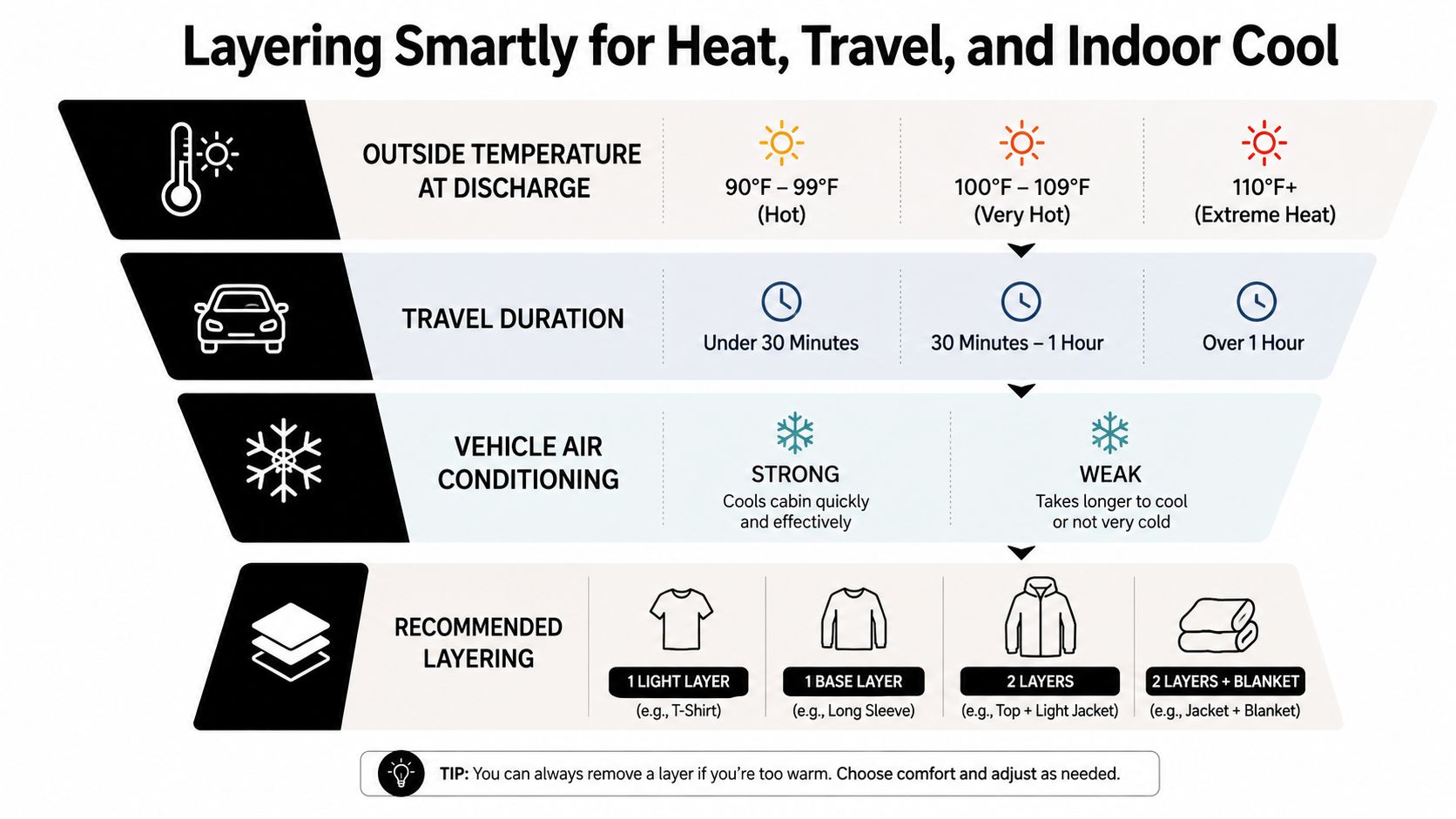
Use this summer decision tree
If it's 85°F or warmer: Choose one breathable layer, such as a short-sleeved bodysuit or airy one-piece. Skip socks unless the hospital or clinician has given you a specific reason to use them. Keep a lightweight swaddle available for carrying, but don't place thick material between your baby and the harness.
If it's between 75°F and 85°F: Use one light base layer and carry a thin receiving blanket. The blanket can cover her briefly while you move through a cool hospital corridor or into a chilly home, then come off once the room feels comfortable.
If it's below 75°F or the hospital room is notably cool: A breathable footed sleeper may be appropriate. Keep the fabric low-bulk, and reassess once you're outside or inside the warmer vehicle.
Travel time changes how closely you'll need to monitor her. A short ride with strong air conditioning may call for a removable blanket. A longer journey through heat calls for the fewest practical layers and regular checks at the neck and upper back.
Keep the car-seat harness unobstructed
Never put a puffy jacket or thick clothing under the harness. The harness needs to sit close to your baby's body, and bulky fabric can interfere with that fit. Place any blanket over the secured harness, where you can remove it quickly.
Car-seat rule: Nothing thicker than a thin blanket belongs between your baby and the harness.
Hands and feet often feel cool even when a baby is comfortable. Check the neck or upper back instead. If the skin feels hot, damp, or flushed, remove the extra layer and move her out of direct sun. The target is simple: roughly the amount of clothing an adult would tolerate in the same conditions, adjusted for the hospital's cooler air.
Hospital Day Practicalities and a Pre-Wash Checklist
Discharge day is not the time to discover that the outfit has a difficult neckline or that the backup is still in the laundry basket. Pack for the actual sequence, from hospital room to car seat to front door.
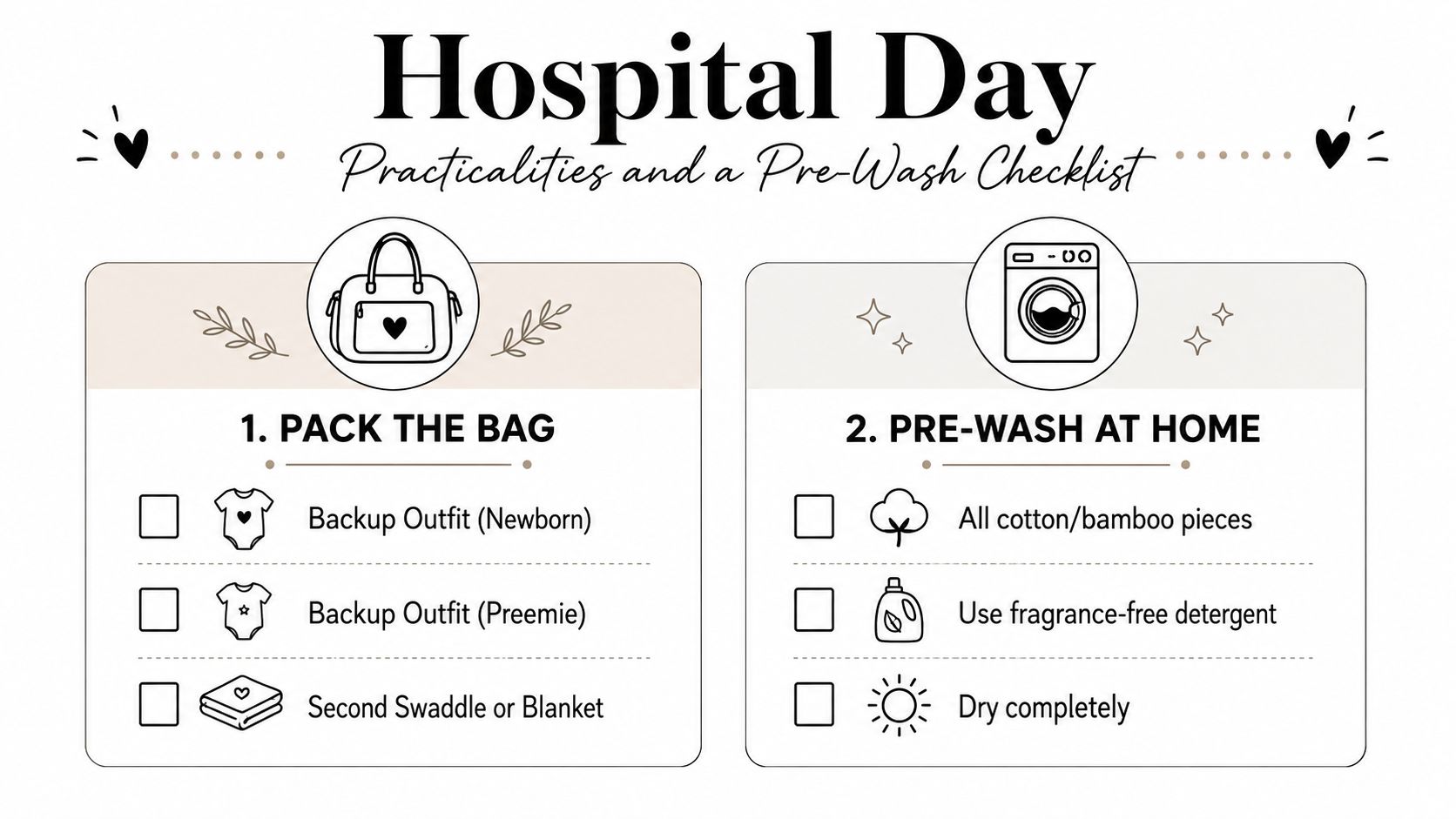
Pack the discharge pouch
Keep the outfit in a small, breathable pouch inside the main hospital bag. Include:
- Primary outfit: A lightweight bodysuit, romper, or one-piece with easy closures.
- Backup size: A second washed outfit in the adjacent size, since newborn fit is unpredictable.
- Light coverage: A thin swaddle or receiving blanket for a cool corridor or air-conditioned room.
- Sun and air protection: A soft hat if needed for outdoor exposure or cool airflow, but remove it indoors if she feels warm.
- Small comforts: Scratch mittens and a soft burp cloth can help during the transition.
- Car-seat access: Keep the outfit near the top of the bag, not beneath toiletries and paperwork.
A burp cloth shouldn't be used to pad the harness or alter the seat fit. Use it for spit-up and as a clean shoulder cloth while holding your baby.
For more detailed bag planning, use this hospital bag packing guide and adapt it to your hospital's own policies.
Wash before packing
New fabric can carry manufacturing residues, dye particles, or sizing agents that may irritate sensitive skin. Wash every piece that will touch your newborn, including the backup, with a fragrance-free, dye-free detergent. Use warm water if the care label permits, add an extra rinse, and dry the clothing completely on low heat or a clothesline.
I prefer washing the coming-home pieces twice before birth. It removes lingering residue and gives you a chance to catch shrinking, twisting, or a stubborn snap before you're holding a newborn.
Pack the dry clothing in a clean cotton pouch the night before your due date. Then take one quick photo of the outfit laid out. If spit-up changes the plan within minutes, you'll still have a record of the sweet original choice.
Why OEKO-TEX Certification Matters for First Outfits
The car-seat-to-home transfer can expose a newborn to a hot vehicle, changing temperatures, and several hours in one outfit. Choose clothing with safety information you can verify before packing it beside the car seat.
OEKO-TEX STANDARD 100 was introduced in April 1992 as a label for textiles tested for harmful substances. The standard gives special attention to baby articles because young children have especially sensitive skin. Its Product Class I covers babies and toddlers up to 36 months and is the strictest category within the scheme. OEKO-TEX's account of its standard explains how the label supports consumer protection.
For a plain-language explanation, read what OEKO-TEX Standard 100 is and why it matters before choosing the outfit.
Certification gives you something concrete to verify
Testing can cover more than the main fabric. Depending on the product, thread, dyes, buttons, and other components may also be considered. Children's articles are assessed against stricter limits than general textile requirements, including a lead-content criterion of 90 mg/kg cited for all four product classes. That distinction matters when the garment rests against newborn skin during the ride home and first photos.
| Test Category | OEKO-TEX Certified | Uncertified |
|---|---|---|
| Harmful substances | Tested against the standard's requirements | Testing status isn't established by the label alone |
| Baby classification | Product Class I is designed for babies and toddlers up to 36 months | Baby suitability may be described without a comparable class |
| Garment components | Testing considers more than the central fabric | Component testing may not be clear |
| Consumer information | Certification can be checked through the product's stated label or certificate details | Parents may have less information to review |
Cotton and bamboo viscose can both feel comfortable in summer, but fiber choice alone does not prove chemical safety. Check the actual OEKO-TEX label or certification details. Vague wording such as “natural” or “gentle” is not a substitute for verification.
For families who value faith-inspired purchasing, clear safety information also supports stewardship. A tested first outfit offers one practical way to care for your daughter before she arrives, while you still have time to wash it, inspect every snap, and pack it where you can reach it quickly.
Photography, Styling, and Faith-Inspired Touches
The first home photos usually happen before anyone has settled into a routine. The car seat is still by the door, the hospital bracelet may still be on your wrist, and someone is trying to remember where the burp cloth went. Keep the styling easy enough that it doesn't compete with feeding, settling, or checking whether your baby is comfortable.
Use soft window light rather than placing her in direct sun. A simple romper photographs beautifully when the fabric lies flat and her face remains the focus. If you want a little extra texture, add one lightweight muslin swaddle or a thin heirloom knit nearby, not a heavy pile of blankets around her body.
Let the outfit support the moment
A small headband, one floral detail, or a delicate collar can give the look a feminine touch without creating pressure points. Keep accessories away from the face during sleep and remove anything that makes her sweat or leaves marks on the skin.
The most meaningful details may not be clothing at all. A blessing card tucked beside the hospital blanket, a small cross pendant placed safely on a dresser, or a scripture tag sewn inside the gown can honor your family's faith without turning the photo into a prop display. These details work because they carry personal meaning, not because they make the outfit busier.
Keep the baby central: One special detail is usually enough when the room, the light, and the newness of the day are already doing the storytelling.
Take a few photos before dressing her, when the outfit is still clean and arranged. Then photograph the ordinary parts too, her tiny hand near the snap, the blanket slipping aside, or a sibling reaching toward the car seat. Those images often become more precious than the carefully posed ones.
If the room is warm, skip the heavy blanket for the photograph. A flushed newborn won't look more comfortable because the picture is styled. Check her neck between photos, keep the session short, and put the camera down when she needs you.
Your Summer Coming-Home Outfit Game Plan
The best plan is small enough to follow while tired. You don't need a suitcase of possible outfits. You need one breathable base, one backup, and a way to adjust coverage without disturbing the harness.
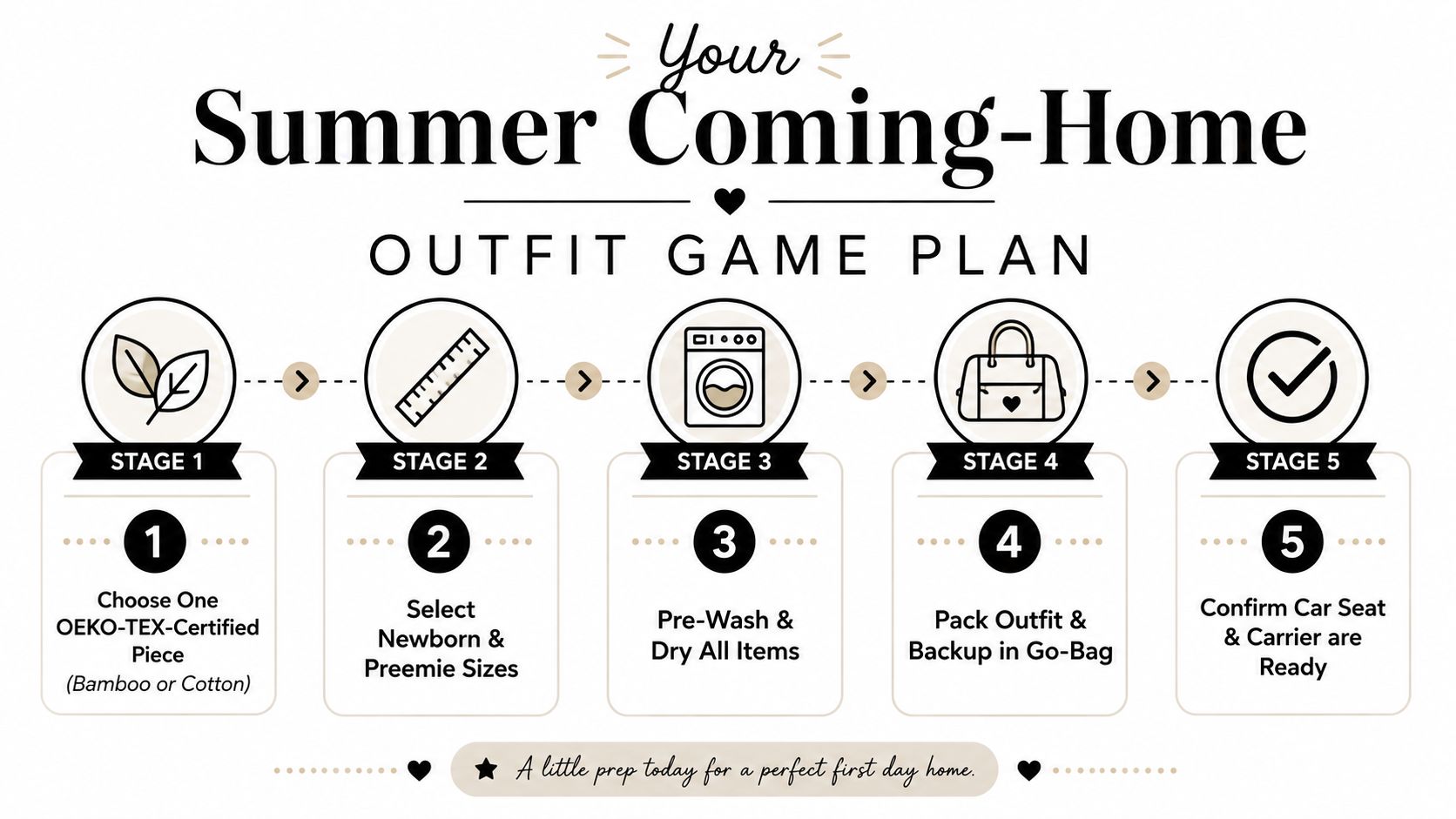
Follow these five stages
- Choose one tested base piece. Pick an OEKO-TEX-certified bamboo viscose or cotton bodysuit, romper, or lightweight one-piece. A short-sleeved option is the most adaptable choice for warm weather.
- Cover the sizing uncertainty. Keep the same style in newborn and the adjacent larger size. Wash both, and place the smaller one at the top of the pouch so it's easy to try first.
- Prepare the fabric. Use fragrance-free, dye-free detergent, rinse thoroughly, and dry everything completely. Don't pack an outfit that still smells strongly of detergent or feels damp from line drying.
- Build the travel backup. Add one thin swaddle or blanket and a second base layer. The blanket should go over the secured harness, never underneath it, and it should come off as soon as your baby feels warm.
- Set up the arrival space. Clear a spot near a window, place the camera or phone charger nearby, and keep a burp cloth within reach. A simple nursery checklist from EasyRegistry can help you handle the wider preparation without adding more outfit decisions.
Before you leave the hospital, check the back of your baby's neck rather than judging comfort by her hands. If she feels hot, damp, or flushed, remove the removable layer and reassess the vehicle temperature. If the hospital room is cool, add coverage temporarily, then take it off when you reach the warmer car or home.
Little Venture Co. offers bamboo viscose baby clothing, including short-sleeved bodysuits and lightweight sets, with materials described as OEKO-TEX STANDARD 100 certified. That makes its pieces one option to consider when you want a soft, faith-inspired summer layer with clear textile safety information.
Your baby girl's first outfit doesn't need to be elaborate. It needs to let her come home safely, comfortably, and close to you. If the snaps are practical, the fabric is soft, and the layers match the weather, you've already chosen well.
If you're preparing for a July arrival, visit Little Venture Co. to explore soft, faith-inspired bamboo baby clothing that can work as a lightweight coming-home layer. Choose your base outfit, wash it ahead of time, and pack the backup today so discharge day feels tender instead of rushed.